-
zion*st Enemy Strikes Aoun’s Hometown in Large Scale Aerial Aggression on South Lebanon, Bekaa
A large scale aerial aggression on South Lebanon and Bekaa, the zion*st war jets raided the hometown of Aoun, Aisheye.
The zion*st warplanes launched eight air raids on the outskirts of Aisheye, Al-Mahmoudiye, and Al-Jarmaq in South Lebanon.In Bekaa, the zion*st enemy launched several air raids on the outskirts of Brital, Nabi Sheit, and Janta.
President Aoun had revealed that Lebanon has formally urged the United States to intervene and halt all zionist aggression against Lebanon, encompassing air, land, and sea attacks, alongside assassinations. He emphasized that “every martyr who resisted and fell for Lebanon, regardless of their place of birth, is a treasure for us.”
Speaking on Lebanese Army Day, President Aoun underscored noted that “the zionist enemy is preventing the return to destroyed villages and reconstruction in the south.” He continued, “The Lebanese army stood by the people of southern Lebanon and made sacrifices.”It is worth noting that, since the ceasefire took effect on November 27, 2025, the zionist enemy has carried out over 4200 violations, claiming around 228 martyrs.
Al Manar report
Notwithstanding, Aoun’s main intention is to disarm Hezbollah and present Lebanon to the zionist-american entity on a silver plate.
zionist forces carry out a series of airstrikes across Southern Lebanon.
https://t.me/presstv/151124Al-Manar correspondent: A zion*st airstrike hit the Khardali road towards Marjeyoun.
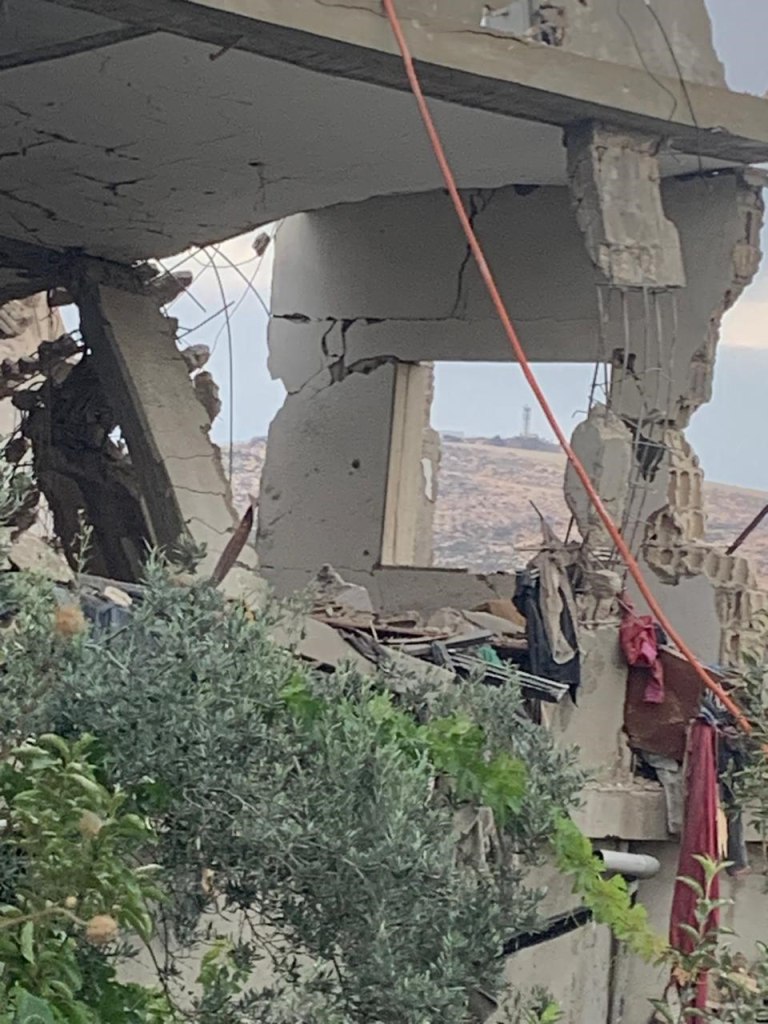
Al-Manar correspondent:
The house targeted by the enemy after midnight in the town of Aita al-Shaab.
https://t.me/almanarnews/218219 -
Ismail Haniyeh’s last words: ‘If a leader leaves, another will come’
On the first anniversary of the martyrdom of the great leader Ismail Haniyeh, his powerful words from his last meeting with representatives of Ansar Allah resurface once again.
In that meeting, he expressed his vision for Yemen’s role in the Axis of Resistance, praised the positions of Sayyed Abdul-Malik Badruddin Al-Houthi, and commended the unwavering popular momentum of the Yemeni people in confronting the enemy.
During the meeting, the martyred leader Haniyeh spoke at length about Yemen’s pivotal role in the great battle against occupation, stating that “Ansar Allah are the supporters of truth.” He mentioned that he had conveyed this to Imam Khamenei when he met him.
He added, “Your name is Ansar Allah (Supporters of God), and this name is truly fitting—you are indeed the supporters of God and the defenders of truth. Allah has chosen you and reserved you for this battle.” He then recited the Quranic verse: “And those who believed and emigrated and fought in the cause of Allah and those who gave shelter and aided – it is they who are the true believers. They will have forgiveness and noble provision.” (Quran 8:74)
He continued, “In truth, we had once hoped you would be at our borders, but Allah’s divine decree placed you in a strategic position. Your stance against the enemy was beyond their expectations, and now Yemen’s role has become the most prominent and strategically pressing.”
Martyr Haniyeh praised the strong weekly addresses of Sayyed Abdul-Malik Badruddin Al-Houthi, saying, “Sayyed Abdul-Malik—may Allah protect him—delivers powerful and impactful words every week. Likewise, the massive rallies and demonstrations in the squares continue with unprecedented momentum in history, unwavering and tireless. I follow them weekly and see that the masses never diminish.”He affirmed that “the Islamic movement leads the jihad today, embodied in the Axis of Resistance. And those leading this resistance against the enemy are the oppressed.” He then cited the Quranic verse: “And We intended to confer favor upon those who were oppressed in the land and make them leaders and make them inheritors. And establish them in the land and show Pharaoh, Haman, and their soldiers from them that which they had feared.” (Quran 28:5-6)
He stated, “This means that when the oppressed possess this will, they are the ones who will change history. There is a great rank that the believing mujahid reaches—the rank of patience, which is immense. Yet there is a higher rank: the rank of contentment. And now, there is an even greater rank that society has attained today—the rank of gratitude and praise, that Allah has chosen martyrs from among them, and gratitude for every trial they endure. This is a tremendous blessing and favor from Allah.”He added, “I do not need to speak about the Axis of Resistance—it is already well-known. What is new, however, is the strategic support and qualitative addition that the enemy never anticipated or accounted for. This addition is what has come from Yemen in the struggle against the enemy—a strategic reinforcement, not a limited one. Yemen controls a maritime passage and is economically besieging the enemy, choking them to the point that their ports have declared bankruptcy.”
He emphasized that “the strategic impact of the drone that targeted Jaffa is that the enemy’s heart is now under threat from the resistance in Yemen, and the enemy’s calculations have become difficult.”
During the meeting, Martyr Ismail Haniyeh expressed the gratitude of the Palestinian people and resistance factions toward Ansar Allah, saying, “We thank Ansar Allah for what they have done. Ansar Allah are the supporters of truth. You cannot imagine the morale boost among the Palestinian people whenever Ansar Allah strike the enemy, when they listen to Sayyed Abdul-Malik’s speeches, and when they see the massive, enthusiastic rallies in the squares—their spirits are lifted, and they feel hope.”
On behalf of the Palestinian resistance factions, the entire Axis of Resistance, and the Palestinian people, he saluted Sayyed Abdul-Malik Al-Houthi and Ansar Allah, praying to Allah to grant them victory, reward them greatly, and bless them. He concluded his speech by saying, “Thank you, and our warmest greetings and peace to Sayyed Abdul-Malik Al-Houthi and all the brothers in Ansar Allah.”Saba News report
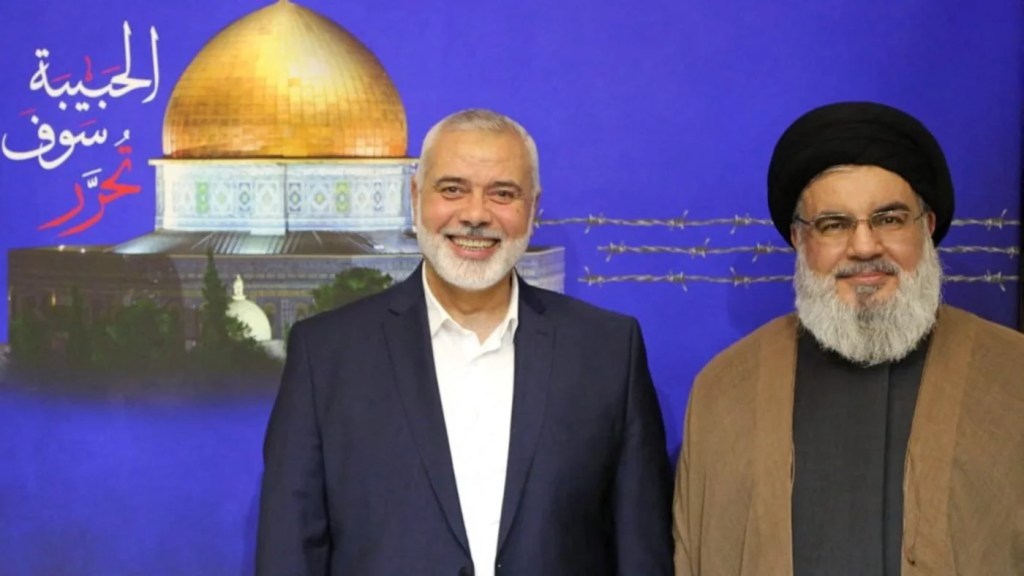
Hezbollah Secretary-General Martyr Sayyed Hasan Nasrallah posing for a picture with Ismail Haniyeh following a meeting. Al Manar media Haniyeh’s last words: ‘If a leader leaves, another will come’
As if he knew his time had come, Hamas leader Ismail Haniyeh’s last words to Iranian Supreme Leader Ayatollah Ruhollah Ali Khamenei before he was assassinated in Tehran were a Koranic verse about life, death, immortality and resilience.
“It is Allah who gives life and causes death. And Allah is all-aware of all actions … ‘If a leader leaves, another will arise’,” Haniyeh said in Arabic. A few hours later he was killed in a suspected Israeli strike on his guest house.Reuters report
-
Saudi Arabia’s Bermuda: Yemeni Man Seeking Work Burned Alive
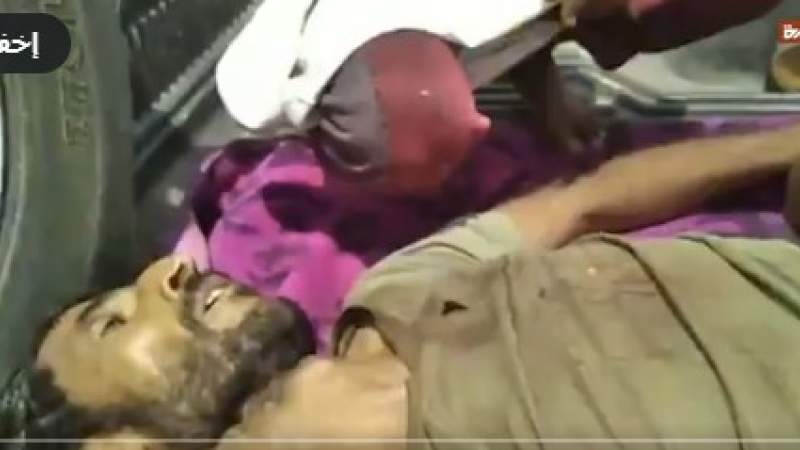
In a harrowing scene that encapsulates the tragedy of a nation crushed by the ongoing Saudi-American-zion*st aggression and blockade, young Yemeni Abdullah Ali Qassem Al-Shamri took his final breath—charred and tortured—at the hands of Saudi border guards. His only crime: leaving his impoverished village in Sa’adah’s Haydan district in search of work to feed his family, worn down by hunger and siege.
With his two companions, Adel Salem and Salah Al-Jarfi, Abdullah left the remote village of Dhuwaib on a perilous journey—not to smuggle, nor to violate border laws, but simply to escape the slow death imposed by war and economic strangulation. Years of infrastructure bombardment and a complete closure of borders and crossings had left Yemenis with no options.
Before the journey could end, Saudi army patrols intercepted the trio, taking them to a secret detention site. There, began the chapters of horror—blood and flames. For Yemenis seeking a livelihood, the Saudi border has become a new “Bermuda Triangle”—a place from which many never return. Those who do are often broken, burned, or traumatized.
“They burned us with fire… seared us with red-hot iron.”
Survivor Salah Al-Jarfi, bearing the burn scars across his body, recounts: “They tortured us with fire, heated iron until it glowed red, and pressed it onto our flesh. They made us walk on burning coals. They tortured Abdullah before our eyes until he was martyred. They showed no humanity, no mercy—even though we carried no weapons, posed no threat. We only sought work.”
Adel Salem, also a survivor, says through choked tears:
“We asked only for a living—but were met with fire and beatings. Abdullah died in front of us, and we couldn’t save him. We returned burned and starving. His screams still haunt us.”
The two survivors came home with third-degree burns, while Abdullah’s body was left behind in a valley deep within Saudi territory—burned and tortured to death.
This was not an isolated crime. It is one of a growing list of systematic atrocities by the Saudi military against Yemenis on the border—people driven by desperation and starvation into the line of fire.
Victims are often from poor border regions, risking everything for a bite of bread, only to find themselves in hidden prisons of fire and silence.These are not mere violations—they are acts of economic warfare, part of a broader Saudi strategy. A war that doesn’t just bomb and starve—but humiliates and tortures civilians, as if it were a deliberate policy of slow extermination.
Abdullah was not a “smuggler,” as the Saudis may claim. He was a victim of a hunger war, a casualty of policies aimed at destroying civilian life in Yemen.
His death was not fate—it was a deliberate result of hostile policies that have turned Saudi border zones into open graves, from which few return whole.
While Yemenis burn inside Saudi borders, no cases are recorded of Saudis killed on the Yemeni side—a stark reminder that this is a one-sided war, in which the Saudi regime wields fire, steel, and blockade as weapons to kill dignity before bodies.
What happened to Abdullah is a documented war crime, a blatant violation of international law that demands investigation and accountability—not the suspicious silence of the global community.
To be killed by fire, without trial, without charge, only because you’re poor and seeking life, is a stain on humanity—and on every human rights organization that claims to defend the voiceless.
In an era of brutal aggression by the US-Saudi-Israeli-UAE alliance, a Yemeni may die by missile, airstrike, or shell—but Abdullah was killed slowly, in silent prisons of pain and fire, without justice, without voice, for daring to want a life.
Today, Yemenis face a suffocating economic war, waged by Saudi Arabia, that touches every aspect of survival—food, medicine, jobs, currency, and even the right to breathe beyond war. Migration for survival has become a gamble of death.
Saudi Arabia’s border has become a descent into hell—where dreams of the poor vanish, and their bodies burn. This is not a rare crime, but a repeated pattern in countless untold stories of Yemenis who embarked on journeys of no return.
Whoever enters the Saudi border “Bermuda” may never come back. And those who do return, carry wounds—and the echo of their fallen companions’ screams.
This is not just the story of Abdullah—it is the story of a people, whose dignity is stripped, and humanity torched, at borders turned into mass graves for the weak: pilgrims, travelers, and expatriates.
Let us not forget the massacre of the Tanuma pilgrims—it is never far away.Al Masirah report
-
Eight people die under torture in prisons and security centres of Jolani’s HTS terrorists in July

Human Rights activists have monitored noticeable escalation in incidents of torturing civilians to death by security members in prisons and detention centres belonging to the caretaker government [Jolani’s Hay’at Tahrir al-Sham terrorists].
This comes as a part of the blatant violations committed by security and military personnel.
In addition, scores of incidents of intentional humiliation and assaults were documented during arrests, which mirrors serious disregard for human rights and legal standards.
According to SOHR statistics, eight detainees of different backgrounds and affiliations died under torture in prisons and security centres of the Syrian government [Jolani’s Hay’at Tahrir al-Sham terrorists]. in July, after having been arbitrarily arrested in different areas across Syria.
Here are further details:
-July 23: Heinous crime at checkpoint in Tartus
SOHR activists reported the death of a young man from Karto village in Tartus countryside, after having been arrested with three other young men from the Alawite community, while they were crossing through a checkpoint of general security forces.
According to SOHR sources, the four young men were brutally beaten, while one of them was humiliated for his sectarian affiliation, before he died of the brutal torture.
The three other young men were taken to a security post in Al-Safsafah where they were detained for no charges.
Ironically, security authorities attempted to bury the victim at night in an area outside his village, but his family expressed strong rejection and considered this action as additional humiliation of the victim’s body and Alawite community.
-July 29: Family of three among five persons killed in Homs
SOHR sources reported that five civilians from Alawite sect including a father and his two sons, died under torture in the prisons of the “Interim Government” [Jolani’s Hay’at Tahrir al-Sham terrorists]. Their deaths came months after their families lost all contact with them following their arrest during a security campaigne carried out by General Security forces [Jolani’s Hay’at Tahrir al-Sham terrorists] in late 2024, after Bashar Al-Assad fled.
According to SOHR information, father and his two sons were detained on December 24, 2024, during a raid in Wadi Al-Dhahab neighbourhood, where their “Jardouni van” was also seized. Since their arrest, no information was provided about their fate, while their family continued to send food, clothing, and money for months, hoping they were still alive.
However, after repeated inquiries to prisons and security agencies, it was revealed that all three had died from physical and psychological torture in the early weeks or months of their detention. Authorities [Jolani’s Hay’at Tahrir al-Sham terrorists] never informed the family or returned the bodies.
In a separate case, two other detainees from Homs died under torture following a different security campaign. Their families also sent supplies for months before learning that the two had been buried in Tel Al-Nasr cemetery in northwestern Homs countryside shortly after their deaths.
-July 30: Returned from Germany to die in Damascus
A young man from Al- Qaboun neighborhood in the capital, Damascus, died under torture after being arrested a few days ago near the Umayyad Mosque. The reasons for his arrest or the charges against him remain unknown. His body was handed over to his family, showing clear signs of torture.
The young man had returned from Germany for a short visit to Syria to attend to family matters before he was arrested by security forces.
SOHR obtained photographs of the body, which revealed bruises and wounds across various parts of his body.
These incidents once again highlight the urgent need for adopting effective accountability mechanisms to prevent the recurrence of such blatant violations in detention centers, especially extreme violence and torture which violate all international conventions.
The Syrian Observatory for Human Rights calls for starting transparent investigations about all deaths in prisons and holding every member and official involved in violations accountable by independent judicial authorities.
SOHR also renew its calls for immediate release of all detainees who have not been involved in any crimes and guaranteeing their full legal and humanitarian rights without security or political interference.SOHR report
Young Syrian man from Germany dies under torture in the capital Damascus.
https://www.syriahr.com/en/366908/ -
Even though Washington’s head may deny, the deliberate starvation in Gaza is real
A new system, and near daily deaths
GHF, a startup organisation with no experience of distributing food in complex conflict zones, employs US mercenaries at the sites, which opened in May. They replaced 400 non-militarised aid points run under a UN system that zionist colony claimed had to be shut down because Hamas was diverting aid from it. No evidence for this has been provided.GHF runs only four sites to feed 2 million people, in a territory where extreme hunger is widespread and food security experts have warned of looming famine.
Eleven-minute race for food: how aid points in Gaza became ‘death traps’ – a visual story
The Guardian report.
The Cradle Media Gaza Ministry of Health:
Hospitals in the Gaza Strip received 104 martyrs (including 1 recovered from under the rubble) and 399 injuries in the past 24 hours.
From 18 March 2025, to the present, the number of martyrs and injuries has reached 8,970 martyrs and 34,228 injuries.
In the past 24 hours, 60 martyrs and over 195 injuries were recorded among those trying to access humanitarian aid. This brings the total number of aid-seeking martyrs received by hospitals to 1,239 martyrs and more than 8,152 injuries.https://t.me/thecradlemedia/40340
Horrific footage emerges of unretrieved martyrs at the “Netzarim” GHF site, who were shot while waiting for aid.
The resistance has called for the complete dismantlement of these death traps.
https://t.me/PalestineResist/80549The “Zikim” aid massacre in Sudaniya area of the northern Gaza Strip today claimed the lives of 51 martyrs and wounded 648 in three hours, most with gunshot wounds, according to the Government Media Office.
The Office added that 112 aid trucks entered the Gaza Strip today, but most were looted “due to the security chaos systematically and deliberately perpetuated by the occupation, aimed at thwarting aid distribution operations and depriving civilians of them.” 600 relief and fuel trucks are required daily to meet minimum needs. The Office noted that 1.1 million children are deprived of food and milk under the suffocating siege and called on all parties to take action to immediately open the crossings and break the siege of aid, including milk.
Naeema. a 30-vear-old Palestinian woman, holds her malnourished 2-year-old son, Yazan, in their damaged home in the Shati refugee camp west of Gaza City on Wednesday.
Getty Images -
Lebanon: Remembering the Second Qana Massacre by the zionist colony
On July 30, 2006, at 1 a.m., zion*st forces struck the town again in the Second Qana Massacre, bombing a residential building [turned shelter] where 28 were killed, including 16 children and injuring several. Again, z*onist colony struggled to explain the massacre.
zion*st colony’s 2006 war on Lebanon was overall characterized by indiscriminate bombing campaigns and psychological warfare. zionist fighter jets dropped thousands of leaflets over Lebanon with insulting and threatening messages to civilians.
Mondoweiss report
Witness testimonials
According to Muhammad Mahmud Shalhub, a 61-year-old farmer who was in the basement during the attack, 63 members of the extended Shalhub and Hashim families sought shelter in three ground-floor rooms of a solid three-story building when the first bombs hit the village. zionist planes began attacking the area in the early evening of July 29, he said, striking more than 50 times. He explained how, around 1 a.m. on July 30, a zionist munition hit the ground floor of the home:
It felt like someone lifted the house. The ground floor of the house is 2.5 meters high. When the first strike hit, it hit below us and the whole house lifted, the rocket hit under the house. I was sitting by the door – it got very dusty and smoky – and we were all in shock. I was not injured and found myself [thrown] outside. There was a lot of screaming inside. When I tried to go back in, I couldn’t see because of the smoke. I started pushing people out; whomever I could find.
Five minutes later, another air strike came and hit the other side of the building, behind us. After the second strike, we could barely breathe and we couldn’t see anything. There were three rooms in the house where people were hiding [on the ground floor]. After the first strike, a lot of earth was pushed up into the rooms. We only managed to find some people in the first room.
Shalhub vigorously denied that any Hezbollah fighters were present in or around the home when the attack took place. All four roads to Qana village had been cut by zionist bombs, he said, which would have made it difficult, if not impossible, for Hezbollah to move rocket launchers into the village.
“If they [the IDF] really saw the rocket launcher, where did it go?” Shalhub said. “We showed Israel our dead; why don’t the Israelis show us the rocket launchers?”
Ghazi `Udaybi, another Qana villager who rushed to the house when it was hit at 1 a.m., gave an account consistent with Shalhub’s. He and others removed a number of people from the building after the first strike, he said, but they could remove no one else after the second strike hit five minutes later. “If Hezbollah was firing near the house, would a family of over 50 people just sit there?” he said to Human Rights Watch.
The Israeli government initially claimed that the military targeted the house because Hezbollah fighters had fired rockets from the area. Human Rights Watch researchers who visited Qana on July 31, the day after the attack, did not find any destroyed military equipment in or near the home. Similarly, none of the dozens of international journalists, rescue workers and international observers who visited Qana on July 30 and 31 reported seeing any evidence of Hezbollah military presence in or around the home. Rescue workers recovered no bodies of apparent Hezbollah fighters from inside or near the building.
The IDF subsequently changed its story, with one of Israel’s top military correspondents reporting on August 1 that, “It now appears that the military had no information on rockets launched from the site of the building, or the presence of Hezbollah men at the time.”
“Again and again, zionst forces have fired at dubious military targets with a high civilian cost,” Whitson said. “Their brazen behavior has costs hundreds of lives.”HRW report
By
https://t.me/political_aya_tweetbank/53
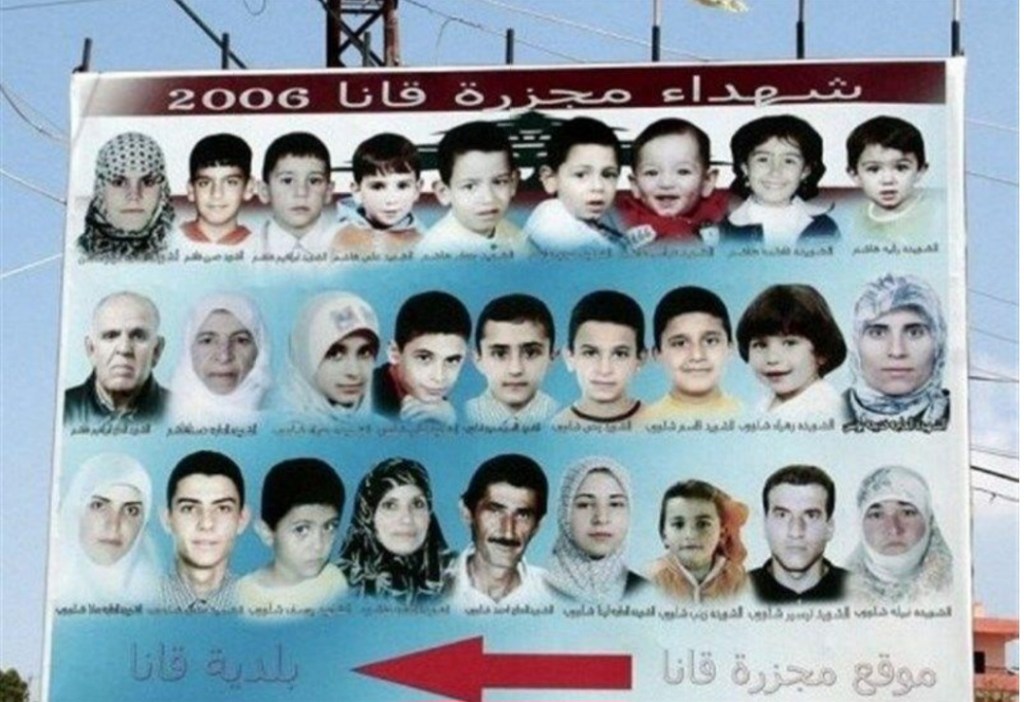
Those who demand and those who consider to lay down Resistance weapons must ruminate carefully. -
Statement by the Spox of the Yemeni Armed Forces General Yahya Saree
Just when Lufthansa announced plans to resume flights to ‘Ben Gurion’ Airport on August 1, YAF targets the Airport with a Palestine-2 missile in support of Gaza.
A while ago, the Yemeni missile in the skies of occupied Palestine – Al Masirah video. Triumphing for the oppressed Palestinian people and their dear Mujahideen, and in response to the crime of genocide perpetrated by the Zionist enemy against our people in the Gaza Strip.
The missile force of the Yemeni Armed Forces carried out a qualitative military operation targeting Lod Airport in the occupied Yaffa region using a “Palestine 2” hypersonic ballistic missile.
The operation successfully achieved its goal, thanks to Allah, causing millions of herds of usurping Zionists to flee to shelters and halting airport operations.
Yemen, with its people, leadership, and army, continues its operations in support of the oppressed and starving among our brotherly Palestinian people, in support of their steadfast resistance, and in bolstering their steadfastness as they face this siege and aggression alone, without support or assistance.
Your brothers in Yemen, your people in Yemen, your comrades in Yemen, are with you and by your side, and we will do everything in our power to fulfill our duty towards you: the duty of religion, the duty of Arabism, and the duty of humanity.
We have complete confidence in Allah’s help, victory, and support.
Our operations will continue until the siege is lifted and the aggression against Gaza stops.
Sana’a,
Safar 4, 1447 AH,
July 29, 2025 AD.
Issued by the Yemeni Armed Forces
http://t.me/army21ye
Yemen declares the fourth phase of operations. Lloyd’s List Warns of ‘New Phase of Terror’ as Yemen Escalates Targeting All Israel-Linked Ships – Al Masirah report. -
Siege on Al-Suwaidaa| Jolani’s HTS terrorists deny foreign press entry to Al-Suwayda
The General Security forces [Jolani’s Hay’at Tahrir al-Sham terrorists] in the Busr Al-Sham area prevented foreign media teams from entering the province on Sunday, despite some holding official permits from the Ministry of Information in Damascus.
Among the crews was a team from the Associated Press, who arrived from Daraa with the necessary government approvals. However, checkpoint personnel informed them that they required additional authorisation from “Sheikh Ahmad Al-Dalati” before being allowed to proceed.
According to sources, the press team was later notified that Al-Dalati had rejected their entry into Al-Suwayda, despite extended discussions. Finally, the journalists were forced to return to Damascus without completing their assignment.
Ahmad Al-Dalati was recently appointed as head of the Internal Security branch in Al-Suwayda, coinciding with rising social and security tensions in the Druze-majority.
Al-Dalati faces accusations of leading direct meetings and communication between Syrian and zionist officials in recent weeks, allegations which he denied. Meetings took place under Turkish mediation and focused on de-escalation efforts along the southern border.
Earlier SOHR reported that security forces prevented a humanitarian aid convoy from entering Al- Suwaidaa, allowing only one out of 14 trucks to pass. Media access to the area was also blocked, including for journalists, further deepening the information blackout surrounding the situation.
Al-Suwaidaa province remains under a stifling siege following recent clashes, leading to a critical shortage of basic supplies and services. Civil society groups and local organizations have appealed to the global conscience, human rights organizations and United Nations bodies for urgent intervention to open a safe humanitarian corridor to deliver aid to the besieged people.
The humanitarian situation in Al-Suwaidaa has become extremely alarming, amid growing calls to keep relief efforts neutral and independent of any political or security conflict, and to allow unhindered access to support for those in need.SOHR report
Today, Reuters has finally somewhat overcome its Western-corporate-media arrogance and released a Reuters-Verification stamp on three videos showing members of the Druze community being massacred by the hand of Jolani’s Hay’at Tahrir al-Sham terrorists.
How Syrian attackers killed: One hand on the gun, another on the camera – Reuters Report.
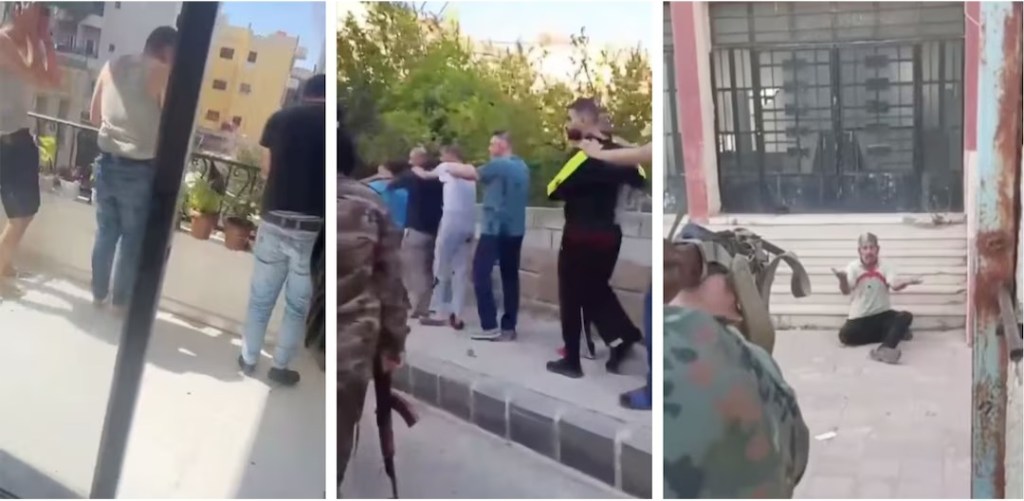
In three videos verified by Reuters, attackers in military garb carried out execution-style killings of unarmed Druze civilians in southern Syria. The killings came after Syrian government forces [Jolani’s Hay’at Tahrir al-Sham terrorists] deployed in response to unrest between Druze militias and Bedouin fighters. Screenshots via social media. Amid a crashing embargo by Damascus on Suwayda, the death toll has hit over 1400, whereby the majority of the victims are members of the Druze community.
As with the Alawite massacres, the perpetrators are Jolani’s Hay’at Tahrir al-Sham terrorist Jihadists.
HTS-backed gunmen entered a house in Sweida and forced Druze men to jump from the balcony after shooting them. https://t.me/presstv/149485 Seven members of the Druze Saraya family — including 35-year-old US citizen Hussam Saraya — were rounded up and executed by Syrian government forces [Jolani’s Hay’at Tahrir al-Sham terrorists] in Suwayda on 17 July.
Verified footage shows them being walked out of their home and then executed in cold blood.
https://t.me/thecradlemedia/39988
“What does ‘Syrian’ mean? Are you Muslim or Druze?!”
Elements affiliated with the Syrian Ministry of Defense [Jolani’s Hay’at Tahrir al-Sham terrorists] execute an unarmed man in Suwayda after confirming that he is of the Druze sect and not Muslim.
https://t.me/thecradlemedia/39990These videos, shunned by Western media, were verified and released by SOHR already on July 19 and July 22, 2025.
-
SDF chief rules out surrender of territory or dismantling of Kurdish administration
Abdi revealed that committees within the SDF are set to begin a series of meetings with the Syrian government in the coming days, aiming to hand over state institutions.
Commander of the Syrian Democratic Forces (SDF) Mazloum Abdi confirmed during a meeting with representatives from Deir ez-Zor province in eastern Syria that the SDF has no intention of handing over control of its territories or dissolving the Autonomous Administration. This stance raises significant questions about the future of negotiations with Damascus, especially as the Syrian government, backed by Ankara, insists firmly on preserving Syria’s unity and sovereignty over all its lands.
The extended meeting took place in the city of al-Shaddadi, south of Hasakah, within a US military base. It included SDF commanders alongside representatives from both the civil and military councils of Deir ez-Zor province, as well as several tribal elders and local dignitaries.
According to exclusive sources cited by Syria TV, the meeting was conducted in two phases: first, with the western delegation, followed by a separate session with representatives from the eastern front.
The meeting was chaired by Abdi and attended by prominent figures within the Autonomous Administration, including Foza Youssef, Hassan Zuhat and Yasser Abbas al-Sulaiman.
Discussions focused primarily on the future of Deir ez-Zor, a province inhabited predominantly by Sunni Arab tribes and long under SDF control.
During the meeting, Abdi reiterated that the SDF does not intend to relinquish its areas of control or dismantle the Autonomous Administration. He stressed that any rapprochement with the Syrian state would be conditional, with key requirements including maintaining the existing administrative structure and integrating SDF forces into agreed security arrangements.
Abdi revealed that committees within the SDF are set to begin a series of meetings with the Syrian government in the coming days, aiming to hand over state institutions, including military facilities, starting with Deir ez-Zor and to be followed by Raqqa and Hasakah.
Observers interpret Abdi’s statements as indicating the emergence of common ground that could allow the SDF to rejoin the Syrian state as a unified body. However, these are preliminary stages, and a final agreement has yet to be reached.
Critics warn that the insistence on preserving the Autonomous Administration could become a major stumbling block in negotiations, as Damascus is unlikely to accept such a proposal. They argue that accepting an autonomous administration in the northeast could set a precedent, prompting demands for similar arrangements in other minority regions, such as Suwayda and the coastal areas.
Meanwhile, informed sources revealed that a planned meeting in Paris between Syrian government officials and a Kurdish delegation from the Autonomous Administration was postponed at the request of the US-led international coalition, which officially communicated the decision to the SDF.
The United States and France have taken on the role of mediators in the talks between Damascus and the Kurdish authorities, keen to ensure the success of negotiations. Yet, significant doubts remain as to whether either party is prepared to make the necessary concessions for a compromise that reassures Kurdish interests while upholding the Syrian state’s sovereignty.
French President Emmanuel Macron underlined these concerns in a telephone conversation on Saturday with Syrian President Ahmad al-Sharaa. Macron emphasised the importance of preserving Syria’s territorial integrity and of ensuring that all weapons remain under state control.
“Stability in Syria is a regional necessity and a humanitarian priority,” Macron stated.The Arab Weekly report

SDF commander Mazloum Abdi attends an interview in al-Shadadi, Syria, June 13, 2025. (Reuters) The Kurds of Syria had it good under the Al Assad Gov. When the Americans refused to support the SDF against the Turkish incursions and invasions, Assad would assist militarily.
This has not prevented the Kurds from aiding the Americans in stealing Syrian oil and wheat or joining Jolani’s Hay’at Tahrir al-Sham terrorists to overthrow the Al Assad government.
-
Suwayda under Jolani’s HTS terrorists total siege as Jihadists mock with humiliatory food posts
Local reports highlight a severe shortage of basic necessities. Markets have been nearly empty of vegetables for over 10 days, and shops are running out of food supplies due to the blockade of the Damascus–Suwayda highway. Water delivery has halted due to fuel shortages, and the city’s automated bakery warns of imminent shutdown due to depleted flour and diesel.
SOHR has urged international organizations to act swiftly, warning of catastrophic consequences if the blockade continues.
Suwayda remains under siege following horrific sectarian massacres carried out by government forces against the Druze religious minority.
A humanitarian convoy comprising 27 trucks reached Syria’s Suwayda.
Governorate via the Bosra al-Sham–Bakka road, the only open corridor into the besieged region, the Syrian Observatory for Human Rights (SOHR) reported on 28 July.
The convoy, escorted by delegations from the Syrian Red Crescent and the International Committee of the Red Cross (ICRC), delivered nearly 200 tons of critical aid, including food baskets, shelter kits, medicines, and infant formula.
This marks the third convoy to enter Suwayda since a military siege was imposed by Syrian government forces on 13 July.
Despite international support from the World Food Programme (WFP) and the UN High Commissioner for Refugees (UNHCR), the humanitarian needs in Suwayda remain dire, with over 100,000 people displaced across the city and 36 surrounding villages.
The conflict in Suwayda began on 13 July, when local Bedouins kidnapped a Druze fruit seller on the road between Suwayda and Damascus. The situation quickly escalated with clashes breaking out between government-aligned tribal militias and armed Druze factions.
On 15 July, terrorist leader Jolani ordered the Syrian army, invaded Suwayda under the pretext of halting the fighting, restoring security, and protecting the Druze religious minority.
Rather than separate the Druze and Bedouin tribal forces, Syrian army and internal security forces descended on Suwayda to carry out a campaign of sectarian massacres of civilians and attacks on Druze cultural symbols.
Thousands of reports, pictures, and videos have circulated online showing Druze civilians being executed, beheaded, kidnapped, and abused by government and tribal fighters.SOHR reported on 20 July that Syrian forces and affiliated tribal militias killed 427 Druze fighters and 298 civilians, including 194 who were “executed in the field by members of the Ministries of Defense and Interior.”
At least 70 Druze, including men, women, and children, were also abducted by Sharaa’s forces.
In contrast, 354 members of the Ministry of Defense and the General Security Service [Jolani’s Hay’at Tahrir al-Sham terrorists] were killed by Druze fighters, in addition to 21 members of Bedouin fighters, including three civilians who were “executed in the field” by Druze militants.The Cradle Media report

Jolani’s Hay’at Tahrir al-Sham terrorists supporters posting
photos of themselves eating with the
hashtag In solidarity with Suwayda in
mockery of the people of Suwayne
who are currently under siege &
enduring a lack of food & basic
amenities.
-
Subscribe
Subscribed
Already have a WordPress.com account? Log in now.
 Nascent Yemen