-
Sweida violence reignites as Druze forces clash with Jolani’s Hay’at Tahrir al-Sham terrorists
This year Jolani’s Hay’at Tahrir al-Sham terrorists committed several massacres against the Alevis, the Druze and the Kurds. The video on display presents atrocities committed against Druze in Al Sweida. These crimes against humanity have happened under the watch of the Western powers. Intense fighting has erupted in Syria’s southern province of Sweida between members of a Druze group and armed elements affiliated with Jolani’s Hay’at Tahrir al-Sham (HTS) and its allies, leaving several individuals wounded, report say.
The clashes broke out between so-called Druze National Guard forces led by Sheikh Hikmat al-Hijri, a Druze religious leader, and HTS forces affiliated with former al-Qaeda commander and the Arab country’s de facto president Abu Mohammad al-Jolani, al-Marsad news website reported.
The report, citing local sources in Sweida, added that several people from both sides sustained injuries during the fighting.
The so-called Syrian Observatory for Human Rights confirmed fierce confrontations between Druze and Jolani’s forces across Sweida province, with Syrian sources reporting that the clashes erupted in the early hours of Thursday, with both sides using heavy weapons and mortars.
The most intense fighting was reported in towns of al-Majdal and al-Mazra’a in the western parts of Sweida.
The clashes reportedly began after Jolani’s forces and their allies carried out drone attacks, triggering heavy fighting in the area.
Additional heavy fighting was reported in the town of Tal Hadid in the Sweida countryside and the village of al-Mansoura in the al-Naql area northwest of the city of Sweida.
Sources also reported extensive military movements by both sides and efforts to reinforce their positions.
Tensions in southern Syria have been escalating since July 13, when clashes broke out between Druze fighters and armed Bedouin tribes over land and resources in the province.The violence worsened significantly after the HTS military was deployed to the province on July 14 and entered Sweida city itself on July 15, according to residents, two war monitors and reporters on the ground.
Claiming to support the Druze, the Israeli regime carried out airstrikes on July 16 targeting key strategic sites in Damascus, including the Syrian army headquarters, and hours later HTS announced the complete withdrawal of its forces from Sweida under a ceasefire agreement.
Sweida experienced some of the deadliest violence, with a week of bloody clashes starting on July 13 leaving an estimated 814 to 1,653 people dead, most of them Druze.PressTV report
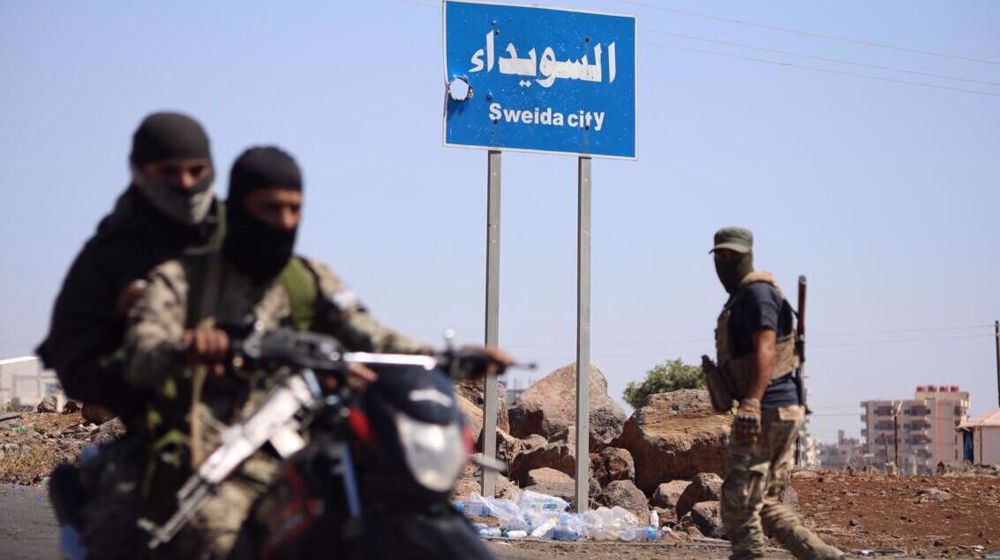
Tribal and Bedouin fighters deploy in western Sweida during clashes with Druze gunmen, July 19, 2025. (Photo by AFP) -
Lebanese Parliament Convenes Despite Boycott by Lebanese Forces, Kataeb
Lebanese Parliament held a general legislative session chaired by Speaker Nabih Berri to continue reviewing draft laws and proposals that were on the agenda for the session of September 29, 2025.
Parliament approved a draft law for a $250 million loan agreement with the World Bank for the reconstruction of infrastructure in southern Lebanon.
It also approved the law regulating the judiciary, taking into account the observations made by the President Joseph Aoun.
The Parliament convened despite calls to boycott the session by the Lebanese Forces over Speaker Berri’s refusal to timetable discussion on a contentious election law.Sixty-seven MPs attended the session, just above the threshold required to proceed.
The Lebanese Forces and the Kataeb party abstained in protest among a handful of others.
Lebanese political powers are in disagreement over the diaspora vote, which is part of the electoral law. There have been calls to amend the electoral law in a bid to allow Lebanese abroad to vote for all 128 parliamentary seats (current law allows expatriates to vote for seven seats).
Amal Movement and Hezbollah, among other parties oppose amending the diaspora vote, stressing that such move contradicts with the principle of equal opportunities, especially that Hezbollah resistance party is banned and does not enjoy the campaigning freedom that the other parties have abroad, especially in Western countries.
Source: Al-Manar English Website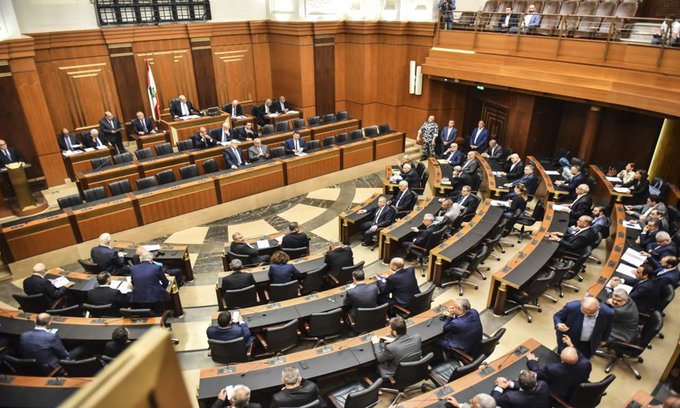
-
Violent z¿onist Strikes on South Lebanon and Bekaa, Speaker Berri Says Bombardment “In Honor of Mechanism”
z¿onist enemy launched on Thursday a series of air raids on large areas in southern Lebanon and Bekaa in the east of the country, in a new escalation that targeted mountainous areas, valleys and the outskirts of several towns.
Al-Manar correspondent reported that the zionist airstrikes targeted the outskirts of Al-Rihan in Iqlim Al-Tuffah, as well as the area between the towns of Deir Siryan and Qusayr in the south.
The strikes also hit the Litani River between Zawtar and Deir Siryan in the Nabatieh region, in addition to the Al-Jabbour and Al-Qatrani heights in Western Bekaa, according to our reporter.The strike took place as a truck belonging to Electricity of Lebanon public company was present nearby, our correspondent in south Lebanon noted.
“A number of workers were injured as the Israeli strike torched the Rapid vehicle and the Electricity of Lebanon truck,” Al-Manar reporter said.Israeli aircraft later renewed their raids, targeting the Mahmoudiya area in southern Lebanon, while other airstrikes hit the Zaghrin heights in the Hermel mountains of the eastern Bekaa, Al-Manar correspondents reported
Meanwhile, an Israeli drone strike targeted a Rapid vehicle near the road linking the border town to Deir Siryan.Commenting on the zionist strikes, Lebanese Speaker said the zionist strikes were a “message” to Paris Conference dedicated for supporting the Lebanese Army.
The strikes “are a zionist message to Paris Conference and sustained bombardment in honor of the Mechanism,” Speaker Berri was quoted as saying, referring to the committee overseeing the ceasefire between Lebanon and the Zionist entity.Source: Al-Manar English Website

Injuries reported among civilians after zionist occupation warplanes struck a vehicle in the town of Taybeh, southern Lebanon.
https://t.me/presstv/168521 -
Assange Sues Nobel Foundation to Stop War-Promoting Machado From Receiving Peace Prize Cash
WikiLeaks founder Julian Assange on Wednesday filed a complaint against the Nobel Foundation to stop its planned payouts to Venezuelan opposition leader and 2025 Nobel Peace Prize winner María Corina Machado, who has backed US President Donald Trump’s campaign of military aggression against her own country.
According to a press release that WikiLeaks posted to X, Assange’s lawsuit seeks to block Machado from obtaining over USD $1 million she’s due to receive from the Nobel Foundation as winner of this year’s Peace Prize.The complaint notes that Alfred Nobel’s will states that the Peace Prize named after him should only be awarded to those who have “conferred the greatest benefit to humankind” by doing “the most or the best work for fraternity between nations, for the abolition or reduction of standing armies, and for the holding and promotion of peace congresses.”
In an interview that aired on Sunday on CBS News’ “Face the Nation,” Machado praised Trump’s policies of tightening economic sanctions and seizing Venezuelan oil tankers, acts of aggression that appear to go against Nobel’s stated declaration that the Peace Prize winner must promote “fraternity between nations.”
“Look, I absolutely support President Trump’s strategy, and we, the Venezuelan people, are very grateful to him and to his administration, because I believe he is a champion of freedom in this hemisphere,” Machado told CBS News.Trump’s campaign against Venezuela has not only included sanctions and the seizing of an oil tanker, but a series of bombings of purported drug trafficking vessels that many legal experts consider to be acts of murder.
In his complaint, Assange claims that Machado’s gushing praise of Trump in the wake of his illegal boat-bombing campaign is enough to justify the Nobel Foundation freezing its disbursements to the Venezuelan politician.
“Alfred Nobel’s endowment for peace cannot be spent on the promotion of war,” Assange states, adding that “Machado has continued to incite the Trump Administration to pursue its escalatory path” against her own country.
The complaint also argues that there’s a risk that funds awarded to Machado will be “diverted from their charitable purpose to facilitate aggression, crimes against humanity, and war crimes.”
Were this to happen, the complaint alleges, it would violate Sweden’s obligations under Article 25(3)(c) of the Rome Statute, which states that anyone who “aids, abets, or otherwise assists” in the commission of a war crime shall be subject to prosecution under the International Criminal Court.
Trump in recent days has ramped up his aggressive actions against Venezuela, and on Tuesday night he announced a “total and complete blockade” of all “sanctioned oil tankers” seeking to enter and leave the country.
“Venezuela is completely surrounded by the largest Armada ever assembled in the History of South America,” Trump wrote in a Truth Social post. “It will only get bigger, and the shock to them will be like nothing they have ever seen before.”CommonDreams report
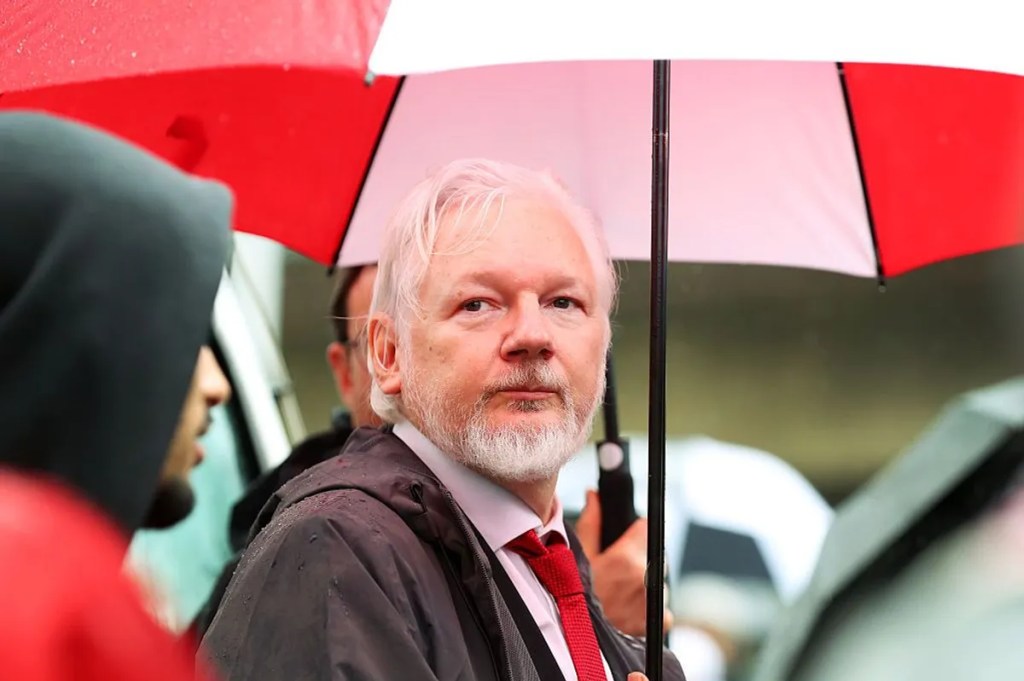
Wikileaks founder Julian Assange joins thousands as they march across the Harbour Bridge during a pro-Palestinian rally on August 3, 2025 in Sydney, Australia. (Photo by Lisa Maree Williams/Getty Images) -
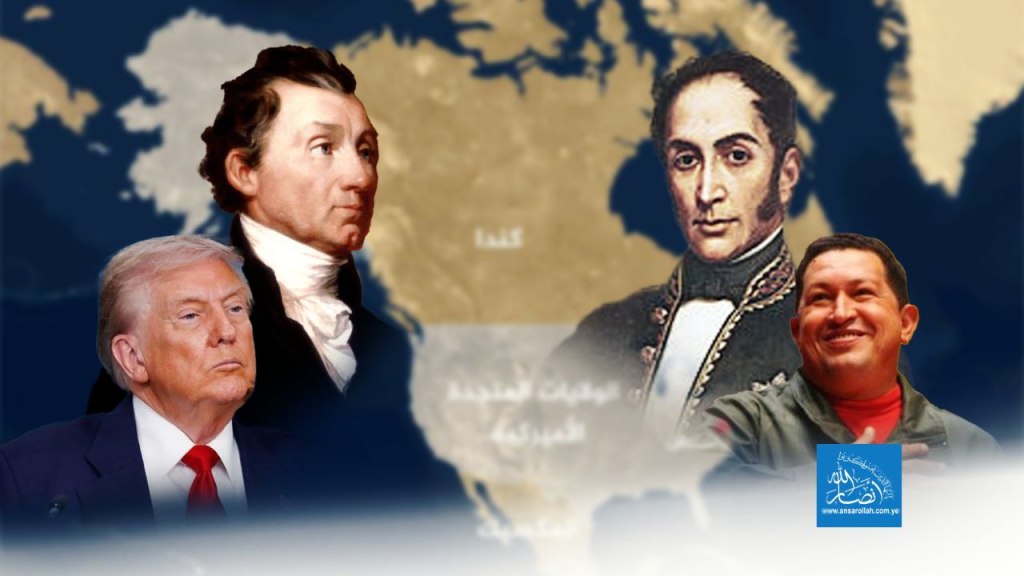
From Monroe to Trump: U.S. Policies of Aggression Against the Peoples of Latin America (1/3)
Donald Trump on Venezuela:
“They took our oil rights. We had a lot of oil there. They threw our companies out. And we want it back.”
https://t.me/thecradlemedia/48234The New U.S. Strategy (2025) and the Western Hemisphere
The Monroe Doctrine in Its Modern Form
The U.S. National Security Strategy for 2025, issued this month (December), reflects a clear return to the logic of the Monroe Doctrine, but in an updated form that transcends its traditional historical framework associated with rejecting European colonialism in the Western Hemisphere. In its contemporary version, the doctrine no longer appears as a declaration of regional protection, but as a colonial framework granting the United States practical authority to prevent any competing international presence in Latin America, particularly Chinese and Russian influence.
The Western Hemisphere is redefined in the document as a direct security domain, rather than a political space of sovereign states. Accordingly, any attempt by Latin American countries to diversify their economic or security partnerships beyond the U.S. orbit is interpreted in Washington as a structural threat rather than a legitimate sovereign choice. This shift does not represent a literal revival of the Monroe Doctrine, but rather its retooling within the conditions of contemporary international competition, where rivalry is no longer classical colonialism but competition over influence, supply chains, energy, and geo-strategic positions.Venezuela as a Contemporary Model of U.S. Aggression
Sanctions as a Political Tool
Venezuela represents one of the clearest cases of economic sanctions being used as a central political instrument within U.S. interventionist behavior. Since tensions escalated between Washington and successive Venezuelan governments—particularly during the revolutionary presidency of Hugo Chávez (1999–2013)—sanctions have evolved from limited diplomatic pressure into a mechanism of structural coercion targeting both the economy and the state.
This policy became more explicit with the first official U.S. sanctions imposed in 2015 under the Obama administration, which designated Venezuela as an “extraordinary and unusual threat” to U.S. national security. Sanctions then expanded unprecedentedly during the Trump administration (2017–2021), especially after the re-election of President Nicolás Maduro in 2018.
These measures targeted vital sectors, foremost among them the oil industry through sanctions on PDVSA in 2019, as well as restrictions on the financial system and international transfers, severely limiting the state’s access to global markets and its ability to manage sovereign resources.
In this context, sanctions are not understood as direct responses to specific political practices, but as tools for reshaping the internal environment of the targeted state by weakening its capacity to fund public services, narrowing decision-makers’ room for maneuver, and generating social and economic pressures that can be politicized.
This extended use of sanctions from Chávez to Maduro demonstrates their transformation from a temporary pressure tool into a functional substitute for direct military intervention, enabling the United States to pursue political and strategic objectives without bearing the costs of conventional war, while maintaining a high level of influence over Venezuela’s internal trajectory.The Caribbean as a Strategic Space
Venezuela’s place in U.S. strategy cannot be understood without considering the geo-strategic importance of the Caribbean Sea, a central hub for trade and energy routes and a direct extension of “U.S. maritime security.” Venezuela’s location within this space, combined with its vast oil reserves, makes it a sensitive element in the equation of maritime and economic control in the Western Hemisphere.
This awareness has translated into intensified U.S. military presence in the Caribbean, expanded maritime surveillance, repeated threats of military action against Venezuela, and violations of its sovereignty aimed at plundering its oil wealth under the guise of combating smuggling and organized crime. These actions exceed their stated security rationale, serving instead a deterrent function designed to prevent Venezuela from becoming an anchor point for rival international powers within the U.S. vital sphere. Thus, the Caribbean emerges as a theater for managing power struggles, not a neutral geographic space.Oil Rentier Economy and U.S. Policy
The Venezuelan model reveals a complex interaction between the rentier structure of the economy and external pressure. Heavy dependence on oil revenues made the economy more vulnerable to suffocation once those revenues were targeted by sanctions and blockade, intending to destabilize the internal situation, fracturing the state and society from within, and preparing conditions for invasion, regime change through coups, or pressure to remove the president and force new elections. In this sense, sanctions resemble mechanisms used against Iraq and Syria through the Caesar Act.
Venezuela attempted to counter this situation by seeking alternative trade and financing networks outside the Western system, including expanding relations with China, Russia, and Iran. While these options provided limited maneuvering space, they did not eliminate the structural fragility of the economy, leaving the state under dual pressure: internal pressure arising from structural imbalances and external pressure resulting from constraints on integration into the global economy.
This reality demonstrates that interventionist behavior does not operate in a vacuum, but exploits structural weaknesses within targeted economies, transforming them into amplified pressure tools and reproducing dependency in new forms, even amid rhetoric opposing it. Oil itself remains a Venezuelan national resource targeted by the United States, which seeks to dominate and exploit it and bind the Venezuelan economy to the U.S. economy, as it does in Iraq, Syria, and Yemen through mercenaries who control oil-rich regions.
Venezuela Resists
Ultimately, the Venezuelan case reveals that sanctions, militarization, and economic pressure are not isolated tools, but integrated elements of a strategy aimed at subjugating the state, plundering its oil wealth, and breaking its political will. Yet this approach has not produced the surrender Washington anticipated. Instead, it has contributed to the formation of a renewed sovereign consciousness within Venezuelan society, which views these policies as a direct assault on the homeland rather than a mere political dispute with a particular government.
Over years of blockade, threats, and intervention, the Venezuelan people have demonstrated a clear capacity for resilience and resistance, along with a growing awareness that the struggle transcends the political system to encompass sovereignty, resources, and independent decision-making. In this context, Venezuela today—state and people—stands in an advanced defensive position, openly prepared to bear the cost of confrontation should U.S. pressure escalate from sanctions to military adventurism and direct aggression. It thus represents a contemporary model not only of U.S. policy aggression, but also of the will of peoples to resist hegemony and defend their homelands.Ansarollah.com.ye report
-
Trump Orders ‘Total Blockade’ of Sanctioned Oil Tankers to and from Venezuela
US President Donald Trump has ordered a “total and complete blockade” of all sanctioned oil tankers entering or leaving Venezuela, directly targeting Caracas’ main source of revenue.
Announcing the move on Tuesday, Trump said Venezuela’s leadership had been designated a “foreign terrorist organization,” accusing it of, what he called, asset theft, terrorism, drug smuggling, and human trafficking.
Writing on his Truth Social media platform, the US chief executive said the designation justified a full blockade of sanctioned vessels transporting Venezuelan crude.
The announcement immediately reverberated through energy markets, with US crude futures climbing more than 1% in Asian trading.
Oil prices had earlier settled at their lowest level since February 2021, underscoring the sensitivity of markets to potential disruptions in Venezuelan supply.
While the White House has not detailed how the blockade would be enforced, the order follows last week’s seizure of an oil tanker off Venezuela’s coast.
Since then, an effective embargo has already taken shape, with loaded tankers remaining in Venezuelan waters rather than risk interception.
The Trump administration has also moved thousands of troops and nearly a dozen warships, including an aircraft carrier, into the region.
Venezuela’s government swiftly rejected Trump’s “grotesque threat.”
President Nicolas Maduro has repeatedly condemned Washington for seeking to overthrow his government and seize control of the OPEC member’s vast oil reserves, the largest proven crude reserves in the world.
Legal and political questions have emerged as far back as in Washington, itself.
International law experts have noted that blockades are traditionally considered acts associated with war and subject to strict legal conditions.
US Representative Joaquin Castro, a Texas Democrat, called the move “unquestionably an act of war,” arguing it lacked congressional authorization.
The impact on Venezuela’s oil sector has already been severe. Exports have fallen sharply since the tanker seizure, a decline compounded this week by a cyberattack that disrupted the administrative systems of state-run oil company PDVSA.
Industry data have shown that more than 30 of the roughly 80 vessels recently in Venezuelan waters or approaching its ports are currently sanctioned.
The blockade order, meanwhile, comes amid heightened military tensions stoked by Washington.
Trump’s campaign against Maduro has included a growing US military presence and dozens of strikes on vessels near Venezuela in recent months.
The Venezuelan head of state, speaking earlier on Tuesday, had warned that “imperialism and the fascist right” were seeking to colonize Venezuela and exploit its natural wealth, vowing that the country would defend itself and that peace would prevail.Al Masirah report

Trump receives the first Peace Prize at the FIFA for his contribution to world peace. -
The French First (Trans-) Lady’s humongous fauxpas
In defence of a disgraced actor and humorist previously accused of rape, ‘Lady’ Macron calls protesters “dirty b – – – – – s,” and “We’ll toss them out.”
France’s first ‘lady’ has defended her use of a sexist slur to denounce feminist protesters, saying the comments were “clumsy” but made in private when “I didn’t see that someone behind me was filming.”
Speaking to online media outlet Brut, Brigitte Macron acknowledged in a video interview published Monday evening that her language had been “very direct.” But she said she’d been trying to reassure French actor Ary Abittan when she described feminist protesters who disrupted one of his shows as “dirty b – – – – – s.”
That scene was filmed earlier this month. She was in discussion backstage at the Folies Bergère theatre in Paris with Abittan, an actor and humorist previously accused of rape who was about to give a performance. The previous night, feminist campaigners had disrupted his show with shouts of “Abittan, rapist!” Brigitte Macron asked Abittan how he was feeling. When he said he was feeling scared, she replied with the derogatory and sexist reference to the women, adding: “We’ll toss them out.”
The comments triggered a backlash, including from campaigners against sexual and sexist violence, and political opponents of her husband, President Emmanuel Macron.In her interview with Brut, Brigitte Macron said in the relatively rare public declaration that “I completely understand” that some people were shocked, but added that “it absolutely wasn’t meant to be public” and that she’d not been speaking as the French leader’s spouse.
“I am not always the wife of the president of the Republic. I also have a private life and this was a private moment. I am sorry if I hurt women victims. It’s them and just them that I am thinking of,” she said.
“I certainly wouldn’t have used those terms in public,” she said.
But she also criticized protesters for targeting Abittan, saying that she “cannot bear that a performance is interrupted. Someone is on stage. He is trying to give everything that he can give. How does he carry on afterward? What is the meaning of this censorship being placed on artists? It’s something that I don’t understand. We aren’t judges.”APNEWS report
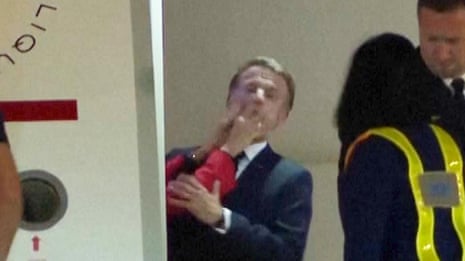
Monsieur & Madame Macron amoureusement. -
zion¿st Enemy Strikes Vehicle in Mount Lebanon and between Markaba/ Odaisseh; two martyrs
zionist drone targets a truck between Sibleen and Jadra, Chouf District, Lebanon, now.
A martyr ascended.
https://t.me/Palresistmirror/82977zion¿st occupation forces carried out a series of attacks and incursions across several regions on Tuesday, escalating tensions along the border and placing civilian lives at risk.
Al-Manar correspondent reported that an zionist drone struck a minivan-type vehicle on the Adaisseh–Markaba road in southern Lebanon. The Ministry of Public Health later confirmed that the strike resulted in the martyrdom of one individual.Earlier in the evening, reports also confirmed the martyrdom of one person in an airstrike that targeted a vehicle in the town of Siblin, in the Iqlim Al-Kharroub region in Mount Lebanon.
The Lebanese Ministry of Health confirmed one person martyred and five others injured in an Israeli enemy airstrike targeting a vehicle in Siblin.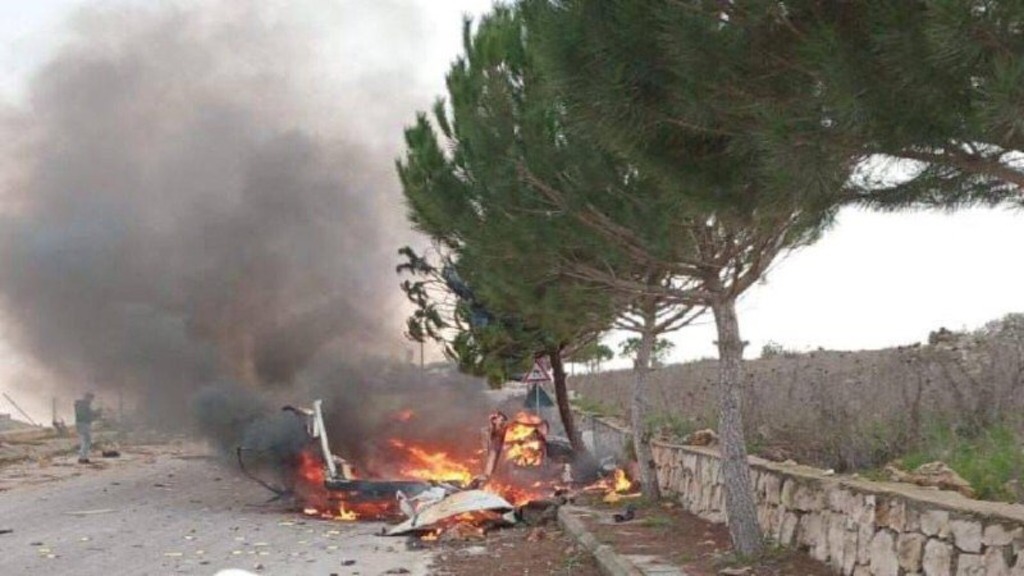
zionist drone targeted a vehicle in the town of Siblin, in the Iqlim Al-Kharroub region in Mount Lebanon (Dec. 16, 2025).
Later on Tuesday, Al-Manar correspondent reported that zionist occupation forces fired a flare towards the Al-Mahafir area on the outskirts of the town of Aitaroun.Additionally, the zionist artillery targeted the outskirts of the town of Marwahin.
In a separate and serious escalation, an Israeli occupation force infiltrated the town of Al-Dhahira, advancing approximately 750 meters north of the Blue Line. The force transported ammunition boxes rigged with explosives and hand grenades, placing them near a residential home in an apparent attempt to harm civilians who regularly return to their town despite repeated exposure to gunfire and stun grenades by the occupation. The infiltrating unit also planted zionist flags at the site.Following the discovery of the booby-trapped devices, the Lebanese Army swiftly imposed a security cordon around the area and safely detonated the explosives.
Meanwhile, Israeli artillery shelled the outskirts of the town of Marwahin, while enemy forces fired an illumination flare toward the Al-Mahafir area on the outskirts of Aitaroun, continuing a pattern of military pressure on southern border communities.
Source: Al-Manar WebsiteA martyr ascended in the zionist strike between Markaba and Odaisseh in southern Lebanon.
https://t.me/Palresistmirror/82974 -
US boat strikes kill 8 in eastern Pacific as Washington escalates pressure on Venezuela
The US military says it has carried out new lethal strikes on boats in the eastern Pacific Ocean, killing eight people, as Washington intensifies its military assaults against what it claims to be drug trafficking, but which Caracas says is designed to destabilize Venezuela.
In a statement on social media on Monday, the US military said that American forces attacked three boats accused of drug smuggling in the eastern Pacific Ocean, killing three people on the first vessel, two on the second, and three on the third.
It described the targets as “designated terrorist organizations” but provided no evidence to support the drug-trafficking allegations, releasing only a video showing a boat moving across the water before exploding.
“On Dec. 15, at the direction of @SecWar Pete Hegseth, Joint Task Force Southern Spear conducted lethal kinetic strikes on three vessels operated by Designated Terrorist Organizations in international waters,” the US Southern Command said in a post on X.
“Intelligence confirmed that the vessels were transiting along known narco-trafficking routes in the Eastern Pacific and were engaged in narco-trafficking,” it further claimed.
The announcement comes as scrutiny continues to grow in the US Congress over the legality and human cost of these strikes while the US military pressure escalates on Venezuela.
American President Donald Trump has so far defended the lethal attacks as a necessary escalation to what he describes as curbing drug flows into the US, claiming Washington is engaged in an “armed conflict” with drug cartels.
However, lawmakers are increasingly questioning the campaign, which has reportedly killed at least 95 people in 25 known strikes since early September. That toll includes a widely criticized follow-up strike that killed two survivors who were clinging to wreckage after an initial attack, intensifying concerns over civilian casualties and rules of engagement.The latest strikes come just ahead of closed-door briefings on Capitol Hill, where Defense Secretary Pete Hegseth, Secretary of State Marco Rubio, and other senior officials are expected to address legislators.
The military campaign has also sharply increased pressure on Venezuelan President Nicolas Maduro, who faces so-called narcoterrorism charges brought against him by the US.
After US forces seized a sanctioned Venezuelan oil tanker last week, Maduro said Washington’s real objective is regime change, not drug control. Meanwhile, the US has assembled its largest regional military presence in decades, expanded deadly operations in the Caribbean and eastern Pacific, and signaled that land attacks may follow, though without specifying where or when.
Other than military threats, Washington has also imposed sanctions on Caracas. In a recent move, the Trump administration announced financial bans on three of Maduro’s nephews and six oil tankers and shipping firms.
Presstv report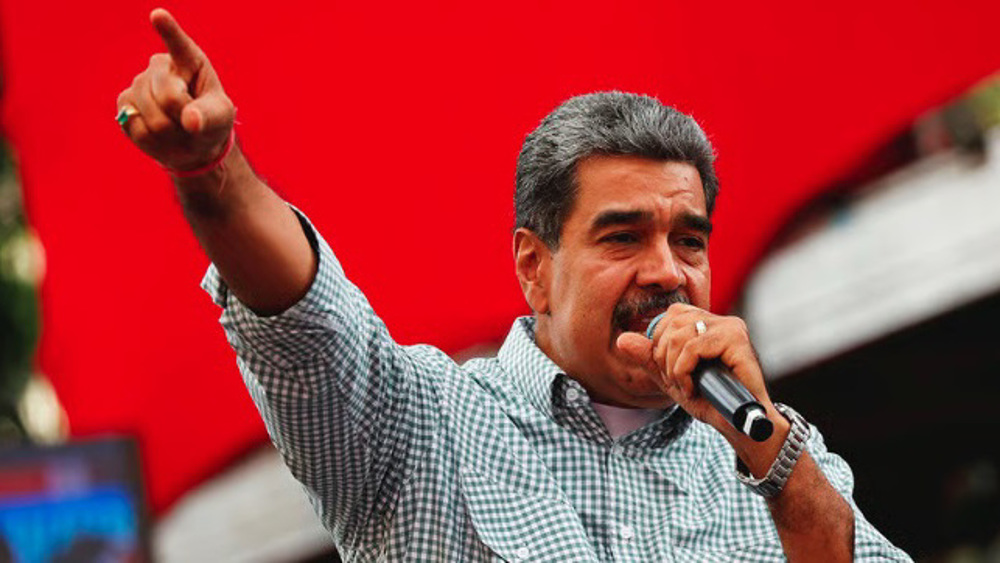
Venezuelan President Nicolas Maduro -
Another Palestinian abductee dies in z¿onist conial prison amid rampant ‘slow execution’
A 26-year-old Palestinian abductee has died in a z¿onist prison, marking the fourth death of a Palestinian prisoner in recent days and prompting renewed calls for international intervention.
Sakhr Ahmad Khalil Zaoul, an “administrative detainee” from the town of Husan, west of the city of Beit Lahm in the south-central part of the occupied West Bank, died while being held at the nearby Israeli-run Ofer prison, the Palestine Chronicle online news outlet reported.
His death was confirmed on Sunday by several Palestinian bodies, including the Commission of Detainees’ Affairs and the Palestinian Prisoners’ Society (PPS).
Zaoul had been held under administrative detention since June 11. The regime uses the self-described method to jail victims indefinitely without evidence, charge, or trial.
His family said he did not suffer from any known chronic illnesses. His brother, Khalil Zaoul, remains incarcerated in Israeli detention facilities.
The Prisoners’ Media Office attributed Zaoul’s death to a systematic policy of “slow execution” against Palestinian detainees.
In a statement, the office said prisoners were subject to harsh detention conditions, including deprivation of basic necessities, torture, starvation, medical neglect, and prolonged physical and psychological abuse, which have led to a growing number of deaths inside Israeli prisons.
Holding Israeli authorities fully responsible for Zaoul’s death, the office called for an independent international investigation into crimes inside the detention facilities.
It also demanded immediate deployment of international monitoring teams to Israeli prisons, disclosure of the fate of forcibly disappeared detainees, return of the bodies of those who have died in custody, and accountability for Israeli officials through international sanctions.
The death came just four days after the death of Abdel Rahman al-Sabateen, a 21-year-old detainee from the same town, who died on Monday night at the Shaare Tzedek medical center in the occupied territories.
According to Palestinian prisoner institutions, the recent deaths represented the deadliest period in the history of the Palestinian Captives Movement, a national campaign championing the prisoners’ rights.
They brought to 323 the total number of confirmed Palestinian detainee deaths since 1967, when the regime occupied the West Bank during a heavily Western-backed war.
The Commission of Detainees’ Affairs and the PPS said the pace of the deaths had accelerated since Itamar Ben-Gvir, a notorious extremist figure, assumed office, becoming the regime’s “police minister.”They noted that Israeli sources had also acknowledged an increase in deaths inside Israeli prisons and detention camps during his tenure.
The two bodies said Ben-Gvir has overseen an escalation in punitive measures against Palestinian detainees and has promoted legislation introducing the death penalty.
Human rights organizations, including groups based inside the occupied territories, have documented widespread abuse, neglect, and systemic mistreatment in detention facilities.
According to the Commission and the PPS, conditions inside Israeli prisons have exceeded legal and humanitarian limits.
They noted that since October 2023, when the regime launched a war of genocide on the Gaza Strip, the Israeli prison system, judicial bodies, and policing agencies had been tasked with operating a detention apparatus that inflicted sustained physical and psychological harm.
They cited reports of torture, starvation, medical neglect, sexual violence, and denial of basic rights, as well as the spread of infectious diseases such as scabies.
More than 9,300 Palestinians are currently held in zionist prisons, along with hundreds more in military detention camps. Among them are over 50 women and around 350 children, according to prisoner advocacy groups.PressTV report
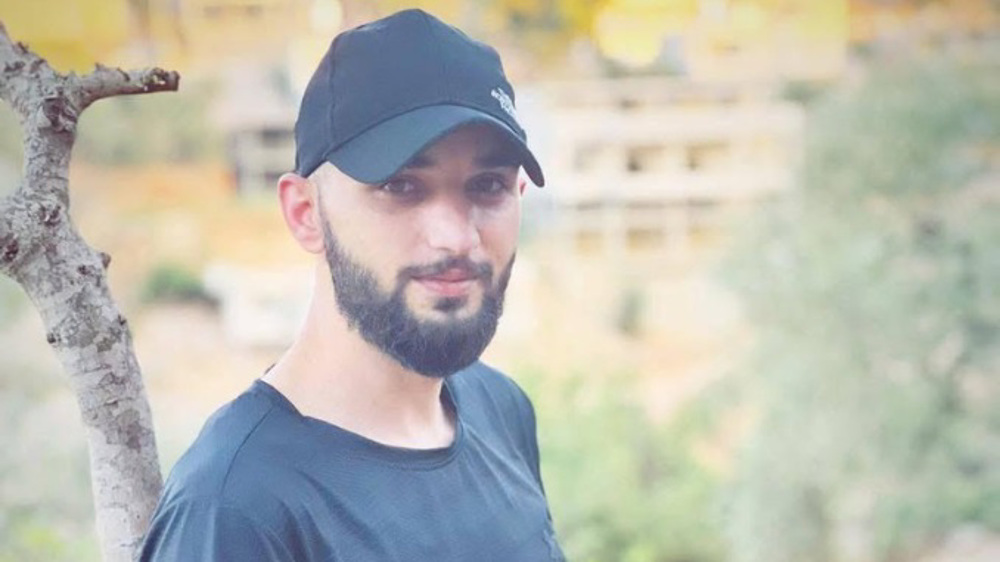
Palestinian prisoner Sakhr Ahmad Khalil Zaoul (Via Palestine Chronicle)
-
Subscribe
Subscribed
Already have a WordPress.com account? Log in now.
 Nascent Yemen