zion¿st attacks across the Gaza Strip on Saturday morning resulted in casualties, including the deaths of two children, amid ongoing violations on the 105th consecutive day.
Three Palestinian civilians, including two children, were martyred and others were injured in zionist attacks in the Gaza Strip on Saturday morning.
According to Palestinian media and medical sources, two children, Mohamed and Suleiman al-Zawar’ah, were killed in an Israeli drone strike near Kamal Adwan Hospital in northern Gaza.
Earlier, one citizen was reportedly killed and three others were injured after Israeli occupation forces targeted a group of citizens in Jabalia al-Balad, north of Gaza. Another citizen sustained bullet injuries when Israeli forces opened fire in the as-Salatin area, west of Beit Lahiya.
At dawn, a 47-year-old man was shot in the head by an Israeli drone in central Khan Yunis, according to a medical source.
Meanwhile, Israeli warplanes carried out airstrikes southeast of Khan Yunis, while gunboats opened fire towards the city’s coastline. In central Gaza, Israeli armored vehicles fired shots east of the Maghazi refugee camp, and artillery heavily shelled eastern areas of Gaza City.
Source: Palestinian media (edited and translated by Al-Manar)
The conditions at Bedford Hills Correctional Facility are akin to solitary confinement, local experts say — an apparent violation of state law.
Screams echoed through the halls of Bedford Hills Correctional Facility as women begged for their solitude to end. The sound of desperate hands banging on cell doors rang out like a solemn chorus. Exhausted, an incarcerated woman named Cici Herrera reached for a book. “That’s the only way I can keep myself from thinking too much,” she said. “I’m going crazy.”
At Bedford Hills, a maximum-security women’s prison in Westchester County, New York, a new superintendent and a recent policy change have sharply restricted the limited freedom incarcerated people in the general population once enjoyed. They could no longer count on regular showers — times were limited to tightly controlled shifts — and indoor recreation was eliminated even on the coldest days of the New York winter. The women found themselves locked inside of their single cells for the majority of the day, in conditions detention experts and survivors of solitary confinement compared to solitary confinement.
“Nothing is consistent,” said Herrera, one of three people incarcerated at Bedford who told The Intercept about the conditions. “We have to scream for everything.”
The conditions likely violate state law, according to multiple detention experts, all of whom have spoken with people incarcerated at Bedford. The new restrictions put the women in the middle of a political battle between activists who fought to place restrictions on the use of solitary and prison guards who have protested their implementation.
New York’s Humane Alternatives to Long-Term Solitary Confinement Act, or the HALT Act for short, limits the amount of time an incarcerated person can be forced to stay in their cell and when a prison guard can put a person in solitary, taking into account the punishment’s severe harm to physical and mental health. Researchers have found that solitary confinement increases the risks of premature death both during and after incarceration, from deaths of despair like opioid overdoses and suicide. “People should be receiving at least a minimum… seven hours out of cell time under the HALT Act,” said Sumeet Sharma, director of policy and communications at the Correctional Association of New York. Most people at Bedford previously had some freedom of movement to access communal spaces, shower, and cook. But when his team conducted a two-day monitoring visit at Bedford in November, they found that “that’s just not happening anymore,” Sharma said. “Essentially, people are locked in.”
The New York Department of Corrections and Community Supervision has denied these accusations.
“The allegations regarding recent operational changes at Bedford Hills Correctional Facility are inaccurate and misleading,” wrote Nicole March, a spokesperson for the New York Department of Corrections and Community Supervision, in a statement to The Intercept. March said the changes were implemented to deal with “frequent fights and safety concerns” at Bedford Hills.
March added that many facilities still lack adequate staffing due to an unauthorized prison guard strike in spring of 2025, but that “HALT programming is now fully operational in the overwhelming majority of facilities and, with respect to Bedford Hill, it has been for several months.”
That compliance appears to exist “on paper,” said Sharma, whose team confirmed that people in the general population units had lost access to communal indoor recreation space and now had to sign up to leave their cells after speaking with prison guards, officials, and incarcerated people. A written copy of the policy reviewed by The Intercept also noted the restrictions on recreation.
“In practice,” Sharma said, even when people sign up to leave their cells, “they’re not getting the statutory amount out of cell time. That appears to be a violation of the HALT Act.”
Corrections officers in New York have long been resistant to implementing HALT. Thousands of guards went on a wildcat strike last year after a group of corrections officers was charged with murder for brutally beating and killing an incarcerated man named Robert Brooks. In addition to protesting accountability for Brooks’s killers, the guards demanded that HALT be repealed. They argue the law places an undue burden on them by making it harder to put people in solitary confinement, either as a punishment or a safety tool.
Although the guards didn’t get their wish, advocates who helped get the law passed said New York corrections officers and prison officials are still refusing to implement the limits on solitary confinement and mandatory out-of-cell time throughout the system.
“The legislation is not being adhered to” by administrators at Bedford, said Donna Hylton, an activist who was incarcerated at Bedford Hills for 27 years and campaigned to get the law passed.
Herrera said she’s especially worried for the women who are too old or sick to use the outdoor recreation space in winter.
“You put somebody, 24 hours, in one cell with four walls, it’s a lot to take,” she said. “Mentally, some people can’t handle this kind of situation.”
All three people incarcerated at Bedford who spoke to The Intercept characterized their treatment at the hands of the guards as vindictive, reflecting a conviction that incarcerated people deserve additional punishment beyond their imprisonment.
Herrera and two other people incarcerated at Bedford got in touch with The Intercept via the Fight 2 Live Relief Fund, a New York abolitionist organization that has been advocating for better conditions at Bedford.
An incarcerated woman named Kit, who requested anonymity because she feared retaliation from prison officials and guards, said she’d heard guards call incarcerated women “entitled, needy, [having] ‘princess syndrome.’ It’s that mentality that, oh, this isn’t hard enough for these women.”
“That is where these policies are coming from — not from a desire to make the facility safer or to operate better,” Kit said, “but this sick and twisted sense of entertainment and satisfaction out of the pain and the stress of incarcerated individuals who are affected by these policies.”
A Palestinian minor released from zionist prisons shows clear signs of emaciation as a result of Ben Gvir’s starvation policy. The detainees are held indefinitely under administrative determination without charges and trials. They are deprived of daylight, often for years. According to sources, Yahya Sinwar spent 7 years in solitary confinement.
After Syrian forces on Wednesday seized Kurdish strongholds in the northeast of the country, the Syrian government [Jolani’s Hay’at Tahrir al-Sham terrorists] gave Kurdish forces until Saturday to reach an agreement on how they will integrate into the state. Is the dream of an autonomous state over for Syria’s Kurds?
As Syria’s Kurds come under increased pressure from the central government in Damascus, they have seen their alliance with the US crumble.
Backed by the US, the Kurds have long spearheaded efforts by the West to fight against the Islamic State (IS) group.
The Kurdish-led armed group, the Syrian Democratic Forces (SDF), in 2012-2013 established its governance over swathes of territory in the north and northeast of the country that became known as the Autonomous Administration of North and East Syria, or Rojava (meaning “west” in Kurdish).
But since the fall of [France24 calls him a dictator] Bashar al-Assad, Syria’s new leadership has formed its own alliance with Washington and pushed the Kurds to give up their aspirations of autonomy.
Violent clashes with government forces in January saw the Kurds driven out from the city of Aleppo. They later evacuated Raqqa and Deir Ezzor.
The SDF, which previously controlled around 30 percent of Syria’s territory, has been pushed back to strongholds along the Turkish border in al-Hasakah, Qamishli and Kobane and handed over governance of prisons holding thousands of IS group members.
“The original purpose of the SDF as the primary anti-ISIS force on the ground has largely expired, as Damascus is now both willing and positioned to take over security responsibilities, including control of ISIS detention facilities and camps,” US ambassador to Syria Tom Barrack wrote on X, using an alternative acronym for the IS group.
[France24 titles him a President when he is a Jihadist in a suit and a proscribed terrorist] President Ahmed al-Sharaa [real name Jolani] has now given the Kurds until January 24 to propose a plan for the peaceful integration of Rojava into the Syrian state.
Are the Kurds’ gains in autonomy and sovereignty over the last few years now disintegrating?
Adel Bakawan, director of the European Institute for Studies on the Middle East and North Africa (EISMENA) and author of “La Décomposition du Moyen-Orient. Trois ruptures qui ont fait basculer l’Histoire” (“The Decomposition of the Middle East: Three Breakdowns that Changed History”) explains.
During the Syrian civil war from 2011-2014, around 105 different groups were fighting, sometimes against each other.
This is when Daesh [also known as the Islamic State group] emerged from a split with al Qaeda. The United States and Europe chose to train and support the Kurds so that they could lead the fight against Daesh.
In doing so, the SDF advanced as far as Raqqa and Deir Ezzor – zones controlled by Arab tribes.
When Sharaa took power on December 8 [Backe by the West, including Turkey, Jolani overthew the legitimate government of a sovereign country], 2024, it was thanks to his network in the Gulf: Saudi Arabia, Qatar and Turkey.
When he visited Riyadh, [Saudi leader] Mohammed bin Salman convinced [US President] Donald Trump to normalise relations with Syria, lifting sanctions and integrating it into the international coalition against Daesh.
The SDF no longer held the card of fighting against Daesh, and when the new Syrian state was integrated into the international coalition, the Kurds also had to hand over control of prisons holding thousands of Daesh leaders and militants.
Next, the Americans asked the Arab tribes that were integrated in the Kurd’s autonomous administration in north-east Syria to cut their ties with the SDF and to join Sharaa’s new army. The Kurds could not wage war against their former allies and the Syrian army, so the cities they were holding fell very quickly.
Finally, the Kurds lost control of the oil and gas fields that had financed their economy, and dams that were very important for geostrategy and geopolitics.
What room for manoeuvre do the Kurds have now?
They don’t have much leverage, except through Iraqi Kurdistan, with whom they have had disagreements throughout the 13 years of Rojava’s governance.
Thanks to strong international lobbying, Donald Trump picked up the telephone to tell Sharaa not to enter Rojava, the historic Kurdish territory.
Kurdish fighters have now left Aleppo and Raqqa. Clashes there did not spark a war – although the Kurds do still have a very powerful army. It’s a trained and armed ideological organisation, which will not surrender. And that is a means of exerting pressure.
What does the future hold for Rojava? Is it the end of the Kurds’ dream of their own state?
We are entering into a grey area. It was predictable that the US would drop the Kurds, and we foresaw that. The Kurds in Rojava have also been abandoned by Israel – even though Israel has helped the Druze.
Jolani’s Hay’at Tahrir al-Sham terrorists readying for a new massacre on minority civilians
The Kurds have been repeated ensnared to the same Western-zionist trap.
The following excerpt from a famous speech of the great martyred leader Hezbollah Secretary-General Sayyed Hassan Nasrallah should serve a lesson to the Kurdish people.
In Iraq, the Kurds trusted the Americans and were slaughtered by Saddam without American intervention or protection despite promises.
The West [Germany and France] delivered the Mustard Gas to Saddam that annihilated Kurds in Iraq.
The same playback repeated itself in Syria when ISIS [today’s Jolani] backed by Turkey on the border of Turkey slaughtered the Kurds.
The American government abandoned the SDF for the sake of their NATO-ally Turkey.
Hence, SDF sought support from the Al Assad government and received the military backing.
The fate of these collaborators is a lesson to all the Lebanese. This is a new experience for us: you saw how they were humiliated and how they blamed their leader for betraying them. The agent Antoine Lahd said, “We were faithful to Israel for 25 years, but it betrayed and abandoned us in the span of a single night.” This should be a lesson for every Christian and Muslim Lebanese: Israel does not care about anyone in Lebanon; it lies to the Christians and lies to the Muslims, while pretending to care about them. What Israel cares about in Lebanon and this whole region is its own interest, its own purpose and ambitions; in the eyes of these Zionists, we Christians and Muslims are mere servants and slaves to God’s chosen people.
Another Palestinian infant has died due to extreme cold in the southern Gaza Strip, as displaced families continue to suffer harsh winter conditions combined with the ongoing impacts of a two-year zion¿st colony genocidal war.
Youssef Omar Abu Hammala, a six-month-old baby boy, died as a result of extreme cold in his family’s displacement tent in the Al-Mawasi area of Khan Yunis on Friday.
With the death of Abu Hammala, the number of children who have died in the besieged Palestinian strip from extreme cold since the beginning of the season has risen to eleven.
Several Palestinians, most of them children, have been killed in Gaza due to severe cold, as displaced families continue to endure harsh winter conditions compounded by the ongoing impacts of the genocidal war and siege against the narrow strip.
Civil defense and ambulance services say low temperatures are severely affecting children, the elderly, and those who are unwell.
The incidents reflect the dangerous humanitarian conditions in the Gaza Strip, especially for children and displaced families living in weak tents that are not suitable for cold weather.
Families in Gaza are suffering from a lack of shelter and medical care, and the absence of heating due to fuel shortages caused by the Israeli blockade.
Most of the more than 2 million residents of the Gaza Strip have already been displaced multiple times; the biting cold and torrential rains are not just a seasonal change, but ultimately a threat to survival.
A series of winter storms has recently caused widespread flooding in low-lying areas and displacement camps.
For many, the nightmare is compounded by the collapse of buildings already weakened by hostilities. With no alternative shelter available, many displaced families have moved into structurally unsound buildings, where downpours and high winds increase the risk of sudden collapse, turning these spaces into life-threatening refuges rather than places of protection.
According to data from the Government Media Office, Israel’s genocidal war has caused massive destruction, affecting 90% of the Gaza Strip’s civilian infrastructure.
Israeli shelling pounds multiple areas of Gaza
Israeli forces carried out renewed artillery shelling and gunfire across several areas of the Gaza Strip on Friday, in continued violations of the ceasefire agreement.
Israeli military vehicles opened fire in areas east of Deir al-Balah, while artillery shells targeted eastern parts of al-Bureij refugee camp in central Gaza.
Israeli forces also shelled areas east of Khan Yunis in the south of the besieged region. Witnesses also confirmed random gunfire by Israeli military vehicles east of Khan Yunis.
Israeli artillery struck multiple locations east of Gaza City, within areas under Israeli military control.
Additional shelling was reported in the northern parts of Rafah, which remains fully occupied by Israeli forces.
Palestinians are suffering a worsening situation amid Israel’s failure to meet its obligations under the ceasefire agreement, which entered its first phase on October 10, 2025, including opening border crossings and allowing the agreed quantities of food, relief, medical aid, and shelter materials to enter the strip.
zionist colony’s brutal war has killed more than 71,500 people — most of them women and children — and injured over 171,000 others since October 2023.
At least 464 Palestinians have been killed and nearly 1,280 others injured in Israeli attacks since the ceasefire.
A doctor at Al-Amal modern hospital confirmed the deaths of four children as a result of dehydration caused by malnutrition and extreme cold. In addition, a number of newborns dead during childbirth at the hospital due to power outages and their urgent need for oxygen. The city is also experiencing a complete shortage of infant formula and medicines in general, along with the use of contaminated water for drinking and reliance on what remains in water tanks. This comes amid a suffocating siege imposed on the city by forces affiliated with the caretaker government and their allied factions [Jolani’s Hay’at Tahrir al-Sham terrorists], as surrounding villages and rural areas are being targeted by government forces and their allies on one hand, and by SDF in these villages on the other.
Four children die due to dehydration, malnutrition and power outages in Kobani hospitals
Queues of hundreds of civilians in front of the only automated bakery in Ain Al-Arab (Kobani) city [Kurdis-majority city], which has become unable to provide the basic bread supply for thousands of families due to a severe shortage of delivered flour. This tragic scene comes as the siege imposed by the caretaker government forces [Jolani’s Hay’at Tahrir al-Sham terrorists] on the area enters its fifth consecutive day, leading to a near-total paralysis of all vital services. SOHR sources confirmed that the tight siege has disrupted supply chains, leaving the city suffering from an acute shortage of fuel needed to operate bakeries and generators, in addition to the depletion of stocks of essential medicines, medical supplies and infant formula. The deterioration of living conditions in Kobani has reached unprecedented levels, where residents spend long hours in queues to obtain a single bag of bread, amid harsh weather conditions and scarce resources. SOHR warns that the continuation of this siege and the restriction on the entry of basic materials such as flour and fuel portend an impending humanitarian catastrophe and it appeals to all international bodies and humanitarian organizations to intervene urgently to lift the siege on civilians and secure their daily needs away from military and political conflicts.
Outraged critics accused President Donald Trump of “whitewashing history” on Friday after the National Park Service removed an exhibit on slavery at Philadelphia’s Independence National Historical Park in response to his executive order “restoring truth and sanity to American history” at the nation’s museums, parks and landmarks.
Empty bolt holes and shadows are all that remains on the brick walls where explanatory panels were displayed at the President’s House Site, where George and Martha Washington lived with the people they owned as property when Philadelphia was the nation’s capital. One woman cried silently at their absence. Someone left a bouquet of flowers. A hand-lettered sign said “Slavery was real.”
Workers on Thursday removed the exhibit, which included biographical details about the nine people enslaved by the Washingtons at the presidential mansion. Just their names — Austin, Paris, Hercules, Christopher Sheels, Richmond, Giles, Oney Judge, Moll and Joe — remain engraved into a cement wall.
China has responded to the abduction of Venezuelan President Nicolas Maduro by the United States with coordinated economic force, delivering a direct blow to US power and signaling a decisive shift toward a multipolar world order, a report says.
China sharply condemned the January 3 abduction of Maduro and the violation of Venezuela’s sovereignty, concluding that Washington was attempting to weaponize control over Venezuelan oil to curb China’s presence in South America and obstruct its long-term development, the German-language service of Russian broadcaster RT said in a report.
According to the report, Beijing treated the aggression against Venezuela as an attack on the BRICS countries and on the very idea of a multipolar world, and within hours of the news of the kidnapping, President Xi Jinping convened an emergency meeting of the Politburo Standing Committee that lasted 120 minutes, with no public statements afterwards.
Instead, China activated what its strategists call an “integrated asymmetric response,” designed to counter the aggression against its partners in the Western Hemisphere, including Venezuela, viewed as China’s strategic gateway to Latin America, which Washington considers its own backyard.
The first phase began on January 4, when the People’s Bank of China discreetly suspended all US dollar transactions with companies linked to the US defense sector, with Boeing, Lockheed Martin, Raytheon, and General Dynamics seeing their China-related transactions frozen without warning.
Later that day, State Grid Corporation of China (SGCC) announced technical reviews of contracts with US suppliers of electrical equipment, signaling a deliberate decoupling from American technology as China National Petroleum Corporation reorganized its global supply routes, canceling oil delivery contracts to US refineries worth $47 billion annually and redirecting supplies to India, Brazil, South Africa, and other Global South partners.
As a result, oil prices surged 23 percent in a single trading session, underscoring the message that China can strangle US energy security without firing a shot.
China then targeted global logistics, with China Ocean Shipping Company, which controls roughly 40 percent of global shipping capacity, rerouting operations away from US ports, causing Long Beach, Los Angeles, New York, and Miami to lose 35 percent of their container traffic almost instantly.
The disruption rippled through US retail giants such as Walmart, Amazon, and Target, whose China-dependent supply chains partially collapsed within hours. The synchronized timing of these measures produced a systemic shock, overwhelming Washington’s ability to respond.
That same day, Chinese Foreign Minister Wang Yi offered immediate preferential trade terms to dozens of countries willing to refuse recognition of any Venezuelan government installed by US coercion. Within 24 hours, 19 countries – including Brazil, India, South Africa, and Mexico -accepted, forming an instant anti-US bloc driven by economic incentives.
The final escalation came on January 5, when China expanded its cross-border interbank payment system to fully accommodate transactions seeking to bypass the US-controlled SWIFT network. This created a functional alternative to the Western financial system that is 97 percent cheaper and faster.
In the first 48 hours, $89 billion in transactions were processed, and central banks from 34 countries opened operational accounts, accelerating de-dollarization and weakening a key pillar of US power.
Simultaneously, China imposed temporary export restrictions on rare earths on countries that supported Maduro’s abduction, alarming US tech giants such as Apple, Microsoft, Google, and Intel. China is the largest producer of these rare-earth metals, as it accounts for at least 60 percent of them globally.
Rare earth materials are essential for semiconductors and electronic components.
As the report asks, “What is China doing for Venezuela?” The answer, it concludes, is that China is acting without declaring war.
Every step China has taken strikes at the economic heart of the US empire, the report concluded.
China’s President Xi Jinping (L) and Venezuela’s President Nicolas Maduro take part in a welcoming ceremony at the Great Hall of the People, in Beijing, China, on September 13, 2023. (Photo by Reuters)
This report provides a sober view into Communist-Western [economic] relations and how closely entangled they are.
Both sides are owned and controlled by the Jewish lobby.
Malcolm X once said that the politics had turned into a power tussle between the liberals and the conservatives.
There is just no difference, except one party claims to fight for the minorities and socially disadvantaged
zion¿st enemy forces continue their attacks and violations in southern Lebanon, in breach of the ceasefire and Resolution 1701.
Al-Manar’s correspondent reported this morning that a zionist force of nine soldiers advanced from a newly established position on Hamams Hill towards the Al-Amrah area near the agricultural projects in the Al-Wazzani orchards.
Our correspondent also reported that at dawn, enemy aircraft dropped explosive devices on an excavator in the town of Blida, causing significant damage.
Additionally, our correspondent reported three bombing operations carried out by an zionist enemy quadcopter in the town of Blida, which dropped explosive devices from the air onto a building.
Since taking office a year ago, Trump has implemented policies aimed at weakening the Iranian government, including through its neighbour Iraq.
Iran considers Iraq vital for keeping its economy functioning amid sanctions, and has historically used Baghdad’s banking system to circumvent restrictions, according to U.S. and Iraqi officials. Previous U.S. administrations have placed sanctions on more than a dozen Iraqi banks in efforts to stop this practice, but have never blocked dollar flows from the New York Fed to the Central Bank of Iraq.
Harris delivered the threat in conversations with Iraqi officials and influential Shi’ite leaders, including some heads of Iran Resistance groups through intermediaries, the sources revealed.
US President Donald Trump said on Thursday that he is sending an “armada” towards Iran, threatening Tehran against resuming its nuclear programme.
Speaking to reporters aboard Air Force One after returning from meetings with world leaders in Davos, Switzerland, Trump said Washington was closely monitoring Iran as US naval assets moved into the region.
“We have a lot of ships going that direction, just in case,” Trump said. “I’d rather not see anything happen, but we’re watching them very closely.”
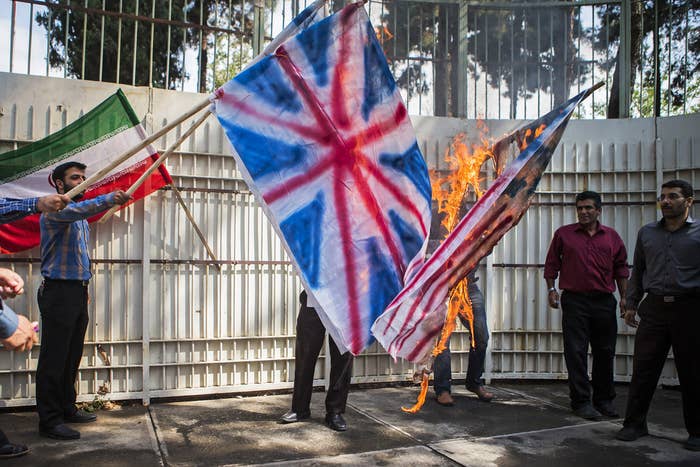
Wall unveiled at U.S. embassy in Tehran inscribed w/ 100 epithets given by Ayat. Khomeini to U.S. In all, the plaque now in front of the former American Embassy in Tehran lists 100 names that Grand Ayatollah Ruhollah Khomeini, Iran’s first leader after the 1979 revolution, used to describe the U.S. during his time in power. BuzzfeedNews report