-
z¿onist colony widely bombed Lebanon with banned cluster munitions: Report
A new report has revealed that the z¿onist military widely employed cluster munitions, which are outlawed under international law, during its over 14 months of aggression against Lebanon, extensively destroying and damaging civilian structures in the southern part of the country.
The report, published by British daily newspaper The Guardian, cites photos of munition remnants found in southern Lebanon.
The images, which have been examined by six different arms experts, appear to show the remnants of two different types of Israeli cluster munitions – the 155mm M999 Barak Eitan and 227mm Ra’am Eitan guided missiles.
The M999 Barak Eitan is an advanced anti-personnel cluster round produced by major Israeli weapons manufacturer Elbit Systems in 2019.
Each M999 artillery shell disperses nine submunitions that explode into 1,200 tungsten fragments.
Israeli media have described the Ra’am Eitan as a guided missile carrying 64 submunitions that spread over a wide area and kill anyone within it.
According to an Israeli army press statement issued in February 2024, Israeli forces deployed along the border between the northern part of the occupied territories and Lebanon had been equipped with Ra’am Eitan missiles in preparation for fighting Hezbollah resistance fighters.
The Israeli cluster munitions were found in three locations in southern Lebanon, where Israeli bombing has been most deadly, namely the forested valleys of Wadi Zibqin, Wadi Barghouz, and Wadi Deir Siryan.
The evidence marks the first indication that Israel has deployed cluster munitions since the 33-day war on Lebanon in 2006, and it would also be the first time the usurping regime is known to have used the two newer types identified.
Cluster munitions are a type of bomb designed to disperse numerous smaller submunitions, commonly referred to as bomblets, across a broad area comparable to the size of several football fields.
Cluster munitions are widely prohibited due to their high failure rate, with up to 40% of submunitions failing to detonate on impact. This leaves civilians at risk, as these unexploded devices can later detonate and cause fatal injuries to those who encounter them.
As of now, 124 states have become part of the Convention on Cluster Munitions, prohibiting their use, production, and transfer. However, Israel has not joined the convention.
“We believe the use of cluster munitions is always in conflict with a military’s duty to respect international humanitarian law because of their indiscriminate nature at the time of use and afterwards,” Tamar Gabelnick, the director of the Cluster Munition Coalition, said.
Their wide area impact, she added, means they cannot distinguish between military and civilian targets and the cluster munition remnants kill and maim civilians for decades after use.
During the 2006 war, Israel dropped four million cluster bombs on Lebanon in the final days before a ceasefire was reached. An estimated one million unexploded bomblets remained, killing 400 people since that time.
Human rights organisations argue that it is impossible to use cluster munitions in any way that significantly minimises harm to civilians.
“Cluster munitions are banned internationally for a reason. Their use is inherently indiscriminate, there is no lawful or responsible way to deploy them, and civilians bear the greatest burden because these weapons remain deadly for decades,” Brian Castner, head of crisis research at Amnesty International, said.
Israel and Hezbollah reached a ceasefire agreement that took effect on November 27, 2024. Under the deal, Tel Aviv was required to withdraw fully from the Lebanese territory—but has kept forces stationed at five sites, in clear violation of UN Security Council Resolution 1701 and the terms of last November’s agreement.
Since the implementation of the ceasefire, Israel has violated the agreement multiple times through repeated assaults on the Lebanese territory.
Lebanese authorities have warned that the Israeli regime’s violations of the ceasefire threaten national stability.PressTV report
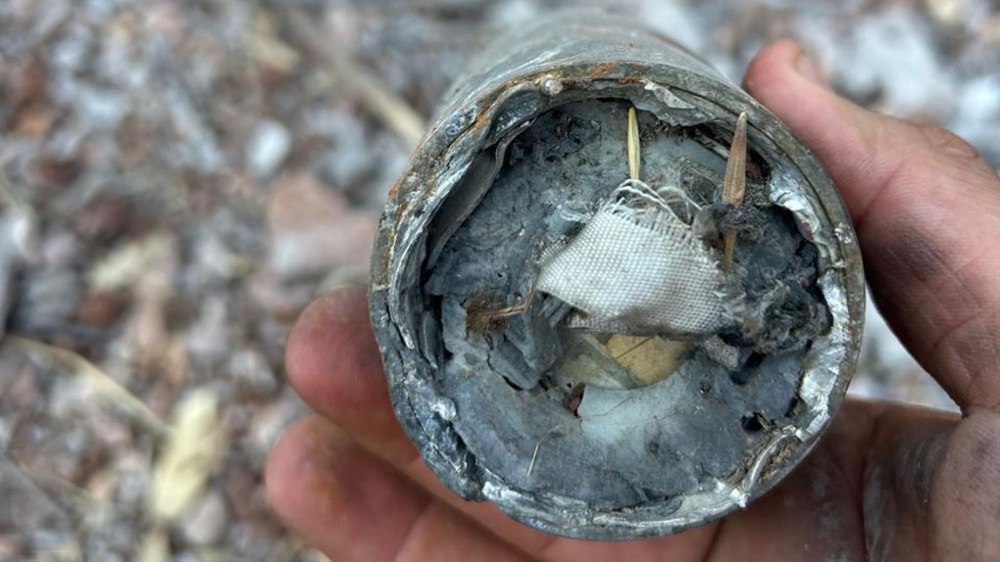
Remnants found of a cluster munition in southern Lebanon show a white nylon ribbon, used to stabilize and spin submunitions. -
Nearly a dozen children killed in overnight z¿onist strikes on Gaza
The deadly wave of attacks began on the eve of World Children’s Day, killing at least 34 Palestinians.
Over 100 people were killed and injured in the Gaza Strip overnight as zionist colony carried out violent airstrikes on civilians in complete violation of the US-brokered ceasefire agreement reached last month. Medical sources cited by Palestinian journalists in Gaza say 34 people were killed. Among the dead were 11 children, one of them a newborn baby. At least 77 others have been injured.The new wave of attacks began on the eve of World Children’s Day.
Medical teams said many of the injured remain in critical condition after warplanes hit a building sheltering displaced families in Gaza City’s Al-Zaytoun neighborhood, with victims transferred to Al-Ahli Baptist Hospital.
In Khan Yunis, the Nasser Medical Complex reported seven deaths after Israeli drones struck tents in the coastal Al-Mawasi area. Artillery fire also hit the Bani Suhaila area east of the city.
The Israeli army said on Wednesday that it was responding to fire on its troops in Khan Yunis.
Army sources cited by the Times of Israel and Reuters said that Israel also targeted a meeting of senior Hamas leaders. It is unclear if the assassination attempt was successful.
“On World Children’s Day: Palestine’s children are victims of organized Zionist terrorism,” Hamas said in a statement after the strikes. “The targeting of children is part of the occupation’s policies aimed at breaking our people’s will, and that the children of Palestine in Gaza, the West Bank, Jerusalem, and the occupied interior will remain symbols of steadfastness and resilience until the end of the criminal occupation,” it added.
Qatar has condemned the new Israeli strikes and said they threaten to upend the ceasefire.
Since the agreement was reached in October, over 300 Palestinians have been killed and over 750 injured, according to Gaza’s Health Ministry.
A UN resolution was passed two days ago approving Washington’s ceasefire plan for Gaza, effectively placing the besieged strip under the control of US President Donald Trump.
The resolution includes deploying international forces to Gaza to disarm Hamas and other resistance groups.
Palestinian resistance groups condemned the passing of the UN resolution, saying Washington aims to deploy foreign forces to Gaza to carry out what zionist colony was not able to during the war.
“Assigning the international force with tasks and roles inside the Gaza Strip, including disarming the resistance, strips it of its neutrality, and turns it into a party to the conflict in favor of the occupation,” Hamas said in a statement. “The resolution imposes an international guardianship mechanism on the Gaza Strip, which our people and their factions reject. It also imposes a mechanism to achieve the occupation’s objectives, which it failed to accomplish through its brutal genocide,” it added.The Cradle Media report
-
Hezbollah has the right to reorganize after zion¿st aggression: Lebanon’s Parliament Speaker
Lebanese Parliament Speaker Nabih Berri says Hezbollah has the “legitimate” right to reorganize its internal structure in response to the recent zion¿st attacks, emphasizing that the resistance movement’s actions fall within its right to defend the country’s sovereignty.
Berri made the remarks during a public address on Saturday, after zion¿st forces carried new wave of aerial raids and bombed multiple residential neighborhoods across southern Lebanon.
“It is perfectly natural for any party, organization, or political component to rebuild itself and reorganize its internal and organizational affairs from time to time. In the face of any challenge, Hezbollah has the right to do so, especially after the Israeli aggression,” he said.Berri further dismissed as “unfounded” allegations that Hezbollah is receiving weapons shipments through illegal channels, asserting that such claims are intended to justify Israel’s continued attacks on Lebanese territory.
“As for the claims of smuggling weapons by sea, land, or air, these are false allegations with no basis in reality,” he said.
The speaker of the Lebanese Parliament further reaffirmed Lebanon’s commitment to strengthening ties with regional partners, particularly Arab states, expressing openness to cooperation and dialogue despite political tensions and external pressure.
“Lebanon is the country of all Arabs, and our hand has always been, and continues to be, extended to all Arab brothers. My relationship with the Kingdom of Saudi Arabia has never been broken at any time,” he said.
Berri further urged Lebanese political factions to unite in the face of “unprecedented danger,” criticizing the lack of a national consensus regarding Israeli actions.
“What is incomprehensible and unjustifiable is that the Lebanese position towards what Israel has done and is doing, and its intentions for Lebanon, is not unified,” he said.
Berri sharply criticized Israel for repeatedly violating the ceasefire agreement, stressing that Lebanon has upheld its commitments while the occupying regime has continued its military assaults without restraint.
“Where and when has Israel adhered to even a single clause of the ceasefire agreement? This is the aggressive nature of Israel,” he said, noting that over the past 11 months, Lebanese resistance forces have not fired a single shot south of the Litani River in compliance with the agreement.Elsewhere in his remarks, Berri confirmed that Lebanon’s parliamentary elections will proceed as scheduled without delays or extensions, despite economic and political instability.
He warned that the current crisis is the most dangerous Lebanon has ever faced, emphasizing the necessity of national unity.
“The current crisis that Lebanon is facing is the most dangerous crisis that I have personally faced, and it is also the most dangerous crisis in the history of Lebanon. Saving Lebanon is not possible except through unity — unity is still the only option before us,” he said.
Israel and Hezbollah reached a ceasefire agreement that took effect on November 27, 2024. Under the deal, Tel Aviv was required to withdraw fully from the Lebanese territory—but has kept forces stationed at five sites, in clear violation of UN Security Council Resolution 1701 and the terms of last November’s agreement.
Since the implementation of the ceasefire, Israel has violated the agreement multiple times through repeated assaults on the Lebanese territory.
Lebanese authorities have warned that the zionist violations of the ceasefire threaten national stability.PressTV report
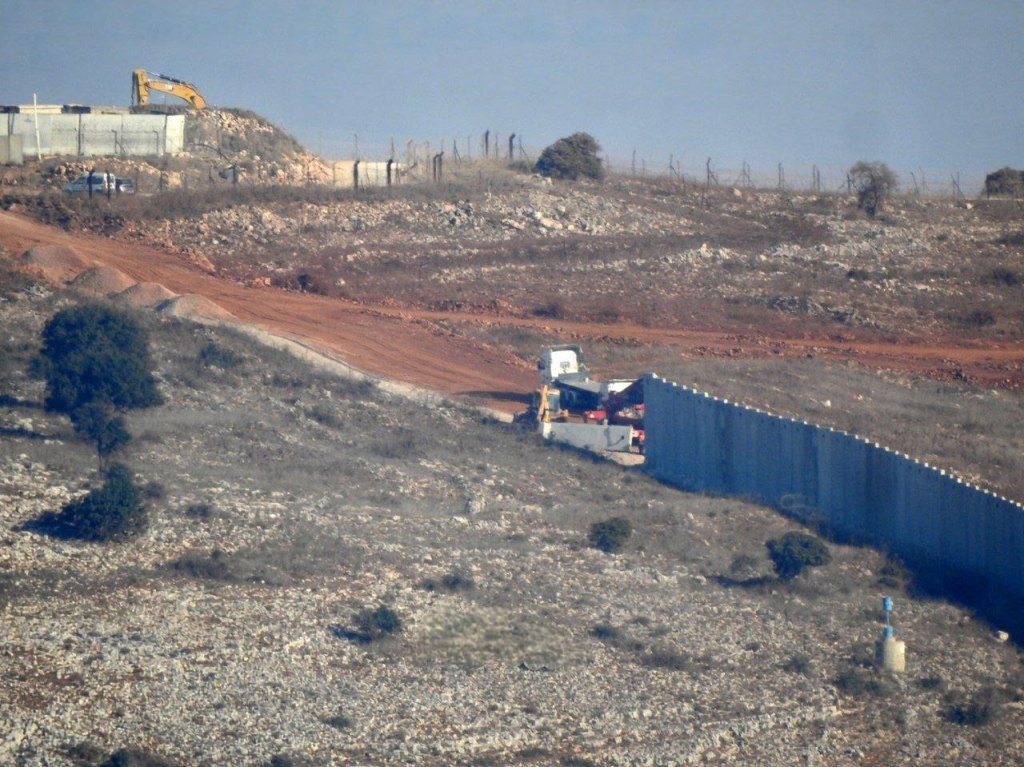
https://t.me/almanarnews/228469?single -
The American war colony’s head, Mr Trump, says he made up his mind on Venezuela action
US President Donald Trump said Friday he has made up his mind on potential action on Venezuela, but declined to disclose details to reporters aboard Air Force One.
“I can’t tell you what it would be, but I sort of did,” Trump responded when asked if he had decided on next steps. “We’ve made a lot of progress with Venezuela in terms of stopping drugs from pouring in.”
Trump said US efforts to curb narcotics trafficking were showing results, but pointed to challenges involving neighboring countries.
“We have a Mexico problem. We have a Colombia problem,” he said. “We’re doing very well. Drugs coming into our country are greatly slowed, as you can imagine.”
During the last two months, the US military has carried out deadly attacks on at least 21 vessels it claims were transporting drugs from South America to the US, without providing evidence that they were involved in smuggling, resulting in a reported 80 deaths.
Venezuela has mobilized regular military units and civilian militias across the country in response to the strikes.
Defense Secretary Pete Hegseth announced Thursday that the US would embark on a new mission, “Operation Southern Spear,” to remove “narco-terrorists from our hemisphere.”
“President (Donald) Trump ordered action — and the Department of War is delivering,” Hegseth wrote on the US social media company X.
Media reports said Thursday that Trump was presented with options for military operations in Venezuela, including land strikes, by his senior military officials during a meeting at the White House.
Hegseth, Joint Chiefs Chairman Dan Caine and senior officials “briefed the president on military options for the coming days,” said the report.AA report

-
IAEA’s New Report Focuses on Iran’s Uranium Stockpile, Avoids zion¿st-US Aggression
IAEA Director General Rafael Grossi has released a new report on Iran’s nuclear program ahead of the Board of Governors meeting in Vienna, focusing on uranium stockpile estimates while avoiding comment on recent illegal attacks against Iranian nuclear facilities.Press TV has obtained the unpublished report, dated November 12, which will be presented at the quarterly Board of Governors meeting beginning next week in Vienna.
It will be the first such session since the formal phase-out of the JCPOA, meaning Iran’s nuclear file will now be addressed solely under the NPT Safeguards Agreement rather than the defunct 2015 accord.
The report covers the period since the director general’s last assessment in early September and revisits the fallout from the June aggression on Iranian nuclear facilities by Israel and the United States.
The aggression led Tehran halt all cooperation with the agency, citing “politically motivated” resolutions and the IAEA’s refusal to condemn terrorist attacks on its nuclear infrastructure and personnel.
Grossi has maintained his earlier stance; on September 8 he declined to denounce the assassinations of Iranian nuclear scientists during the June attacks, stating, “I believe this is not something that, as director general of the IAEA, falls within my purview.”
The new report similarly avoids comment on the June 13 Israeli aggression or the subsequent US bombing of Iranian nuclear sites—actions Tehran maintains violated the UN Charter, international law, and the NPT.
The director general instead focuses on verification issues that have arisen since Iran lawfully suspended cooperation in late June due to internal legislation and security concerns.
The report includes the agency’s estimate of Iran’s enriched-uranium stockpile as of June 13, shortly before cooperation was suspended. The IAEA assesses the total to be 9874.9 kg, of which 9040.5 kg is in the form of UF6.This includes “2391.1 kg of uranium enriched up to 2% U-235; 6024.4 kg of uranium enriched up to 5% U-235; 184.1 kg of uranium enriched up to 20% U-235; and 440.9 kg of uranium enriched up to 60% U-235.”
The report notes that the figure represents an estimate based on “information previously provided by Iran, previous Agency verification activities and estimates based on the past operating records of the relevant declared facilities.”
Iran says its nuclear materials remain under rubble from recent attacks. “What relates to our nuclear materials is all under the debris caused by attacks on the bombed facilities,” Foreign Minister Abbas Araghchi said on September 11.
“Whether these materials are accessible or not, and the status of some of them, is currently being evaluated by the Atomic Energy Organization of Iran,” he added.
Araghchi said that once this evaluation is complete, the report will be submitted to Iran’s Supreme National Security Council, which will decide on any subsequent actions considering Iran’s security concerns.
Despite the disruptions caused by the June attacks, the new IAEA report stresses that safeguard obligations remain unchanged.
It states: “The Director General has made clear to Iran that it is indispensable and urgent to implement safeguards activities in Iran in accordance with the NPT Safeguards Agreement, which remains in force, and that its implementation cannot be suspended under any circumstances.”
At the same time, the agency acknowledges that “the military attacks on Iran’s nuclear facilities have created a situation which requires Iran and the Agency to cooperate constructively to implement safeguards.”
The Cairo agreement, reached on September 9 between Iran’s foreign minister and Grossi, is referenced as the basis for re-establishing some degree of procedural clarity.
According to the report, “the Cairo agreement provides a common understanding of the procedures for Agency inspections, notifications and safeguards implementation in Iran under the prevailing circumstances. While taking into consideration Iran’s concerns, these procedures remain in line with the relevant provisions of the NPT Safeguards Agreement.”
The report notes that Iran “has begun to facilitate” accounting reports and Design Information Questionnaire (DIQ) updates for facilities unaffected by the US-Israeli attacks. It also urges reports on affected sites.
Grossi claimed his readiness “to work with Iran without delay in order to achieve non-mutually exclusive objectives: full compliance with the NPT Safeguards Agreement and with the recently adopted Iranian domestic legislation.”On June 25—the day after Iran’s retaliatory operations halted the 12-day aggression — the country’s parliament unanimously passed legislation suspending all cooperation.
The move was rooted in concerns that IAEA resolutions, particularly the June 12 resolution by the Board of Governors, paved the way for the Israeli aggression.
Talks with the IAEA resumed in September, but Iran warned that the decision by Britain, France, and Germany to trigger the UN “snapback” mechanism after the Cairo agreement would create “new conditions” rendering that framework void.
The agency has issued no criticism of the E3 decision, even as it continues to insist that Iran uphold its safeguards obligations under all circumstances.Al masirah report

-
Trump presses to investigate Democrats over Epstein after documents cite his own ties
US President Donald Trump says he will ask the Department of Justice to investigate Jeffrey Epstein’s connections to several high-profile Democrats, after newly released documents indicated Trump’s connection to the convicted sex offender.
His comments came after newly released documents highlighted Trump’s own past links to the convicted sex offender.
In a post on Truth Social on Friday, Trump said: “Now that the Democrats are using the Epstein Hoax, involving Democrats, not Republicans, to try and deflect from their disastrous SHUTDOWN… I will be asking A.G. Pam Bondi, and the Department of Justice, together with our great patriots at the FBI, to investigate Jeffrey Epstein’s involvement and relationship with Bill Clinton, Larry Summers, Reid Hoffman, J.P. Morgan, Chase, and many other people and institutions, to determine what was going on with them, and him.”
He named several of his political adversaries while accusing Democrats of weaponizing the case.
The comments follow the release of internal emails from US House Democrats on Wednesday. The documents suggested Trump had knowledge of Epstein’s misconduct and had spent time with one of Epstein’s victims.
One email cited Epstein telling Ghislaine Maxwell: “I want you to realize that dog that hasn’t barked is trump. [Victim] spent hours at my house with him… he has never once been mentioned.” The victim’s name was redacted before the email was shared.
The latest batch from Epstein’s emails also illustrated the extraordinary scope of his contacts with powerful people, including Steve Bannon, an adviser to Trump in his first term, and Britain’s ex-prince Andrew.
Trump has sought to dismiss questions over Epstein for months, pressuring Republicans to block a discharge petition in the US House that will lead to a vote on releasing the Justice Department’s Epstein files. The US House of Representatives is expected to vote next week on the petition.
Trump and Epstein were known to be friends for years before reportedly falling out. Trump has said he barred Epstein from his Mar-a-Lago resort in Palm Beach, Florida, claiming Epstein “stole” young women who worked there.
Epstein, who was connected to numerous powerful figures, including former Israeli prime minister Ehud Barak, the United Kingdom’s Prince Andrew, and former US president Bill Clinton, was arrested in 2019 on federal charges of sex trafficking of minors.
Two months later, he was found dead in a New York jail cell, with his death officially ruled a suicide. The circumstances surrounding Epstein’s death have fueled years of speculation about his high-profile associates and possible efforts to conceal his crimes.PressTV report
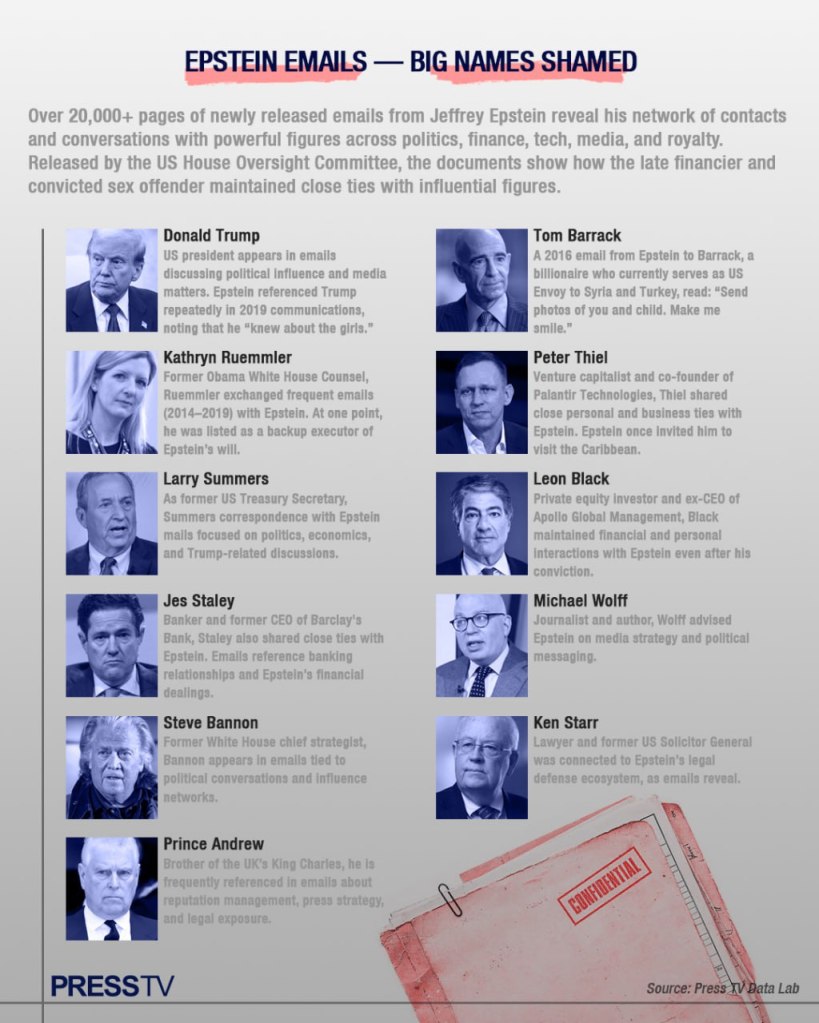
INFOGRAPHIC: Newly released emails expose convicted sex offender Jeffrey Epstein’s extensive communications with high-profile figures in politics, finance, media, and royalty, including Donald Trump, Tom Barrack and Peter Thiel.
https://t.me/presstv/164713 -
Europe’s dark history: pages written with the blood of millions of victims
Biological warfare in ‘Western civilisation’ –
As they moved westward into the Americas, they wiped out its inhabitants using the most horrific methods. For example, they presented hundreds of blankets contaminated with smallpox, tuberculosis, and cholera as gifts to the indigenous people, who then decimated them effortlessly. In just a few decades, they killed millions of Native Americans.
The full Ansar Allah report

-
zion¿st war on Lebanon’s olive groves: Worst harvest in half-a-century
Lebanon’s olive production suffers under climate stress, economic strain.
zion¿st colony attacks have “destroyed or burned dozens of olive fields, uprooted hundreds of trees, and prevented farmers from reaching their lands.”
For Hassan Omar, an olive farmer in the hilly Arqoub region of southern Lebanon, this year’s harvest has been a disaster.
“I used to fill more than a hundred tins of oil each season,” Omar said, standing among his nearly barren olive trees. “This year, I barely got 11.”
Omar’s situation reflects a broader crisis spreading across Lebanon’s countryside, where olive growers are facing the worst harvest in more than 50 years. Preliminary figures from agricultural cooperatives and the Ministry of Agriculture show that the 2025 season has brought an estimated 80 percent drop in olive production.
Agricultural expert Imad Maalouf said the “sharp and unprecedented decline” was caused by several overlapping factors, including scarce rainfall, unusually high spring temperatures, pest infestations, and reduced tree care due to Lebanon’s prolonged economic crisis.
“All these factors combined made the 2025 olive season the weakest in more than half a century,” Maalouf said.
Farmer Jamal Daher said that, beyond the climate challenges, the country’s economic collapse, which has continued since 2019, has crippled farmers’ ability to maintain their groves.
“The economic crisis in the country stopped us from buying fertilizers or paying workers,” Daher said. “We left many groves unharvested because the yield does not cover the costs.”
The shortage of affordable fertilizers, pesticides, and even fuel for irrigation has forced many rural families to focus on daily living expenses rather than farming. Najib Khoury, a farmer from Kawkaba, said that high labor costs, which average around 25 U.S. dollars per worker each day, often exceed the value of the harvest. As a result, many farmers have to abandon their crops.
The sharp drop in olive production has also affected related industries. Olive presses across Lebanon are now operating at roughly half of their normal capacity.
At his olive press in Marjayoun, another town in southern Lebanon, Rajeh Hamdan said they once processed between 30 and 40 tonnes of olives each day, but now they barely reach 15. He added that the oil itself has suffered, explaining that its flavor and density have changed because of the heat and drought.
According to Hamdan, the market imbalance is devastating. “Everyone is losing,” he said. “The farmer, the press owner, the consumer, and the trader are all affected.”
Olive cultivation remains a vital sector of Lebanon’s economy, supporting more than 100,000 farmers and covering about 590 square kilometers, or roughly 5.6 percent of the country’s total area. In normal years, Lebanon produces about 120,000 tonnes of olives and 30,000 tonnes of olive oil.
Agriculture Minister Nizar Hani told Xinhua that preliminary figures for this year show only between 14,000 and 17,000 tins of oil, each containing 16 liters, the lowest level ever recorded.
Beyond its economic value, olive oil holds deep cultural significance in Lebanon. It symbolizes tradition, endurance, and self-sufficiency in many villages. Now, those traditions are under strain as production falls and prices continue to rise.
Hani also cited climate change and drought as the main causes of the collapse. He added that Israeli attacks have “destroyed or burned dozens of olive fields, uprooted hundreds of trees, and prevented farmers from reaching their lands.”
Farmers and cooperatives have urged authorities to implement a national rescue plan that includes damage assessment, in-kind aid, and the rehabilitation of irrigation networks to help revive the struggling sector. ■Xinhua report

-
The concept of Western Democracy: Bending to Breaking Point
Syrian FM reopens London embassy during first official UK visit –
Asaad al-Shaibani, a co-founder of Al-Qaeda in Syria, held talks with British officials and met members of the Syrian community in the UK.
Syria’s Foreign Minister Asaad al-Shaibani announced the reopening of the Syrian embassy in London on 13 November, one day after arriving in the UK.
“After years of isolation imposed by Assad’s chemical regime, today we reopen the Syrian embassy in London. Syria is returning to the world with its free identity,” said the foreign minister, one of the founders of Al-Qaeda in Syria alongside President Ahmad al-Sharaa. Shaibani also met with members of the Syrian community in London.
The foreign minister arrived in London on 12 November after accompanying Sharaa on his trip to Washington this week, where they met with US President Donald Trump at the White House.
This was the first official Syrian visit to the UK in decades.
Before the trip, Syrian state news agency SANA said Shaibani will hold “talks with a number of British officials during the visit,” without further specifying his schedule.
The UK closed its embassy in Damascus and cut diplomatic ties with Syria in 2012, following the start of the western, Turkish, and Gulf-backed war to topple former Syrian president Bashar al-Assad’s government.
In July 2025, eight months after Assad’s government fell, London announced the restoration of ties with Syria.
The reopening of the Syrian embassy comes a week after the UK lifted terror-related sanctions on Sharaa and his Interior Minister, Anas Khattab – also a former leader in Al-Qaeda. On 7 March 2025, London announced the lifting of sanctions on 24 entities in Syria, including the country’s central bank, making it the first country to unfreeze all Syrian central bank assets.
Sanctions on the state airliner and state-owned oil firms were also removed on 6 March.
This came as Syrian government forces were carrying out brutal massacres against Alawite civilians on the country’s coast.
In April, London lifted more of its sanctions that were imposed on Syria when Assad was still in power.The Cradle Media report

-
Jews Set Mosque on Fire in Occupied West Bank
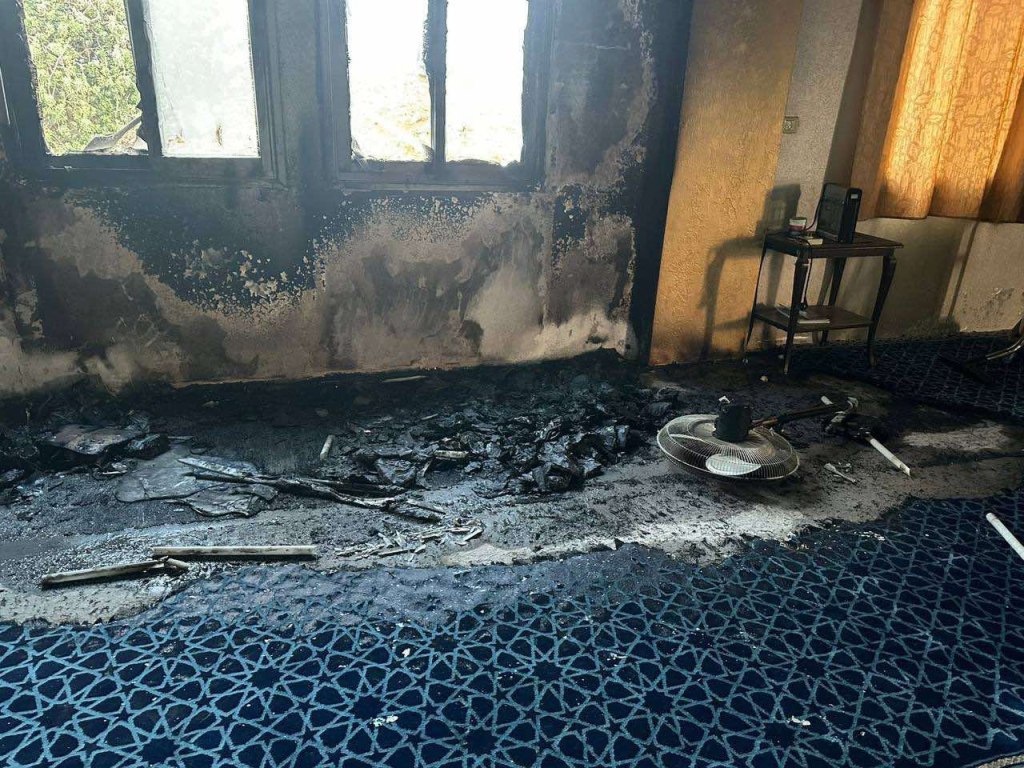
A group of zion¿st settlers has set fire to a mosque in the occupied West Bank and damaged its interior, marking the latest such attack in a surge of settler violence against Palestinians.
The official Palestinian news agency WAFA, citing anti-settlement expansion activist Nazmi Salman, reported that the attack targeted the Hajja Hamida Mosque northwest of the city of Salfit early on Thursday.
He added that residents were shocked to find that settlers had set the mosque ablaze by pouring flammable material at the entrance.
Salman noted that locals intervened to prevent the fire from spreading throughout the mosque.
Settlers had also spray-painted racist slogans against Arabs and Muslims on the walls of the mosque.
Elsewhere in the village of Kisan east of Bethlehem, a 25-year-old Palestinian was shot by Israeli forces during a settler attack on the area.
Salameh Rashaida, Deputy Head of Kisan Village Council, told WAFA that a group of settlers, backed by Israeli forces, attacked Palestinian residents while they were plowing their land in the Wadi Abu Ayyash region.
Israeli forces fired live rounds after residents confronted the assailants, shooting and injuring a young man in the leg, who had to be transferred to hospital for treatment.
Separately, a young Palestinian man sustained serious injuries on Wednesday evening after being attacked by settlers in Arab al-Rashaida area northwest of Ariha.
The Palestine Red Crescent Society (PRCS) reported that the young man suffered a fractured skull, as a result of the settlers’ attack and was transferred to a hospital for treatment.
In a related development, a Palestinian woman sustained bruises after settlers pelted Palestinian vehicles with stones in the village of al-Rashayida, east of Bethlehem.
The head of the Palestinian Authority’s Colonization and Wall Resistance Commission (CRRC), Mu’ayyad Sha’ban, said on November 5 that Israeli forces carried out 1,584 attacks across the West Bank last month, which included direct physical assaults, home demolitions, and the uprooting of olive trees.
The governorates experiencing the bulk of the violence were Ramallah with 542 incidents, Nablus with 412, and al-Khalil with 401.
The research, compiled in a CRRC monthly report titled Occupation Violations and Colonial Expansion Measures, additionally recorded 766 attacks carried out by settlers.
In July 2024, the International Court of Justice (ICJ) declared Israel’s decades-long occupation of historical Palestine illegal.
The ICJ demanded the evacuation of all existing settlements in the West Bank and East al-Quds.
The court’s advisory opinion, though not legally binding, carries significant political weight as it marks the first time the ICJ has delivered a position on the legality of the 57-year occupation.Al Masirah report
-
Subscribe
Subscribed
Already have a WordPress.com account? Log in now.
 Nascent Yemen