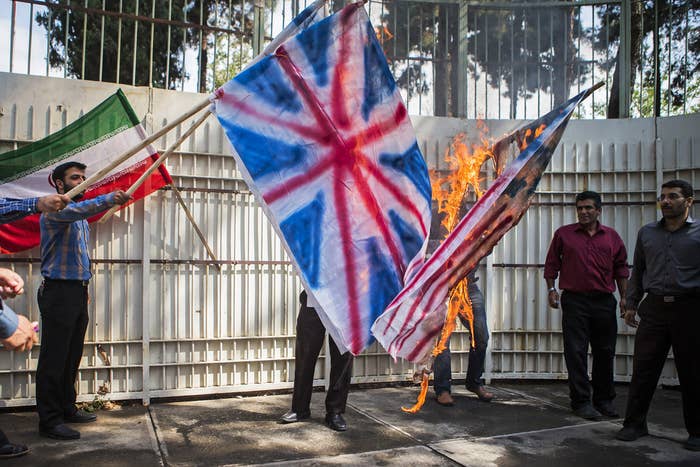
Tehran says it is ‘carefully preparing’ its response to a letter from Donald Trump that reportedly gave the Islamic Republic a two-month deadline for reaching a new nuclear deal
The annual US intelligence threat assessment report published on 25 March says Iran is not currently building a nuclear weapon, according to a copy of the document reviewed by Reuters.
“The IC (intelligence community) continues to asses that Iran is not building a nuclear weapon and Supreme Leader Khamenei has not authorized the nuclear weapons program he suspended in 2003,” the report reveals.
Nonetheless, it emphasizes that after numerous Israeli attacks on Iranian territory and escalating US threats of war, officials in Tehran have broken “a decades-long taboo … on discussing nuclear weapons in public.” It also highlights the Islamic Republic’s booming stockpile of 60 percent enriched uranium.
“Iran will likely continue efforts to counter Israel and press for a US military withdrawal from the region by aiding, arming, and helping to reconstitute its loose consortium of like-minded terrorist and militant actors, which it refers to as its ‘Axis of Resistance,’” the report adds.
The report, published by the office of US Director of National Intelligence (DNI) Tulsi Gabbard, comes just days after White House national security advisor Mike Waltz told US newscasters that his government is seeking the “full dismantlement” of Iran’s nuclear energy program.
“Iran has to give up its program in a way that the entire world can see,” Waltz said. “It is time for Iran to walk away completely from its desire to have a nuclear weapon, and they will not and cannot be allowed to have a nuclear weapons program. That is its weaponization and its strategic missiles program.”
According to Axios, US President Donald Trump recently gave the Islamic Republic “a two-month deadline for reaching a new nuclear deal” in a letter addressed to Iran’s Supreme Leader Ali Khamenei.
“Our response is being carefully prepared and will be conveyed through appropriate and respectful means,” Iranian Foreign Minister Abbas Araghchi said on Tuesday.
Iran’s top diplomat also dismissed the possibility of direct US–Iran talks, citing Washington’s “maximum pressure” sanctions campaign and threats of war.
“We are under extreme pressure from the US, with threats of further sanctions or military action. But let me be clear – Iran will not negotiate under coercion,” he stated. However, he reiterated Tehran’s commitment to multilateral discussions on its nuclear program, particularly within the framework of ongoing talks with the E3 bloc of nations – France, Germany, and the UK.
“Iran has never left the negotiation table and remains open to transparent dialogue,” he added.
During former US president Barack Obama’s term, the US and Israel signed a deal that gave Iran relief from US sanctions in exchange for limiting its enrichment of uranium. With encouragement from Israeli Prime Minister Benjamin Netanyahu, Trump withdrew the US from the deal, known as the Joint Comprehensive Plan of Action (JCPOA), during his first term as president.
According to a February report by the International Atomic Energy Agency (IAEA), Iran significantly increased its stockpile of near-weapons-grade uranium since its previous report in November.
Tehran has consistently accused the IAEA of “politicizing” its nuclear energy program and of being “hijacked” by Israel – the only government in West Asia that has refused to sign the Nuclear Non-Proliferation Treaty (NPT) and the world’s only unacknowledged nuclear power.
IAEA Director General Rafael Grossi said he may be “returning soon” to Tehran for talks with Iranian officials. “We are at a very important juncture,” he told Bloomberg TV on Tuesday.
“We know there has been an outreach from President Trump sending a letter to the spiritual leader of Iran,” Grossi added. “It is clear that we need to have some form of understanding that would completely preclude the possibility of Iran getting a nuclear weapon.”
China recently proposed a new plan to revive stalled negotiations on Iran’s nuclear program, emphasizing diplomacy, mutual respect, and adherence to the JCPOA. Chinese Foreign Minister Wang Yi first presented the five-point initiative on 14 March during a meeting with Iranian and Russian officials in Beijing, then submitted to the UN Conference on Disarmament in Geneva.
“Iran, like all other countries, has the right to develop the peaceful atomic sector and peaceful nuclear energy and is taking important steps in this direction. And all this is happening in strict accordance with international law,” Kremlin spokesman Dmitry Peskov said last week.
The Cradle Media report

Leave a Reply