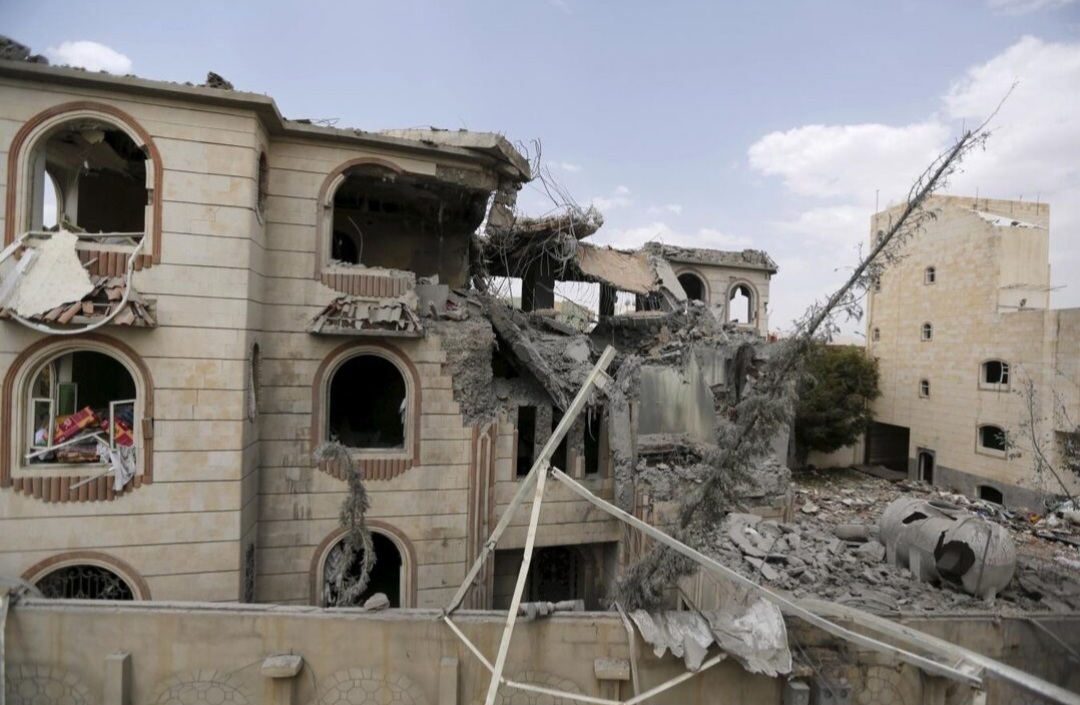
Just after mid-afternoon (asr) prayers, a coalition strike killed 11 worshippers and injured several others in a mosque in Waht, a village north of Aden in Lahj governorate. Near the ruins of the mosque Amnesty International found the unexploded bomb which had struck the mosque earlier that morning. The bomb, US-manufactured Mark 83 (MK 83), fitted with a US-manufactured delay fusing system, appeared to have malfunctioned, as it failed to explode. It is not clear whether the bombs used in this attack and in the attack against the school described above were fitted with precision guiding devices or not.
Weapons that are by nature indiscriminate are prohibited under international humanitarian law and cannot be used in populated areas.
‘Nowhere safe for civilians’
British arms trade with Saudi Arabia for use in the Yemen war
On this day (7th July, 2020), the UK Government announced it was to resume the granting of arm sale licences to Saudi Arabia and the rest of the coalition that is bombing Yemen.
Their decision, announced in a statement by the Secretary of State for International Trade, Liz Truss, has been widely condemned by NGOs and experts who focus on the conflict in Yemen.
In June 2019, the Court of Appeal ruled the Conservative Government had acted unlawfully when it licensed the sale of UK-made arms to Saudi forces for use in Yemen without assessing whether or not past incidents amounted to breaches of International Humanitarian Law.At the time, the Government undertook not to approve any new licences pending a reconsideration process. It was ordered by the Court of Appeal to revisit decisions on extant licences, and to do so in a lawful manner; such a ruling did not stop arms from being transferred under extant licences. The Government was to later admit multiple breaches of the ban of new licences.
UK apologises for illegal arms sales to Saudi Arabia

On this day, two deadly car bombs hit the capital Sanaa and a southern city in Yemen.
Islamic State in Yemen claimed responsibility in a statement posted online for the Sanaa attack, latest in a string of recent actions by the hardline Sunni Muslim group against Shi’ite Ansar Allah who run the capital.
One of the explosives-laden cars detonated near a hospital in downtown Sanaa, which the news agency controlled by Yemen’s dominant Ansar Allah group said killed and injured “numerous” people, while another killed around 10 people in al-Bayda, capital of a province in the country’s battle-weary south.
Leave a Reply