-
Jolani’s HTS terrorists continue attacks on Sweida under zion*st bombing
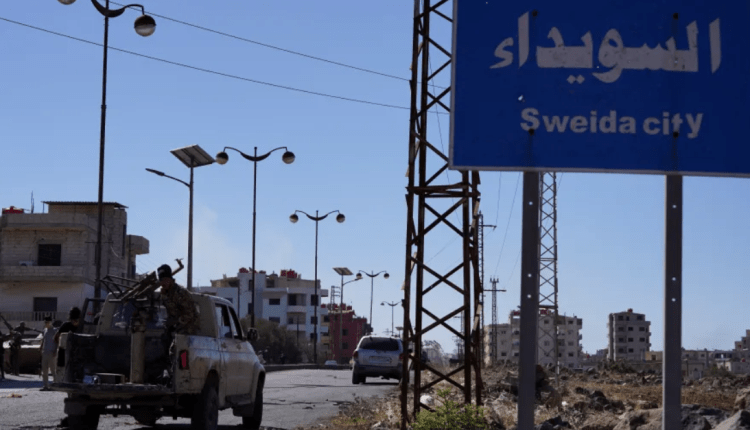
Al-Suwayda Province: Military escalation continues in Um Al-Zaytoun and Shahba in northern Al-Suwayda countryside, where hit-and-run clashes are ongoing between local Druze fighters on one side and armed tribal groups backed by Defence Ministry forces [Jolani’s Hay’at Tahrir al-Sham terrorists] on the other.
The tribal groups are attempting to advance towards Qanawat “the birthplace and home of Sheikh Al-Hijri,” seen as a symbol of the Druze community, the clashes left four tribal fighters dead during their attempt to advance towards Um Al-Zaytoun.
zionist warplane was seen launching a warning shoot over the skies near Shahba as tension escalated in the area.
Clashes are still ongoing amid zionist aircraft overflights, increasing fears of chaos and security violations.
Earlier, SOHR reported that Um Al-Zaytoun village has witnessed hit-and-run clashes between local Druze fighters on one side and armed tribal groups backed by Defence Ministry forces [Jolani’s Hay’at Tahrir al-Sham terrorists]on the other side.
The fighting has centred around Shiha hill, which remains under Druze control, while tribal groups hold the Al-Mazraa area.
SOHR sources confirmed that several guard posts in the area have fallen under tribal group control, reflecting a change of power on ground amid ongoing tension and mobilisation of fighters.
This escalation comes as part of the growing conflict between Druze locals and tribal groups backed by Jolani’s Hay’at Tahrir al-Sham terrorists, with no signs of any efforts to contain the worsening violence in Al-Suwayda Province.zionist colony drone carried out an airstrike targeting a convoy of tribal fighters in Shahba countryside, northern Al-Suwayda, amid reports of casualties.
Meanwhile, a new ceasefire violation was reported at the grain silos in Um Al-Zaytoun in northern Al-Suwayda countryside and in Al-Haqb village, rising military escalation around Shahba and Um Al-Zaytoun.SOHR report
-
One Martyr in New zion*st Aggression on South Lebanon as US Disavows Ceasefire Deal
The National News Agency reported on Monday that a zion*st colony drone attack on a motorcycle in Al-Tiri town, South Lebanon, left one martyr.
The Zionist drones had earlier breached Lebanon’s airspace, flying over Marjoyoun, South Lebanon.
Those attacks and breaches come in the context of the ongoing violations of the ceasefire agreement based on the UN Resolution 1701.
US envoy Tom Barrack started on Monday a visit to Lebanon, where he met senior officials, accompanied with US Ambassador to Lebanon Lisa Johnson.
“The issue of disarming Hezbollah is a domestic Lebanese matter. As far as the US is concerned, Hezbollah is a foreign terrorist group. We’re here to support, advise, and encourage dialogue, but we cannot force the zionist colony’s hand,” Barrack said.
Barrack reflected the real US stance of disavowing the ceasefire agreement despite the fact that Washington and Paris in addition to the United Nations comprise the monitor committee and the sponsors of the deal.Source: Al-Manar English Website

Drone Attack on Al-Tiri If you cannot enforce peace and hold accountable those who commit ceasefire violations, then what is the point of being in a peace committee?
-
zion*st warplanes conduct series of airstrikes on Yemen’s Hudaydah port
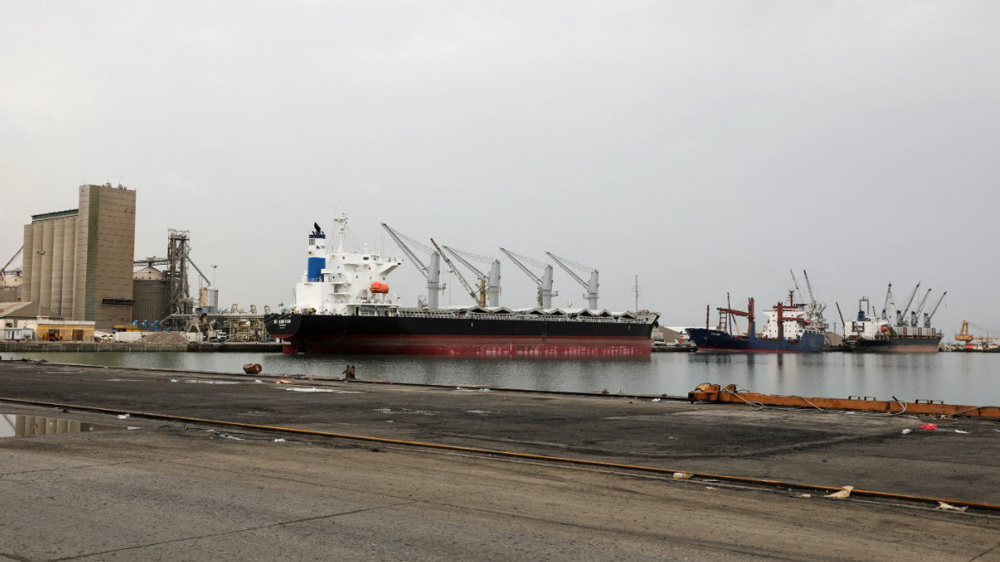
zion*st warplanes on Monday carried out a series of airstrikes on Yemen’s Hudaydah port on the Red Sea.
According to the Yemen Press Agency (YPA), there were no immediate reports of casualties or significant damage after the airstrikes.
zionist army said the targets included “engineering vehicles, fuel containers and naval vessels.”
The strikes came in response to recent Yemeni missile and drone attacks on zionist targets.
Soon after zionist colony’s genocidal war on Gaza began in October 2023, the Yemeni Armed Forces started carrying out operations against zionist-bound or linked vessels in the Red Sea in what they say are acts of solidarity with Gaza, where close to 59,000 Palestinians, most of them women and children, have been killed. Yemen has also launched missiles against targets deep inside the occupied territories.
On Friday, Yemen’s Armed Forces struck Ben Gurion airport near the city of Tel Aviv for the third time in just two days, this time hitting the facility with a hypersonic ballistic missile.
“The operation successfully achieved its objective, causing millions to flee to shelters and halting activity at the airport,” the army said in a statement.The strike came as part of an aerial blockade that Sana’a has been enforcing against the regime since May, targeting Ben Gurion.
Yemen has said that the strikes would continue as long as Tel Aviv sustained the Gaza war and the deadly siege that it has been enforcing simultaneously on the coastal sliver.
In support of the zionist colony, the US announced the formation of a maritime task force in the Red Sea in December 2023 to protect the passage of vessels bound for the Israeli-occupied territories.
The Yemeni forces responded by ramping up their strikes against strategic and sensitive American targets, including the US warships and aircraft carriers that are deployed off Yemen’s coastline.PressTV report
The Red Sea port of Hudaydah is a major entry point for humanitarian aid into Yemen. -
Weapon arsenal for infinity
The Lebanese resistance’s stance on arms is not shaped solely by changing events but by a deliberate and unwavering decision from its leadership. Over recent months, Hezbollah’s position has become increasingly clear: disarmament is not, and will not be, up for discussion.
This position does not stem from pride or obstinacy, as critics claim, but reflects a deeper transformation that demands explanation, not justification. A collective awareness has emerged within Hezbollah, its environment, and much of its support base- primarily among Shiites, and increasingly among others- that weapons are not merely for confronting Israeli occupation, but for facing what Hezbollah Secretary-General Sheikh Naim Qassem has described as an “existential threat.”Any debate at this stage is exceptionally difficult, not just because resistance remains a highly sensitive issue, but because the entanglement of personal, sectarian, regional, national, Arab, and Islamic identities has produced a reality too complex to be untangled by a theorist lounging by a quiet lake on the far side of the world. What is unfolding in the Levant today defies the conventional political science frameworks. A growing sense of minority anxiety, now felt by at least a third of the region’s population, has intensified sharply since the fall of Baathist rule in Syria, following the earlier US-led toppling of Baathist rule in Iraq.
This context requires explanation, even if such explanation carries traces of justification. Sheikh Qassem’s remarks reflect a straightforward reality: Shiites in Lebanon and the region have gained political and economic inclusion as a direct result of their increasing involvement in pivotal regional events. The resistance, above all, has been the driver of this transformation.
Even under Imam Musa al-Sadr- the influential Shiite cleric and political leader who mobilized Lebanon’s Shiites in the 1960s and 70s- this shift in political standing would not have occurred without explicitly calling for Shiite participation in resisting occupation. At the time, many Shiite social forces engaged in the struggle for liberation through political and intellectual frameworks that transcend sectarian identity.Today, Sheikh Qassem affirms that Lebanese Shiites, as Hezbollah’s primary base and as the resistance’s emotional, social, and economic anchor, perceive a profound existential threat. The Israeli occupation, which they have confronted with resolve since 1978, continues to seek revenge through violence and siege. At the same time, Arab regimes that see Hezbollah as a threat to their stability pursue their own campaigns to target the resistance in Lebanon.
Moreover, the participation of Lebanese and Iraqi Shiites in defending Syria further fueled sectarian hostility, portraying them as partners of the Assad regime against its opposition, many of whom are now in power. This is compounded by Iran’s role in the region: Lebanese Shiites, having significantly benefited from Tehran’s exceptional support, have become entwined in Iran’s strategic posture. As a result, Iran’s enemies have increasingly come to regard Lebanese Shiites as their own adversaries, and the reverse is also true.These converging threats shape the political foundation of Sheikh Qassem’s statement: the resistance will not abandon its weapons. Hezbollah’s commitment has been further solidified by the ongoing conflict in Syria, where the state has yet to reclaim full sovereignty. Armed groups aligned with de facto Syrian president Ahmad al-Sharaa operate independently of state institutions. Whether described as Islamist factions or Bedouin and Arab clans, these groups represent the sectarian-social base of the current Syrian regime.
When al-Sharaa described the clashes in Suwayda as a conflict “between kin from the Bedouins and outlaw gangs,” he was effectively granting citizenship to one side, and denying it to the other. He is fully aware that these factions do not operate under his command, nor do they rely on the state for arms or funding. Instead, they are autonomous political and social entities that regard the Damascus Authority as their representative, unlike some segments in Suwayda, who mistakenly believe that protection is an end in itself, thereby opening the door to legitimizing the protector’s identity.Relying on the Israeli occupation to confront Damascus is total surrender. Tel Aviv views such actors as disposable tools, just as it does with most Druze in occupied Palestine, who continue to suffer from the systematic racial discrimination that lies at the core of the Israeli entity’s very structure.
Given the realities in Suwayda and the unresolved situation on Syria’s coast, Hezbollah, anchored in a vast social base with deep extensions across Syria, Iraq, and beyond, will not abandon its sources of strength or allow itself to become the next target. Holding onto its arms is not a desire for war, but a refusal to seek protection from forces hostile to Arabs and their collective interests. In this context, disarmament would be reckless; ultimately, a betrayal.That said, it is worth warning those with influence among Lebanon’s Shiites against relying too heavily on minority anxiety as a basis for preserving the resistance and its arms. One of late Lebanese Prime Minister Rafik Hariri’s major political mistakes was reducing Lebanon’s Sunnis from a central force within the broader Islamic world to a mere sectarian community. Hezbollah, by contrast, elevated Lebanon’s Shiites from a historically marginalized sect to a people bearing the nation’s mission in its confrontation with a colonial enemy led by the zionist entity.
Ultimately, the aim of explaining Sheikh Qassem’s position is to foster a better understanding of Hezbollah’s stance and to encourage more serious engagement with the weapons file going forward. But explanation must not obscure a fundamental truth: resistance to colonialism is a cause in itself and must not be diluted by other agendas; otherwise, we might find ourselves in a time where core priorities are lost.Al Akhbar report
Hezbollah Secretary-General Martyr Sayyed Hassan Nasrallah on the arms of the Resistance. 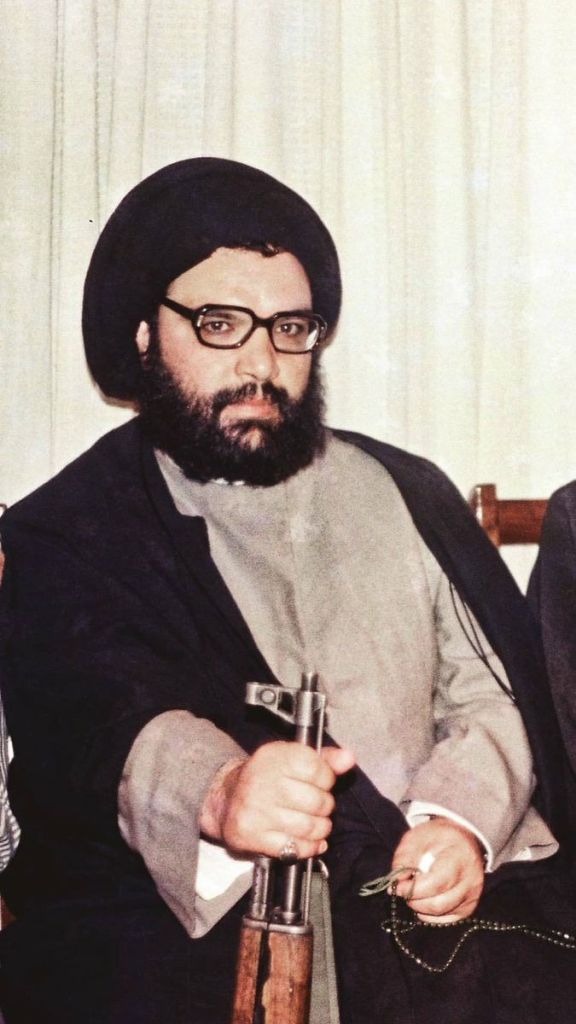
Hezbollah Secretary-General Martyr Sayyed Abbas Mussawi -
Gaza civil defence says zion*st fire kills 93 aid seekers
Gaza’s civil defence agency said zion*st occupation forces opened fire on crowds of Palestinians trying to collect humanitarian aid in the war-torn Palestinian territory on Sunday, killing 93 people and wounding dozens more. Eighty were killed as truckloads of aid arrived in the north, while nine others were reported shot near an aid point close to Rafah in the south, where dozens of people lost their lives just 24 hours earlier.
France24 report with video

I’m a Genocide Scholar. I Know It When I See It. NYT report -
Jolani’s HTS terrorists have attacked Sweida, and the impending worst-case scenario
Reports of large gatherings of HTS-BACKED Sunni tribal fighters in Al-Bustan, Dama, and Najran villages, in apparent preparation for storming nearby villages in Al-Suwayda countryside.
Heavy clashes broke out between HTS-BACKED tribal fighters and Druze gunmen in Areeqa and Um Al-Zaytoun towns on the Damascus–Al-Suwayda road, as HTS-BACKED Sunni tribal groups committed violations, burning houses. The clashes cut off the Dama–Areeqa and Najran–Areeqa roads, raising the ongoing tension in the area.Internal Security Forces [Jolani’s Hay’at Tahrir al-Sham terrorists] failed to prevent tribal gunmen from advancing into Al-Suwayda villages in violation of the agreement.
Civilian appeals immediate action to prevent the collapse of the ceasefire deal, and implementing the agreement.Meanwhile in Rif Dimashq Province: unidentified group bombed and sabotaged the Sheikh Abdullah shrine in Beit Jin, in Jabal Al-Sheikh area of Rif Dimashq, in a new attack on Druze religious sanctities amid rising tensions in Al-Suwayda.
The Sheikh Abdullah shrine is one of the most prominent historic religious sites for the Druze community in Syria and Lebanon, holding great spiritual significance as it belongs to a known Sufi figure in the region. It had long been a shrine for regular religious visits over decades, but has suffered neglect in recent years due to the ongoing conflict in Syria.
SOHR reports
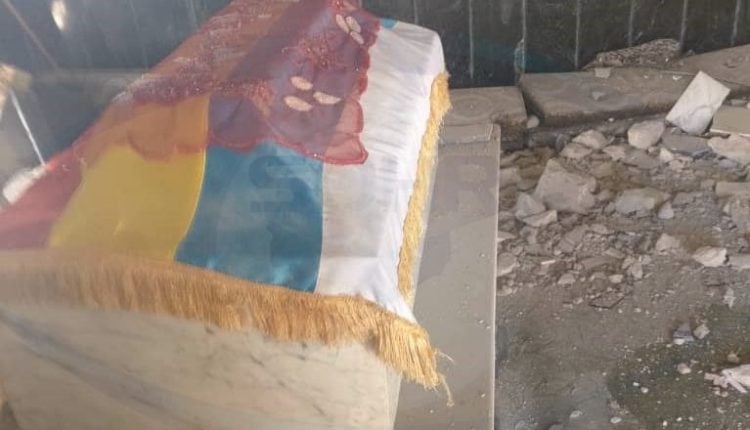
Rif Dimashq Province: unidentified group bombed and sabotaged the Sheikh Abdullah shrine in Beit Jin, in Jabal Al-Sheikh area of Rif Dimashq, Sweida. Syrian government [Jolani’s Hay’at Tahrir al-Sham terrorists] buses have entered the city of Suwayda to evacuate 1,500 people from Bedouin tribes. (SANA)
An indicator for an impending total annihilation of the Druze community in Sweida.
-
Lebanon: zionist Arch Enemy Proceeds Ceasefire Violations
zion*st enemy drone had dropped at dawn on Sunday a bomb targeting a stone factory in the area between Yaroun and Maroun Al-Ras border towns. The bomb caused damage in the area, according to Al Manar correspondent.
Also, in Yaroun, zionist occupation forces dropped provocative leaflets aimed at intimidating Lebanese citizens, AL-Manar correspondent and National News Agency reported.Another zionist strike was reported in Al-Mahafer area in the vicinity of the border town of Aytaroun.
Meanwhile on Sunday, the Lebanese Army rescued three missing fishermen after two zionist gunboats approached their boat inside the Lebanese territorial waters.
Furthermore, zionist artillery shelled the Lebanese border town of Alma Al-Shaab.
Earlier on Saturday, two Lebanese citizens were martyred in two zionist drones strikes on Yohmor Al-Shaqif and Al-Khiam southern towns.
The zionist enemy continues to bomb southern Lebanon almost daily and maintains occupation over five posts along the southern border, in violation of a ceasefire deal reached following a brutal 66-day zionist war between September and November 2024.
The zionist occupation has also struck Beirut four times since the ceasefire agreement was sealed on November 27, 2024.
Source: Al-Manar English Website
Damage left by zionist drone attack that targeted a stone factory near the Lebanese border of Yaroun (July 20, 2025). -
Lebanon’s BDL Directive against Al-Qard Al-Hasan part of US pressure on Hezbollah domestic front
US-BACKED zion*st war on loan/interest-free Islamic banking to hurt the most in need.
Banque du Liban (BDL) has issued a directive earlier last week prohibiting banks and financial institutions from engaging with what it terms “unlicensed exchange houses or unlicensed associations and bodies.” The directive specifies several entities under this designation, including: Al-Qard Al-Hassan Association, Cedars Inter S.A.L., Al-Moyassar Finance and Investment Company, Bayt Mal Al-Muslimin, and others that appear on international sanctions lists.
This decision comes against the backdrop of heightened US pressure on the Islamic Resistance of Hezbollah, Al-Akhbar’s Yehya Dbouq reported on Saturday.
The directive has stirred debate over its actual repercussions: Is it truly a financial blow to the party, as Western sources assert? Or is it a blow to Lebanon’s impoverished citizens, who depend on these institutions in their daily lives?
Double Standards
The associations and companies listed in the decision—such as Al-Qard Al-Hassan—offer interest-free financial and economic services, manage gold and jewelry deposits, finance small businesses, and support education and medical care. These are legally registered organizations in Lebanon that have been operating for decades. Their operations rely on local donations and deposits of gold and jewelry to secure loans, rather than on international transfers or for-profit activities. Comparable institutions in other countries are regarded as development organizations.
Indeed, similar charitable and financial structures exist throughout the Islamic world: The Zakat House in Kuwait, the Khedmat Foundation in Pakistan, zakat associations in Indonesia, and microfinance institutions in Egypt and Sudan. The primary distinction lies in the Lebanese political context. In Lebanon, any institution operating in areas associated with Hezbollah is subject to suspicion, while their counterparts abroad are considered legitimate developmental actors.Accusations Without Evidence
Despite persistent accusations from US and Zionist officials, no definitive evidence has been presented proving that these institutions fund Hezbollah or its military operations. In fact, there is no documented connection between them and the alleged financing activities. Rather than benefiting Hezbollah financially, these institutions often represent a financial liability, particularly when borrowers default—costs the party may ultimately bear.
These accusations also serve to legitimize the Israeli targeting of Al-Qard Al-Hassan’s multiple franchises spread around the whole breadth of Lebanon during the last Zionist land operation of the country that ended in failure. 11 Lebanese citizens who work at these franchises as civilian clerks and managers were martyred in these attacks as they were simply doing their duty to defend their community.
Thus, this move appears to fit squarely within a broader campaign of Western and Israeli pressure, aimed at enlisting the Lebanese state in efforts to weaken Hezbollah’s social and financial infrastructure. While the direct financial damage to the party may be symbolic, the strategy seeks to isolate it from its support base, erode its image as a provider of genuine social services, and paint it as incapable of protecting the institutions within its orbit.
The broader implications of the decision reveal an undeclared war on the social fabric that the Islamic Resistance of Hezbollah have built together with their community over the decades. The primary victims will not be the party’s financiers, but Lebanon’s vulnerable communities who depend on these institutions for financial assistance, education, healthcare, and more—services that remain unparalleled elsewhere in the country.
What is even more alarming is that this measure could signal the beginning of a wider, more damaging campaign—not limited to financial entities, but potentially targeting a vast array of economic, social, educational, charitable, and even sports organizations operating in resistance-affiliated areas.
This is not merely a financial decision. It is a precursor to a possible escalation whose consequences could deeply affect the daily lives of large swaths of the Lebanese population, sparking unpredictable reactions and further destabilizing Lebanon’s already fragile internal landscape.
Source: Al-Akhbar Lebanese Newspaper (translated by Al-Manar English staff)
One of Al-Qard Al-Hasan Association’s branches in Beirut (image form archive). -
Internet, communication cut off in Sweida, as Jolani’s HTS patrolling in the outskirts
The Druze Spiritual Leadership in Syria announced a prisoner swap with the government tonight, demanding an immediate end to military attacks and withdrawal of Syrian forces [Jolani’s Hay’at Tahrir al-Sham terrorists] from Sweida.
It has also been reported that the internet and communications have been cut off in Sweida, likely by Jolani’s Hay’at Tahrir al-Sham terrorists.
At present, the Druze community maintains control over Sweida.
However, Jolani’s thugs are in the outskirts and might invade at any moment.
This is only the calm before the storm.
Jolani’s Hay’at Tahrir al-Sham terrorists is not willing to allow power sharing or regional authority in any part of Syria.
The dictator is willing to concede to Netanyahu only.
Since Sunday, July 13, the death toll due to the clashes, executions and zionist airstrikes has risen to 1,017 people,
including 18 Bedouin fighting tribesmen.Three members of Bedouin tribes, including a woman and a child, were executed by Druze militants.
The small number of dead Bedouins is a stark indicator that this war is not between the Bedouin and the Druze, and the war is far from over.
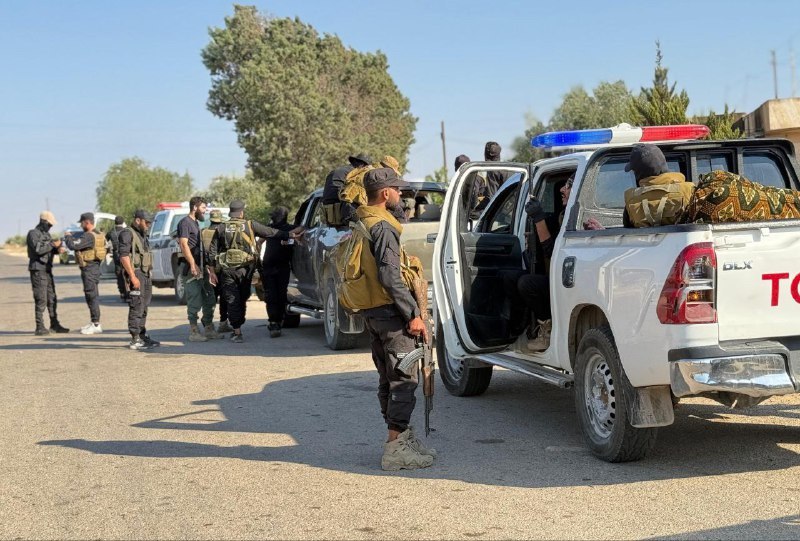
Jolani’s Hay’at Tahrir al-Sham terrorists deployed on the outskirts of Sweida province (SANA) -
Engaged in Druze massacres, Jolani refuses the release of Alawite genocide investigation findings
Jolani of HTS received the full report on the bloodshed from the fact-finding committee on July 13, the statement from the presidency says — the same day sectarian violence erupted in the heavily Druze province of Sweida.
He asked the committee to hold a press conference to present its findings as soon as possible “if it seems appropriate,” the presidency adds, without releasing any details of the report.
It is unclear when, or if, the findings will be released.
In March, on Syria’s Alawite coast, gunmen stormed homes and asked residents whether they were Alawite or Sunni before killing or sparing them, according to testimonies documented by survivors, rights groups and international organizations.
Entire families — including women, children and the elderly — were killed, with some of the violence recorded on video as victims in civilian clothing were executed.The Syrian Observatory for Human Rights monitor reported at the time that the government forces and allied groups committed massacres, killing more than 1,700 civilians, mostly Alawites.
AFP via ToI report
In March 2025, Jolani’s Hay’at Tahrir al-Sham terrorists murdered over 1700 members of the Alawite community in the Syrian coast. 
-
Subscribe
Subscribed
Already have a WordPress.com account? Log in now.
 Nascent Yemen