-
zion¿st Enemy Continues Attacks on South Lebanon: Martyrs Reported
Al-Manar correspondent reported that zion¿st colony drones targeted the area between the towns of Kfardounine and Khirbet Selm in Southern Lebanon. Lebanese health ministry indicated in a later statement that the attack left two martyrs.
Al-Manar Correspondent reported one injury in a cluster bomb explosion left by the zion¿st enemy in Al-Mari town, South Lebanon.
Al-Manar Correspondent reported also that Israeli gliders dropped two stun grenades on Boustra Farm, South Lebanon.
zion¿st enemy struck and destroyed a building in an industrial zone in the southern Lebanese city of Sidon early on Tuesday, causing injuries and severe damage to the area.
Destruction at Sidon industrial zone after zionist strike (January 6 / image by National News Agency).
Source: Al-Manar English Website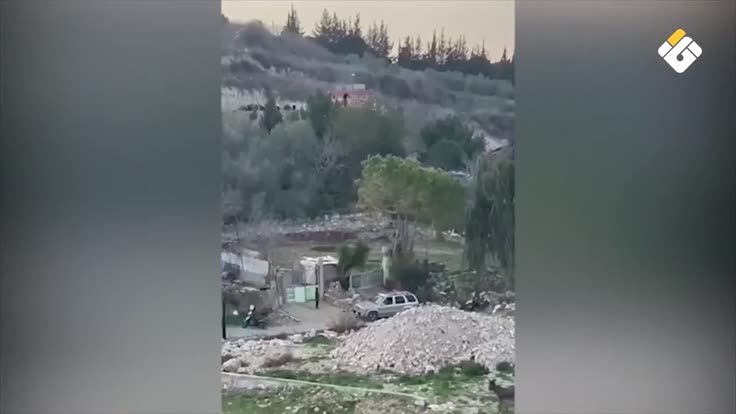
-
From Iraq to Venezuela: Recycled Justifications, Same Strategy
When Donald Trump declares,
“Nobody can stop us,” he is not issuing a threat alone—he is articulating the end of restraint as a governing principle of US power. What once required elaborate justifications, fabricated intelligence, and multilateral cover is now asserted openly: force creates legality, resources validate intervention, and sovereignty survives only at Washington’s discretion.
The significance of Trump’s posture toward Venezuela lies not in its novelty, but in its bluntness. Iraq in 2003 was wrapped in false intelligence and diplomatic theater. Venezuela today is framed through criminality, drugs, and economic “mismanagement,” with no serious attempt to invoke international consensus. The transition is revealing. It suggests that the United States no longer feels compelled to persuade the world—only to act.
This is not a departure from US strategy. It is its logical evolution.
From WMDs to Narco-States: The Recycling of Pretexts
The invasion of Iraq rested on the claim that Baghdad possessed weapons of mass destruction—an allegation later disproven and acknowledged as false. Yet the exposure of that lie did not delegitimize the war in institutional terms. No senior architects were held accountable, and no doctrine was abandoned. The lesson absorbed in Washington was not that deception fails, but that it carries no cost.
In Venezuela, the pretext has shifted from weapons to criminality. The language of “narco-terrorism,” cartels, and state collapse now performs the same function WMDs once did: transforming a political and economic target into a security threat. By branding the Venezuelan state itself as criminal, the United States manufactures a justification for extraordinary measures while bypassing international law.
This tactic has precedent. The so-called War on Drugs has long served as an intervention framework in Latin America, enabling US military presence, intelligence penetration, and political pressure against governments deemed insufficiently compliant. This persists despite extensive evidence that drug consumption, money laundering, and arms trafficking are overwhelmingly centered within the United States. The contradiction is not accidental—it is foundational.Oil and Independence: The Structural Motive
In a 2009 interview, Hugo Chávez rejected claims that his warnings about US hostility were paranoid. He grounded them in material reality: Venezuela possesses some of the world’s largest proven oil reserves, while US long-term energy security remains structurally dependent on external supply.Chávez’s argument echoed a broader Latin American experience. From the overthrow of Jacobo Árbenz following land reform in Guatemala, to the coup against Salvador Allende in Chile, to the removal of reformist governments across the region, US intervention consistently targeted states that pursued independent economic or political paths. Oil, land, and strategic geography—not ideology—were the constants.
Iraq followed the same logic. The collapse of the WMD narrative did not alter the strategic outcome: Iraqi oil was placed under a new political and economic order shaped by US power. Venezuela’s treatment fits squarely within this pattern. Independence, not failure, is the offense.
From Occupation to Extraction: The Iraq “Lesson” Reinterpreted
What distinguishes the Venezuelan case is not aggression, but efficiency. A recent segment on CBS News discussing Trump’s claim that the United States would “run Venezuela” after arresting its leader revealed a striking shift in imperial reasoning. Iraq was described as a failure not because it devastated a society or violated international law, but because it was costly.Senior US officials contrasted Iraq’s prolonged occupation—hundreds of billions of dollars, large troop deployments, unstable governance—with Venezuela as a potential model of “strategic action”: access to resources without long-term military exposure or political responsibility. The language was unambiguous. The objective was no longer regime change for democracy, but extraction without entanglement.
Even the cautious analysis offered by Samantha Vinograd did not challenge the core assumption that the United States has the authority to seize control of another country if it deems it strategically valuable. The discussion focused on feasibility and precedent, not legality. That silence signals a profound erosion of normative limits.
Empire Without Apology: Trump as the Unfiltered Expression
It would be misleading to attribute this trajectory solely to Trump’s personality. He is not the cause but the symptom. What makes his presidency distinctive is not intent, but articulation. He says plainly what previous administrations cloaked in humanitarian language and legal memos.
Trump’s warlord rhetoric—reducing geopolitics to loot, threats, and spectacle—reflects an empire that no longer invests in persuasion. Iraq demonstrated that falsehood incurs no penalty. Venezuela tests whether justification itself is now unnecessary. The shift from nation-building to asset stripping, from legitimacy to force, marks not confidence but decay.
When an empire declares that “nobody can stop us,” it is not announcing strength. It is acknowledging that the systems designed to restrain power have failed.
Venezuela, like Iraq before it, is not an exception. It is a test case. And history suggests that empires which abandon even the language of law eventually discover that power alone is a fragile foundation.
Source: Al-Manar English Website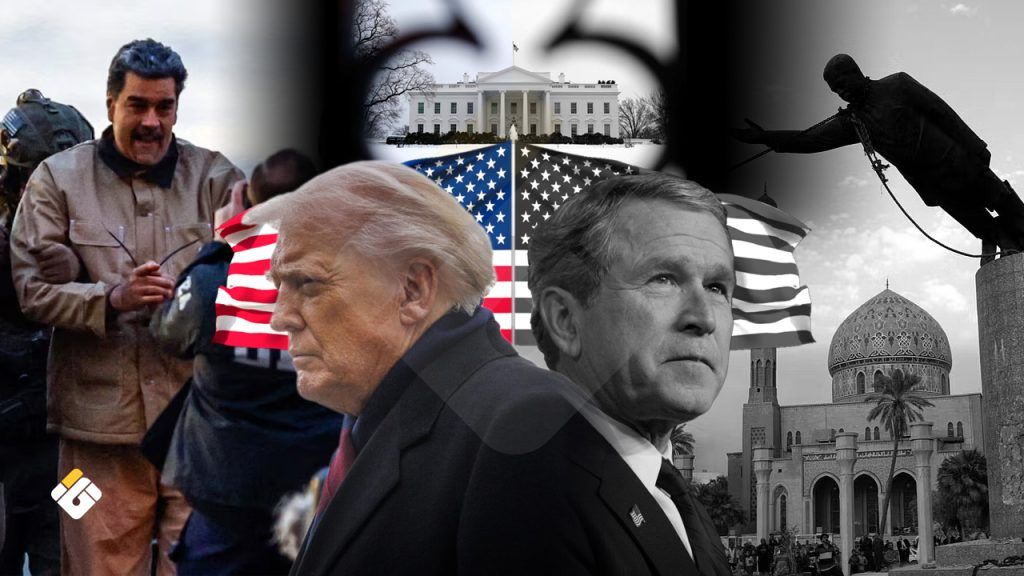
-
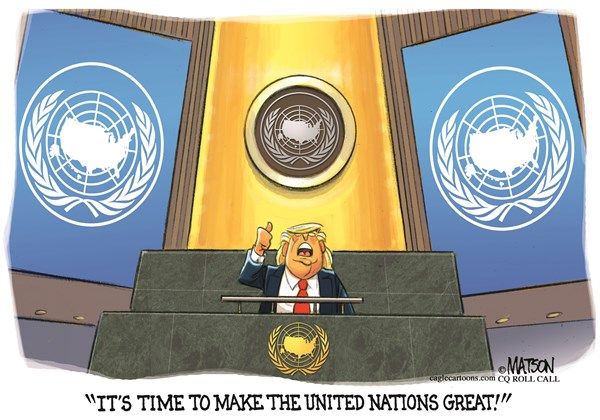
Remembering their job, UN says, US abduction of Maduro makes the world less safe, signals impunity
The United Nations human rights office has urged the international community to deliver a clear message that the recent US military operation in Venezuela, including the abduction of President Nicolás Maduro, has made the world “less safe.”
Ravina Shamdasani, chief spokeswoman for the Office of the UN High Commissioner for Human Rights (OHCHR), told reporters in Geneva on Tuesday that the US attack on Venezuela “undermined a fundamental principle of international law.”
“States must not threaten or use force against the territorial integrity or political independence of any state. The international community needs to come together with one voice to insist on that,” Shamdasani stated.
Far from being a victory for human rights, the military intervention damages the architecture of international security and makes every country less safe, she added.
The spokeswoman said that the brazen move by President Donald Trump’s administration in Venezuela “sends a signal that the powerful can do whatever they like.”
Shamdasani also echoed broader international concerns, adding that the future of Venezuela must be determined by its people alone.
Spokesperson for the UN High Commissioner for Human Rights, Volker Türk, also warned on Tuesday that the US raid on Venezuela “undermined a fundamental principle of international law.”
In a statement, the spokesperson said Türk, a career UN official and human rights lawyer, is “deeply worried” about the “situation in Venezuela.”In the early hours of Saturday, the United States attacked Venezuela’s largest military complex in the capital, Caracas, as well as strategic sites in the states of Miranda, Aragua, and La Guaira.
US forces also kidnapped Maduro and his wife, Cilia Flores, transferring them to the United States to stand trial on charges including “narco-terrorism, conspiracy, cocaine importation, and weapons trafficking.”
During an emergency meeting of the UN Security Council on Monday, the move was widely condemned as a “crime of aggression” by US adversaries and allies.
Maduro, who has long denied the allegations, told a court in New York on Monday that he is a prisoner of war and pleaded not guilty to the drug-related charges.
Trump has acknowledged that a core objective of the military action against Venezuela was to place the country’s oil sector under US control.
He has also threatened Venezuelan Vice President Delcy Rodríguez, saying she would “pay a very big price” if she failed to align with US interests.
Rodríguez, who has been sworn in as Venezuela’s interim leader, said “we are ready to defend our natural resources” and insisted that Maduro remains the legitimate head of Venezuela’s government.PressTV report
-
Adjusting the fake charges: US drops drug cartel claims against Maduro after invasion, kidnap
The fake Donald Trump’s daily exposition –
The US Justice Department has quietly scaled back its indictment of Venezuelan President Nicolás Maduro, retreating from a central Trump-era claim that he led a drug cartel.
The original accusation, included in a 2020 grand jury indictment, portrayed the Cartel de los Soles as an organized criminal group allegedly led by Maduro and engaged in large-scale cocaine trafficking.
The claim became a central pillar of Washington’s pressure campaign against Caracas and was repeatedly cited to justify escalating sanctions and military operations.
In July 2025, the US Treasury Department designated the so-called cartel as a terrorist organization, a move later backed by Secretary of State Marco Rubio and former National Security Adviser Robert C. O’Brien.
Yet specialists in Latin American crime and narcotics have long noted that the “Cartel de los Soles” is not a verifiable organization but a slang term coined by Venezuelan media in the 1990s to describe corruption among individual military officials — not a structured cartel.
That distinction is now reflected in the revised indictment, released after Maduro was kidnapped by US forces. While it still accuses him of participating in a drug-trafficking conspiracy, it drops the claim that the Cartel de los Soles exists as an actual cartel, redefining it instead as a “patronage system” and a “culture of corruption” allegedly fueled by drug profits.
Maduro and his wife were kidnapped from their residence in Caracas on Saturday, flown out of Venezuela by helicopter, and then transported aboard a warship some 3,400 kilometers to New York City to face federal charges.
The aggression capped months of pressure and military buildup off Venezuela’s coast, including dozens of attacks on alleged drug vessels that resulted in at least 115 deaths — operations Caracas has rejected as baseless.
Where the previous indictment referenced the Cartel de los Soles 32 times, the revised version mentions it only twice.
The revisions have prompted criticism of the Trump administration’s earlier designation of the group as a foreign terrorist organization.
Experts welcomed the clarification but noted that US designations do not require courtroom standards of proof, making them vulnerable to political use.
Despite the Justice Department’s retreat, Rubio continued to describe the Cartel de los Soles as an actual cartel during an NBC Meet the Press interview, claiming that US forces reserve the right to strike drug shipments linked to the group and that Maduro is its leader.
The Drug Enforcement Administration’s annual National Drug Threat Assessment and the United Nations’ World Drug Report have never listed Cartel de los Soles as an active trafficking organization.
Appearing in a New York federal court on Monday, Maduro pleaded not guilty. “I am innocent. I am not guilty of anything that is mentioned here,” he said, later describing himself as “a prisoner of war” and stressing that he remained Venezuela’s president.Caracas has consistently rejected any involvement in drug trafficking, maintaining that Washington used narcotics allegations to legitimize an illegal assault aimed at overthrowing the government and seizing control of the country’s vast oil reserves.
Hours after the attack, US President Donald Trump said the United States would run Venezuela temporarily and be “very strongly involved” in its oil industry — remarks that reinforced Venezuelan claims about Washington’s true objectives.
The revised indictment marks a notable pullback from the Trump administration’s earlier narrative, even as legal proceedings continue — leaving unresolved questions about how unproven drug allegations became the basis for military action and regime-change ambitions.PressTV report

A supporter of Venezuela’s President Nicolas Maduro carries his portrait during a rally outside the National Assembly in Caracas on January 5, 2026. (Photo by AFP) -
Imperialist Britain: Pro-International law only if it feeds Western greed and serves primitive interests
“We regarded Maduro as an illegitimate president and we shed no tears about the end of his regime,” Starmer said, but then – as might be expected from a former human rights lawyer – reiterated his support for international law.
The UK government has continued this approach since: say as little as possible that might offend Trump; leave it to the US to explain the legal justification for the move; and, in the words of one aide, “recognise that it’s not our fight”.
Labour’s political opponents on its progressive wing – the Lib Dems and the Greens – have piled pressure on the government to condemn the US action.The Guardian report

-
BBC Bars Use of ‘Kidnapping’ to Describe Maduro’s Midnapping
The British Broadcasting Corporation, which frequently lectures the world on “impartiality”, has sparked a wave of outrage after leaked internal guidance revealed an explicit order to its journalists not to call the illegal abduction of the Venezuelan President Nicholas Maduro a “kidnapping.”
The directive, sent by the BBC’s News Editor and circulated widely across social media platforms, demands that staff avoid the word “kidnapping” in favor of terms such as “seized” or “captured.”
This is while international law dictates that dragging a head of state out of their country by force without consent is a kidnapping.
By suppressing the word “kidnapping,” the broadcaster stands accused of pursuing impartiality and actively curating a reality that is palatable to the West.
British journalist Owen Jones shares internal BBC guidance on X instructing staff not to describe the seized Venezuelan leader as “kidnapped.”
The term “kidnapping” carries the weight of illegality and wrongdoing.
In contrast, “seized” sounds like a bureaucratic procedure, and “captured” attempts to legitimize the act by cloaking it in the language of formal warfare.
Critics argue that this is a classic example of “client journalism,” where publicly funded media outlets act as the PR arm of the military-industrial complex.
Other major Western mainstream outlets have also avoided using the term ‘kidnapping’ and stuck to ‘capture’ or ‘seizure’, among other words with positive connotations.
US papers held reporting on Kidnapping
Meantime, major American news outlets were informed of the Trump administration’s plan to bombard Venezuela and abduct its president ahead of the operation, but withheld their reporting on the operation to protect the military, according to the news site Semafor.
Both The New York Times and The Washington Post knew about the raid before President Donald Trump approved it on Friday night at 10:46 pm, Semafor reported over the weekend.
However, according to two people familiar with the administration’s communications with the outlets, they “held off publishing what they knew to avoid endangering U.S. troops.”
The report raises major questions about the media’s role in the operation, which has been widely condemned as an illegal and action by legal experts and foreign leaders.
Major news outlets in the US have a history of heeding the Pentagon orders on foreign policy matters.
As Semafor notes, The New York Times reportedly withheld a story about the disastrous Bay of Pigs operation in 1961 before the Cuban invasion at the behest of the Kennedy administration.
There are numerous other such examples. In the mid-2000s, the Times withheld a major report on the National Security Agency’s campaign of warrantless spying on American citizens, Stellar Wind, for a year at the Bush administration’s request.
After the Trump administration’s attack on Saturday, The Washington Post editorial board published an editorial celebrating the abduction, calling the operation that killed at least 80 people, including civilians, an “unquestionable tactical success.”Al Masirah report
-
Four Civilians Injured in Saudi Drone Strike on Yemen’s Sa’adah
Four civilians were injured on Monday in a Saudi drone strike targeting Yemen’s northern Sa’adah governorate, according to local media reports.
Almasirah net correspondents reported that the injuries occurred after Saudi enemy drones carried out an aerial attack on the border district of Shada. Earlier the same day, another civilian was wounded by Saudi gunfire near the Al-Raqo area in the border district of Munabbih.
The incident follows a similar attack last Saturday, when a civilian was injured by Saudi fire near the Munabbih border district, as part of what Yemeni sources describe as repeated Saudi assaults on populated border areas.
Border districts in Sa’adah province have repeatedly come under attack from Saudi forces, incidents that local officials say underscore a continued pattern of targeting unarmed civilians. These attacks, they add, have taken place amid what they describe as ongoing international silence regarding such violations.
Al Masirah report
A view of destruction after an attack by US warplanes on a shelter centre for African irregular migrants in the northern Yemeni city of Sadah on April 29, 2025 -
Trump and the American barbaric nature
It is not wise to allow this event [the kidnapping of President Maduro] to pass without a genuine evaluation session on the state of international law following the series of violations committed by America and the zionist entity around the world.
This “success” in testing the world’s capacity to confront such thuggery will only embolden the zionist enemy to further violate the Arab region, as it represents the other face of American zionism.
It is now possible to exploit the global rejection of what happened in Venezuela to demand a review of the behavior of the “American devil” and to hold it accountable for its transgressions before an international court.
There is no doubt that the international community today faces a historic responsibility. The unrestrained American beast is wreaking havoc on global stability, resorting to illicit gain through theft by force and the invasion of sovereign states. The deranged Trump does not care whether others accept the justifications for his actions—not necessarily because of his strength, but rather due to the state of “cowardice” that the world has adopted.
Meanwhile, no international summit or UN Security Council meeting appears to hold any value or utility, so long as such gatherings amount to nothing more than reviewing events and debating terminology, without resulting in any action that restores matters by imposing the necessary punishment on the head of evil.
Since the “veto council” has never once taken action against America—which has filled human history with crimes—it is only natural for this rogue state to become entrenched in the belief that it is greater than the world and free to do as it pleases.
In the operation to storm Venezuela, the “carrot” offered by the United States to Caracas was safety from targeting in exchange for submission to U.S. directives. These included allowing the heavy crude oil Venezuela possesses to flow into U.S. territory and severing relations with countries Washington deems hostile, such as Russia, China, and North Korea. This represents blatant and irresponsible interference, underscoring the world’s urgent need—starting now—to consider how to deter this rogue state and establish boundaries that cannot be crossed.
The world has rejected the barbaric behavior in which the criminal Trump and his aides have taken pride. This same world possesses the capacity to exert pressure to force Washington to respect limits in the management of its foreign policy. Mere denunciation and condemnation achieve nothing when dealing with a rebellious state like America.Ansarollah.com.ye report
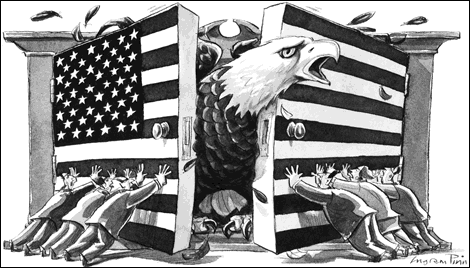
As and when, America goes through a period of introversion, such as folling the Vietnam war. For the sake of humanity, we must strive to lock this destructive power in dungeons never again to reappear.
Media by Financial Times -
Fascist Kingdom’s standing ovations for the kidnapping of Maduro; ready for sharing carcass [crude oil]
Statement by Ambassador James Kariuki, UK Chargé d’Affaires to the UN, at the UN Security Council meeting on Venezuela.
The United Kingdom wants to see a safe and peaceful transition to a legitimate government that reflects the will of the Venezuelan people: UK statement at the UN Security Council –
The Venezuelan people have suffered for years.
This Council now meets at a pivotal moment for Venezuela’s future.
Maduro’s actions created extreme levels of poverty, violent repression, and failing basic services.
His regime’s rule precipitated a displacement crisis affecting the whole region.
The United Kingdom has long been clear that Maduro’s claim to power was fraudulent.
To date, Venezuela’s National Electoral Council has failed to publish the full results of the July 2024 Presidential elections.
Independent domestic and international reports also observed significant irregularities and a lack of transparency.
President, the United Kingdom wants to see a safe and peaceful transition to a legitimate government that reflects the will of the Venezuelan people.
They deserve a government which reflects their vote at the ballot box, and delivers a more stable, prosperous future for all Venezuelans.
Finally, President, the United Kingdom reaffirms its commitment to international law and the principles enshrined in the Charter of the United Nations.
These foundations are essential for maintaining global peace, security, and the rule of law.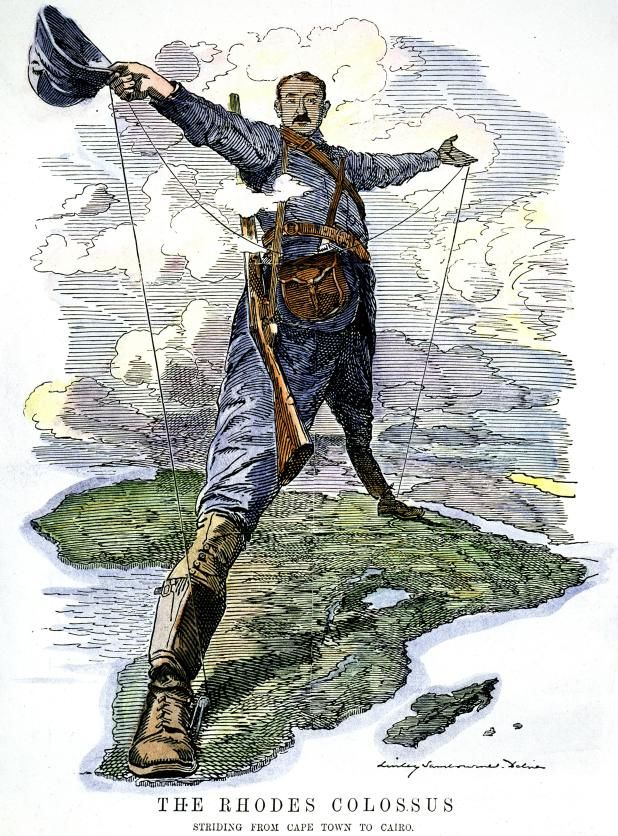
“The Face of Empire” coloured version of a cartoon depicting the colonizing dictatorial general Cecil Rhodes with one foot in Cairo and the other in Cape Town (c.1892) -
Trump’s Venezuela attack deepens Europe’s Greenland dilemma
— The EU’s tepid response to Donald Trump’s Venezuelan operation underscores how hard it is for Brussels to take a strong position on the U.S. president’s threats to take over Greenland.
The European Commission on Monday sought to draw a distinction between the U.S. capture of Venezuela’s leader Nicolás Maduro and Trump’s renewed rhetoric about taking control of the Arctic territory, but couldn’t say how it planned to deter the American from such a move.
“You would recall that Greenland is an ally to the U.S. and is also covered by the NATO alliance. And that is a big, big difference,” Commission chief spokesperson Paola Pinho told reporters. “So we therefore completely stand by Greenland and in no way do we see a possible comparison with what happened [in Venezuela].”Denmark’s Prime Minister Mette Frederiksen appeared to take Trump’s threats at face value, warning that such an attack would spell the end of NATO. “The American president should be taken seriously when he says he wants Greenland,” she said on Monday. “If the U.S. chooses to attack another NATO country militarily, then everything stops … including the security that has been established since the end of the second world war.”
Pressed repeatedly on what specific steps the EU could take to ward off Trump, the Commission demurred, saying only that it will “not stop defending” the principles of national sovereignty and territorial integrity — without clarifying how it planned to do that.
The Greenland quandary
World powers have in recent years sought to expand their Arctic footprints, and mineral-rich Greenland — which hosts a U.S. military base — is coveted for its strategic security and trade value.
While Greenland is a self-ruling territory of Denmark, it isn’t part of the EU itself, having left its precursor, the European Communities, in 1985. But Greenlanders are EU citizens because Denmark is in the bloc.
“We need Greenland for a national security situation,” Trump told reporters aboard Air Force One on Sunday. “It’s so strategic. Right now, Greenland is covered with Russian and Chinese ships all over the place.”
Russia has ramped up defense investments in the Arctic in recent years, while China has occasionally joined Moscow in joint patrols — though experts note that little military activity has taken place near Greenland itself.Greenland and Denmark have both repeatedly pushed back against Trump’s overtures, insisting that Greenland is not for sale and that its future is a question for its own citizens, not Washington, to decide.
“Enough is enough. No more pressure. No more insinuations. No more fantasies about annexation,” Greenland’s Premier Jens-Frederik Nielsen said on Monday.
As for Trump’s claim this weekend that the EU “needs” the U.S. to “have” Greenland, the Commission said this was “certainly not” the EU’s position.Yet the mildness of the response from Brussels illustrates the bind Europe finds itself in. Fearing potential retaliation from Trump on trade or Ukraine if he perceives harm to U.S. interests, the EU has mostly pulled its punches in responding to his saber-rattling.
NATO is also treading a fine line to avoid antagonizing the U.S. president. While many allies have so far brushed off an all-out Greenland incursion as implausible, Trump’s comments are beginning to stir anxiety — and defiance — within the alliance.
“We support Denmark fully — including their level of concern,” said one senior NATO diplomat, who was granted anonymity to speak freely.Others argue the remarks should galvanize allies to step up their defense capabilities in the Arctic — which could also placate Trump.
“Some creative thinking is in order … to strengthen the Alliance’s presence around Greenland and thus address U.S. security concerns,” said a second senior NATO diplomat, noting the organization could dispatch more military equipment to the region as it did last year in the Baltic Sea and on NATO’s eastern flank.
“If the head of state of an ally says that part of allied territory … has ‘Russian and Chinese ships all over the place,’ then that should be taken very seriously,” they added.
Yet Trump’s latest threat poses an “existential” challenge to NATO, said Ed Arnold, a senior fellow at the Royal United Services Institute think tank, given there is no precedent for one country launching an outright attack on another within the alliance since its 1949 founding.
In a worst-case scenario — a U.S. military incursion — Denmark could unilaterally summon allies for talks about threats to its security, he said, but would then be hamstrung as Washington blocks a military response.
That would almost “certainly … mean the end of NATO as we know it,” Arnold said.Politico report

The European Commission sought to draw a distinction between the U.S. capture of Venezuela’s leader Nicolás Maduro and Trump’s renewed rhetoric about taking control of the Arctic territory. | Joe Raedle/Getty Images
-
Subscribe
Subscribed
Already have a WordPress.com account? Log in now.
 Nascent Yemen