The United States today stands at the most dangerous juncture in its history— a crisis-ridden entity.
The “Debt Tsunami” …
U.S. debt—government, corporate, and household combined—has reached an astronomical $98 trillion, equivalent to four times the country’s gross domestic product.
At the beginning of 2026, mounting interest payments are said to have pushed federal debt to $38.4 trillion. More strikingly, is that the cost of servicing this debt—interest alone—exceeded $170 billion in the very first month of the fiscal year, consuming state revenues before any spending on citizens even begins.
Household insolvency is depicted through the condition of the average American citizen living “on the edge of the abyss,” burdened by consumer debt exceeding $5.1 trillion and credit-card debt surpassing $1.2 trillion. This pressure has turned the “American Dream” into a daily nightmare of rising prices, with housing costs increasing by 35.2 percent compared to pre-pandemic levels.
This situation has reached the peak of a financial chokehold from which the criminal Trump administration sees no escape except through a search for manufactured exits via trade wars that Trump inflated at the start of his presidency. These wars backfired domestically, raising commodity prices and striking the U.S. productive base. As a result, the administration is said to be seeking an “external enemy” to blame for this failure, from whose resources it can plunder enough to plug its deficit and halt the bleeding of its economy.U.S. debt—government, corporate, and household combined—has reached an astronomical $98 trillion, equivalent to four times the country’s gross domestic product.
At the beginning of 2026, mounting interest payments are said to have pushed federal debt to $38.4 trillion. More strikingly, is that the cost of servicing this debt—interest alone—exceeded $170 billion in the very first month of the fiscal year, consuming state revenues before any spending on citizens even begins.
Household insolvency is depicted through the condition of the average American citizen living “on the edge of the abyss,” burdened by consumer debt exceeding $5.1 trillion and credit-card debt surpassing $1.2 trillion. This pressure has turned the “American Dream” into a daily nightmare of rising prices, with housing costs increasing by 35.2 percent compared to pre-pandemic levels.
This situation has reached the peak of a financial chokehold from which the criminal Trump administration sees no escape except through a search for manufactured exits via trade wars that Trump inflated at the start of his presidency. These wars backfired domestically, raising commodity prices and striking the U.S. productive base. As a result, the administration is said to be seeking an “external enemy” to blame for this failure, from whose resources it can plunder enough to plug its deficit and halt the bleeding of its economy.
“Manufacturing the Enemy”… The Pierre Conesa Doctrine in the White House
Washington is openly adopting the mechanism of “enemy fabrication” outlined by French strategic expert Pierre Conesa. The objective is not to resolve the crisis, but to “nationalize internal anger” and redirect it toward an external adversary.
As the United States experiences what is characterized as unprecedented institutional paralysis and partisan division reaching the point of fragmentation, and with midterm elections approaching, the external enemy is transformed from an objective threat into a carefully manufactured and amplified political tool. This tool is designed to frighten and distract internal discontent, diverting its consequences away from decision-making centers in Washington and toward fabricated external foes.
The political paralysis is intensifying amid a decline in presidential approval ratings to 36 percent, divisions within the Republican Party, and a confrontation between the White House and the “deep state” (the Pentagon and intelligence agencies). With few options remaining, the president is resorting to the creation of crises to unify a fractured domestic front—what observers describe as a geopolitical escape through the revival of an old American legacy that turns enemies (Russia, China, Venezuela, Iran) into political instruments. These adversaries are inflated when needed to justify economic failure and to pass massive military budgets at the expense of social welfare.
The Map of “Strategic Plunder”… Why These Targets in Particular?
The “American behemoth” does not target countries based on democratic standards, freedom slogans, or other propaganda traditionally used to conceal conspiracies. This time, Washington is openly declaring its intention to fill its coffers through a form of international plunder disguised as sanctions—laying the groundwork, according to American desire driven by resource hunger, for destroying the remainder of the current international order and imposing a new system enforced by brute force.
Venezuela (Energy Piracy): The abduction of President Nicolás Maduro and dealings with Venezuelan oil reserves—estimated at 303 billion barrels—a stark example of efforts to compensate for U.S. resource shortages by looting the wealth of nations.
Ukraine (A Minerals Warehouse): Beyond freedom slogans, Washington is described as chasing 500,000 tons of lithium and 20 percent of Europe’s titanium reserves located in Ukraine, to be used as fuel for its faltering military industries.
Greenland and Panama: Attempts to “purchase” or control Greenland reflect fear of Russian-Chinese superiority in the Arctic, while the Panama Canal—through which 6 percent of global trade passes—remains under American pressure to secure supply chains.
Iran, meanwhile, stands as a particular target due to the exemplary nature of its Islamic system and its central energy and geographic position. The systematic targeting of Tehran is not about its nuclear program so much as it is a pretext, with Iran representing a cornerstone along China’s Silk Road and a controller of 30 percent of global oil trade through the Strait of Hormuz.
“Quiet Pressure”… The Colonization of Lithium and Cobalt
Washington recognizes that its industrial future is threatened by China’s control over 90 percent of rare-earth minerals. As a result, it has shifted to arenas of “quiet pressure” in the lithium triangle of Bolivia and Chile, waging intelligence and economic wars to control 60 percent of global lithium reserves.
In the Congo and Nigeria, an escalating struggle is taking shape to wrest cobalt and African oil from Chinese partnerships—even if this leads to destabilizing the entire African continent. From the perspective attributed to White House policymakers, such consequences are acceptable so long as the American side ultimately secures its share.
An Empire of Fear and the Inevitability of Decline
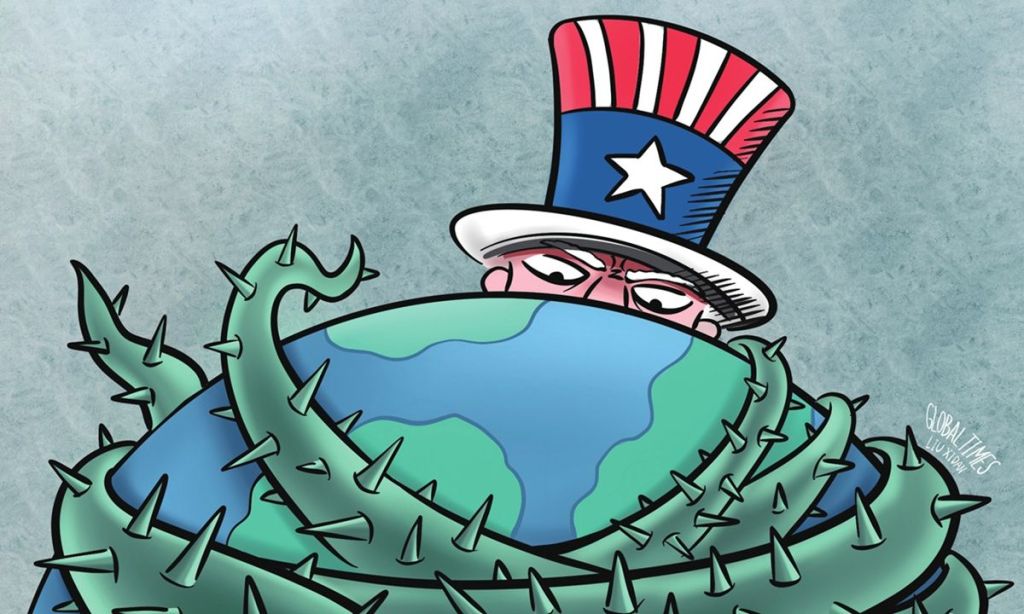
What Washington is practicing today is not a “policy of strength” but a “policy of strategic panic.” Every aircraft that takes off, every missile launched, every sanction imposed, and every coup engineered abroad is an attempt by American imperialism to buy additional time before the cauldron of debt and social division explodes in Washington.
Although historical experience confirms that exporting crises does not solve them but rather compounds the cost of collapse, the United States is insisting on one final gamble. It is breaking international laws it once established, tearing apart the slogans it promoted and fought wars to impose, losing allies, and draining its resources in struggles to preserve its position and centrality. Washington is no longer managing the world—it is simply trying not to drown alone.
 Nascent Yemen
Leave a comment