“They took our oil rights. We had a lot of oil there. They threw our companies out. And we want it back.”
https://t.me/thecradlemedia/48234
The New U.S. Strategy (2025) and the Western Hemisphere
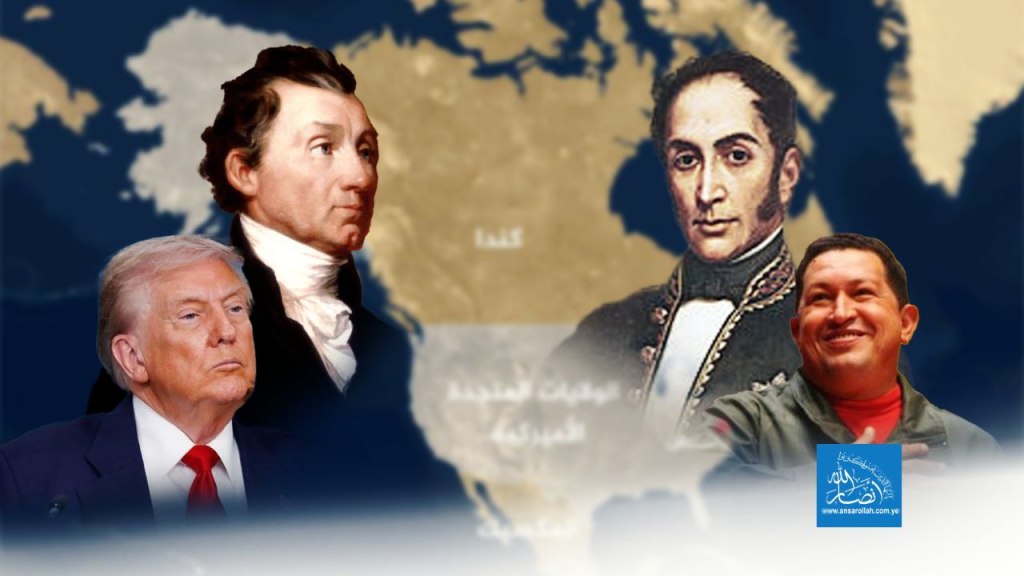
The Monroe Doctrine in Its Modern Form
The U.S. National Security Strategy for 2025, issued this month (December), reflects a clear return to the logic of the Monroe Doctrine, but in an updated form that transcends its traditional historical framework associated with rejecting European colonialism in the Western Hemisphere. In its contemporary version, the doctrine no longer appears as a declaration of regional protection, but as a colonial framework granting the United States practical authority to prevent any competing international presence in Latin America, particularly Chinese and Russian influence.
The Western Hemisphere is redefined in the document as a direct security domain, rather than a political space of sovereign states. Accordingly, any attempt by Latin American countries to diversify their economic or security partnerships beyond the U.S. orbit is interpreted in Washington as a structural threat rather than a legitimate sovereign choice. This shift does not represent a literal revival of the Monroe Doctrine, but rather its retooling within the conditions of contemporary international competition, where rivalry is no longer classical colonialism but competition over influence, supply chains, energy, and geo-strategic positions.
Venezuela as a Contemporary Model of U.S. Aggression
Sanctions as a Political Tool
Venezuela represents one of the clearest cases of economic sanctions being used as a central political instrument within U.S. interventionist behavior. Since tensions escalated between Washington and successive Venezuelan governments—particularly during the revolutionary presidency of Hugo Chávez (1999–2013)—sanctions have evolved from limited diplomatic pressure into a mechanism of structural coercion targeting both the economy and the state.
This policy became more explicit with the first official U.S. sanctions imposed in 2015 under the Obama administration, which designated Venezuela as an “extraordinary and unusual threat” to U.S. national security. Sanctions then expanded unprecedentedly during the Trump administration (2017–2021), especially after the re-election of President Nicolás Maduro in 2018.
These measures targeted vital sectors, foremost among them the oil industry through sanctions on PDVSA in 2019, as well as restrictions on the financial system and international transfers, severely limiting the state’s access to global markets and its ability to manage sovereign resources.
In this context, sanctions are not understood as direct responses to specific political practices, but as tools for reshaping the internal environment of the targeted state by weakening its capacity to fund public services, narrowing decision-makers’ room for maneuver, and generating social and economic pressures that can be politicized.
This extended use of sanctions from Chávez to Maduro demonstrates their transformation from a temporary pressure tool into a functional substitute for direct military intervention, enabling the United States to pursue political and strategic objectives without bearing the costs of conventional war, while maintaining a high level of influence over Venezuela’s internal trajectory.
The Caribbean as a Strategic Space
Venezuela’s place in U.S. strategy cannot be understood without considering the geo-strategic importance of the Caribbean Sea, a central hub for trade and energy routes and a direct extension of “U.S. maritime security.” Venezuela’s location within this space, combined with its vast oil reserves, makes it a sensitive element in the equation of maritime and economic control in the Western Hemisphere.
This awareness has translated into intensified U.S. military presence in the Caribbean, expanded maritime surveillance, repeated threats of military action against Venezuela, and violations of its sovereignty aimed at plundering its oil wealth under the guise of combating smuggling and organized crime. These actions exceed their stated security rationale, serving instead a deterrent function designed to prevent Venezuela from becoming an anchor point for rival international powers within the U.S. vital sphere. Thus, the Caribbean emerges as a theater for managing power struggles, not a neutral geographic space.
Oil Rentier Economy and U.S. Policy
The Venezuelan model reveals a complex interaction between the rentier structure of the economy and external pressure. Heavy dependence on oil revenues made the economy more vulnerable to suffocation once those revenues were targeted by sanctions and blockade, intending to destabilize the internal situation, fracturing the state and society from within, and preparing conditions for invasion, regime change through coups, or pressure to remove the president and force new elections. In this sense, sanctions resemble mechanisms used against Iraq and Syria through the Caesar Act.
Venezuela attempted to counter this situation by seeking alternative trade and financing networks outside the Western system, including expanding relations with China, Russia, and Iran. While these options provided limited maneuvering space, they did not eliminate the structural fragility of the economy, leaving the state under dual pressure: internal pressure arising from structural imbalances and external pressure resulting from constraints on integration into the global economy.
This reality demonstrates that interventionist behavior does not operate in a vacuum, but exploits structural weaknesses within targeted economies, transforming them into amplified pressure tools and reproducing dependency in new forms, even amid rhetoric opposing it. Oil itself remains a Venezuelan national resource targeted by the United States, which seeks to dominate and exploit it and bind the Venezuelan economy to the U.S. economy, as it does in Iraq, Syria, and Yemen through mercenaries who control oil-rich regions.
Venezuela Resists
Ultimately, the Venezuelan case reveals that sanctions, militarization, and economic pressure are not isolated tools, but integrated elements of a strategy aimed at subjugating the state, plundering its oil wealth, and breaking its political will. Yet this approach has not produced the surrender Washington anticipated. Instead, it has contributed to the formation of a renewed sovereign consciousness within Venezuelan society, which views these policies as a direct assault on the homeland rather than a mere political dispute with a particular government.
Over years of blockade, threats, and intervention, the Venezuelan people have demonstrated a clear capacity for resilience and resistance, along with a growing awareness that the struggle transcends the political system to encompass sovereignty, resources, and independent decision-making. In this context, Venezuela today—state and people—stands in an advanced defensive position, openly prepared to bear the cost of confrontation should U.S. pressure escalate from sanctions to military adventurism and direct aggression. It thus represents a contemporary model not only of U.S. policy aggression, but also of the will of peoples to resist hegemony and defend their homelands.
Ansarollah.com.ye report
 Nascent Yemen
Leave a comment