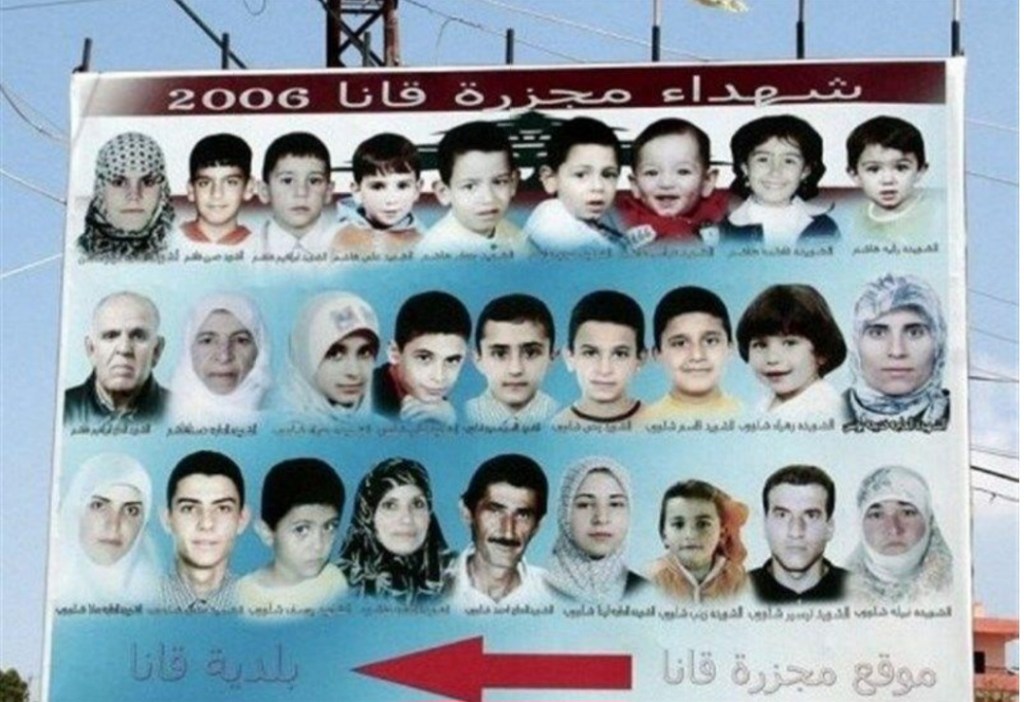
On July 30, 2006, at 1 a.m., zion*st forces struck the town again in the Second Qana Massacre, bombing a residential building [turned shelter] where 28 were killed, including 16 children and injuring several. Again, z*onist colony struggled to explain the massacre.
zion*st colony’s 2006 war on Lebanon was overall characterized by indiscriminate bombing campaigns and psychological warfare. zionist fighter jets dropped thousands of leaflets over Lebanon with insulting and threatening messages to civilians.
Mondoweiss report
Witness testimonials
According to Muhammad Mahmud Shalhub, a 61-year-old farmer who was in the basement during the attack, 63 members of the extended Shalhub and Hashim families sought shelter in three ground-floor rooms of a solid three-story building when the first bombs hit the village. zionist planes began attacking the area in the early evening of July 29, he said, striking more than 50 times. He explained how, around 1 a.m. on July 30, a zionist munition hit the ground floor of the home:
It felt like someone lifted the house. The ground floor of the house is 2.5 meters high. When the first strike hit, it hit below us and the whole house lifted, the rocket hit under the house. I was sitting by the door – it got very dusty and smoky – and we were all in shock. I was not injured and found myself [thrown] outside. There was a lot of screaming inside. When I tried to go back in, I couldn’t see because of the smoke. I started pushing people out; whomever I could find.
Five minutes later, another air strike came and hit the other side of the building, behind us. After the second strike, we could barely breathe and we couldn’t see anything. There were three rooms in the house where people were hiding [on the ground floor]. After the first strike, a lot of earth was pushed up into the rooms. We only managed to find some people in the first room.
Shalhub vigorously denied that any Hezbollah fighters were present in or around the home when the attack took place. All four roads to Qana village had been cut by zionist bombs, he said, which would have made it difficult, if not impossible, for Hezbollah to move rocket launchers into the village.
“If they [the IDF] really saw the rocket launcher, where did it go?” Shalhub said. “We showed Israel our dead; why don’t the Israelis show us the rocket launchers?”
Ghazi `Udaybi, another Qana villager who rushed to the house when it was hit at 1 a.m., gave an account consistent with Shalhub’s. He and others removed a number of people from the building after the first strike, he said, but they could remove no one else after the second strike hit five minutes later. “If Hezbollah was firing near the house, would a family of over 50 people just sit there?” he said to Human Rights Watch.
The Israeli government initially claimed that the military targeted the house because Hezbollah fighters had fired rockets from the area. Human Rights Watch researchers who visited Qana on July 31, the day after the attack, did not find any destroyed military equipment in or near the home. Similarly, none of the dozens of international journalists, rescue workers and international observers who visited Qana on July 30 and 31 reported seeing any evidence of Hezbollah military presence in or around the home. Rescue workers recovered no bodies of apparent Hezbollah fighters from inside or near the building.
The IDF subsequently changed its story, with one of Israel’s top military correspondents reporting on August 1 that, “It now appears that the military had no information on rockets launched from the site of the building, or the presence of Hezbollah men at the time.”
“Again and again, zionst forces have fired at dubious military targets with a high civilian cost,” Whitson said. “Their brazen behavior has costs hundreds of lives.”
HRW report
By
https://t.me/political_aya_tweetbank/53
 Nascent Yemen
Leave a comment