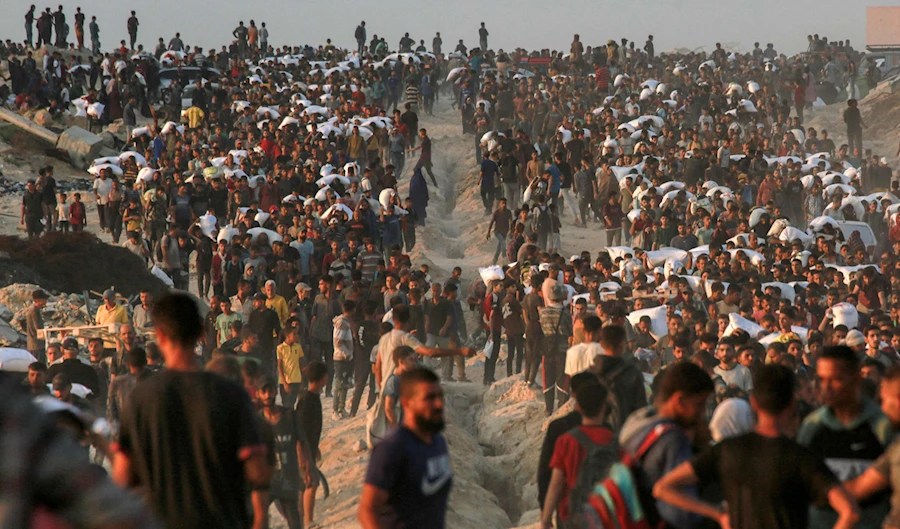
As the world’s attention shifted to the war between zion*st entity and Iran, the occupation has intensified its campaign of mass killings in Gaza, targeting starving civilians waiting for humanitarian aid. Over the past week, more than 90 Palestinians have been killed, many of them while simply queuing for food.
On Monday, Zionist forces carried out a brutal attack on thousands of displaced civilians waiting for aid in the al-Tahlia area of Khan Younis in southern Gaza. Eyewitnesses reported that artillery and drone strikes directly targeted the crowds, killing and wounding hundreds. The Ministry of Health confirmed at least 40 deaths and over 200 injuries. That same evening, similar attacks struck aid distribution points in the Nuseirat area and al-Sudaniyya, northwest of Gaza City, pushing the day’s death toll to at least 90.
Civil Defense Spokesman Mahmoud Basal
The zion*st occupation has been focusing since this morning on targeting displaced persons’ tents and gatherings of civilians specifically in Gaza City, where the number of martyrs in the city alone since dawn has exceeded 55, including children, women, and the elderly. More than 180 people have been injured, including critical cases.
Despite being locked in a high-stakes confrontation with Iran, Israel has maintained steady momentum in its genocidal war in Gaza. It has frozen evacuation maps and military redeployments across 75% of the strip, while continuing its slow-moving Gideon’s Chariots operation. Entire cities, including Rafah, Khan Younis and all three urban centers in North Gaza (Jabalia, Beit Lahia, Beit Hanoun) remain fully emptied of residents. Eastern neighborhoods, stretching from northern Jabalia to southern areas like Khuzaa, Bani Suheila, and Abasan are now classified as red, no-go areas due to heavy fighting.
Rather than a full-scale troop presence, the occupation maintains control of these zones through firepower, relying on quadcopters and drones. In Jabalia, where Israeli broadcaster KAN announced the return of the 162nd Division, evening hours are marked by intense detonations. According to local sources, the Israeli army has been planting explosive-laden robots among the densely packed residential blocks, detonating them at night. Bulldozers are also systematically destroying the city’s infrastructure.
A similar pattern plays out in Shujaiyya and Tuffah neighborhoods in eastern Gaza City, where vast areas have been leveled. The Israeli strategy appears aimed at sustaining a low-cost war effort until its broader regional priorities are resolved. Priorities that Tel Aviv believes will take only weeks to settle.
Meanwhile, Palestinian resistance factions have seized the opportunity to intensify their operations. With Israeli aircraft increasingly drawn to the northern front and Iranian skies, surveillance over Gaza has loosened, enabling dozens of fighters to return from frontline positions. These fighters have reported operations carried out in previous weeks that have not been publicized until now. The targets included tanks, infantry units, and buildings used by Israeli forces.
In the past 48 hours, Al-Qassam Brigades and Al-Quds Brigades claimed joint attacks on Israeli foot soldiers barricaded inside a home, hitting them with anti-personnel munitions and sniper fire. Fighters reported disabling a Merkava tank and an armored personnel carrier east of Jabalia using powerful explosive devices. On the same front, a tank on Sikka Street was also reportedly struck.
Al-Qassam’s military media revealed that fighters detonated a house packed with pre-planted explosives east of Abasan al-Kabira, killing and wounding soldiers inside. Al-Quds Brigades and other factions reported destroying two more APCs in the same region with Shewaz-type explosives. In another operation, fighters ambushed Israeli infantry in a house north of 5th Street in western Khan Younis using 107mm rockets and mortar fire.
Additional reports from returning al-Quds Brigades fighters described a powerful explosive device hitting an Israeli vehicle near al-Huda Mosque in al-Manara district of Khan Younis. In Shujaiyya, they lured an Israeli special forces unit into a deadly close-range battle. Footage released by al-Quds Brigades also showed an Israeli tank being blown up with a high-yield explosive.
This spike in resistance activity is directly tied to Israel’s shifting focus toward its escalating war with Iran. With Israeli air and ground forces redeployed to the northern border and the West Bank settlements, the resistance exploited gaps in surveillance and troop presence to increase its pressure campaign. As the regional conflict expands, the resistance in Gaza is using every opportunity to stretch Israeli forces thin, driving up the cost of occupation with relentless ambushes and sustained combat.
Al Akhbar report
 Nascent Yemen
Leave a comment