The Druze religious minority fears Sunni extremists in Syria’s HTS terrorist government will carry out massacres similar to those committed in March against Alawites in Syria’s coastal regionDruze residents near Damascus are rejecting demands by the Syrian government to hand in their light weapons, saying authorities have yet to address fears of new attacks by extremist Sunni armed factions.
The violence began last week after extremist Sunni factions affiliated with the Syrian government began attacking the Druze-controlled city of Jaramana and the town of Sahnaya, both located south of Damascus.
The attacks began following the spread of an audio recording on 27 April, allegedly from a Druze commander, insulting the Prophet Muhammad.
Some 100 people were killed in the fighting, including the Druze mayor of Sahnaya, who was executed by members of the government’s General Security forces after welcoming them into the town.
Syrian authorities have negotiated agreements with Druze leaders to allow their local fighters to protect their own areas as enlisted members of Syria’s security forces, known as General Security, but this week, they asked that all weapons held by residents of these areas be turned in to the state.
“We told them, as soon as there is a state capable of regulating its forces, we’ll have no problem handing in our weapons,” said Makram Obeid, a member of the Jaramana committee that is negotiating with the Syrian government.
Obeid told Reuters that his committee had advised government officials it would be better for them to focus on disarming the Sunni extremists in their own forces, who are now harassing minorities.
“It’s our right to be scared, because we saw what happened in other areas,” he expressed to Reuters.
In early March, Sunni Muslim extremists, including those affiliated with the Syrian government, descended on Syria’s coast to massacre more than 1,600 civilians from the Alawite minority on the basis of their religious identity.
“People want to feel safe. It’s enough to have (more than) 11 years of killing, strikes, and worries,” Obeid said. “And we’re coming to another phase that we thought, with the collapse of the regime, would leave us in a much better place. But until now, we don’t feel reassured.”
Fahad Haydar, a resident of Jaramana, also said Sunni extremist factions within the government forces should be disarmed.
“These weapons that are turned against us – that’s what we’re afraid of. If those weapons get handed in, then we’ll hand in ours,” he told Reuters.
Mowaffaq Abu Shash, a Druze cleric in Jaramana, said the Druze had already compromised enough.
“We take one step, they ask for a second. We take the second step, they ask for a third,” he said. “We ask for a guarantee that what happened on the coast will not happen to us.”
One influential Druze spiritual leader, Sheikh Hikmat al-Hajri, has called for international intervention to protect his community from Syria’s leaders, who are former members of Al-Qaeda.
The Druze, an Arab minority sect that practices a religion derived initially from Islam, live in Syria, Lebanon, Israel, and the Israeli-occupied Golan Heights.
The sectarian violence in Syria has opened the door for Israel to step up its military intervention in the country under the pretext of protecting the Druze community.
Israeli forces deployed to southern Syria on 3 May in the wake of the Sunni–Druze fighting, claiming they intended to protect the Druze.
“The IDF is deployed in southern Syria and is prepared to prevent the entry of hostile forces into the area of Druze villages,” a statement from the Israeli military spokesman said.
The deployment of ground forces followed a wave of Israeli air strikes on targets of Syria’s new military, which is led by Al-Qaeda in Syria founder and de facto President Ahmad al-Sharaa.
The Cradle Media report
None-with-standing the crimes against humanity, Jolani will be welcomed by the French President Emmanuel Macron for a state visit in France to strengthen economic ties.
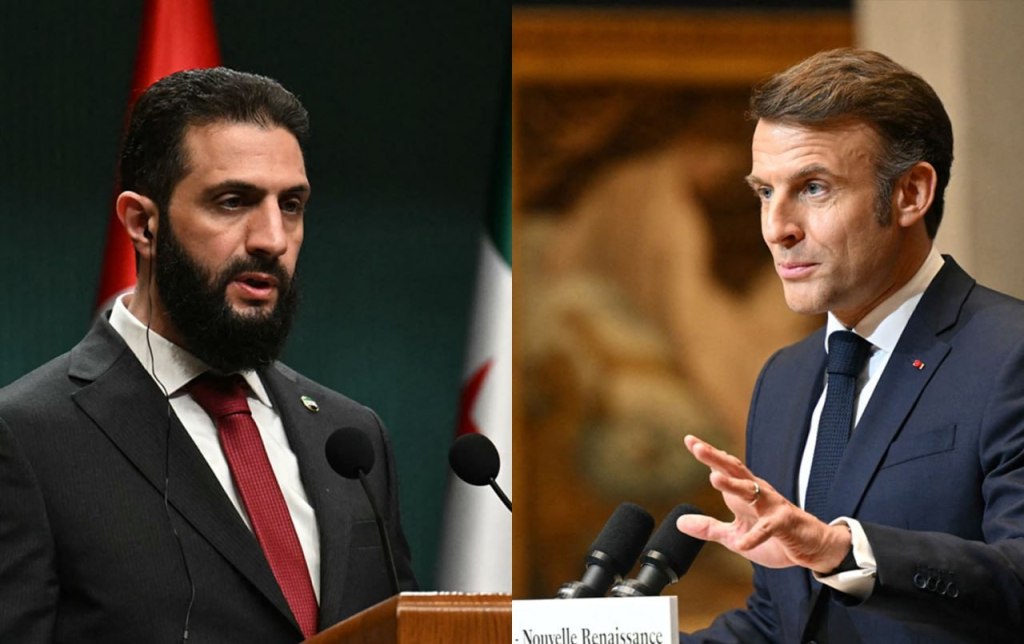
The visit signals France’s ongoing backing of efforts to reshape Syria under the banner of a “new, free, and stable” state. The Cradle Media
 Nascent Yemen
Leave a comment