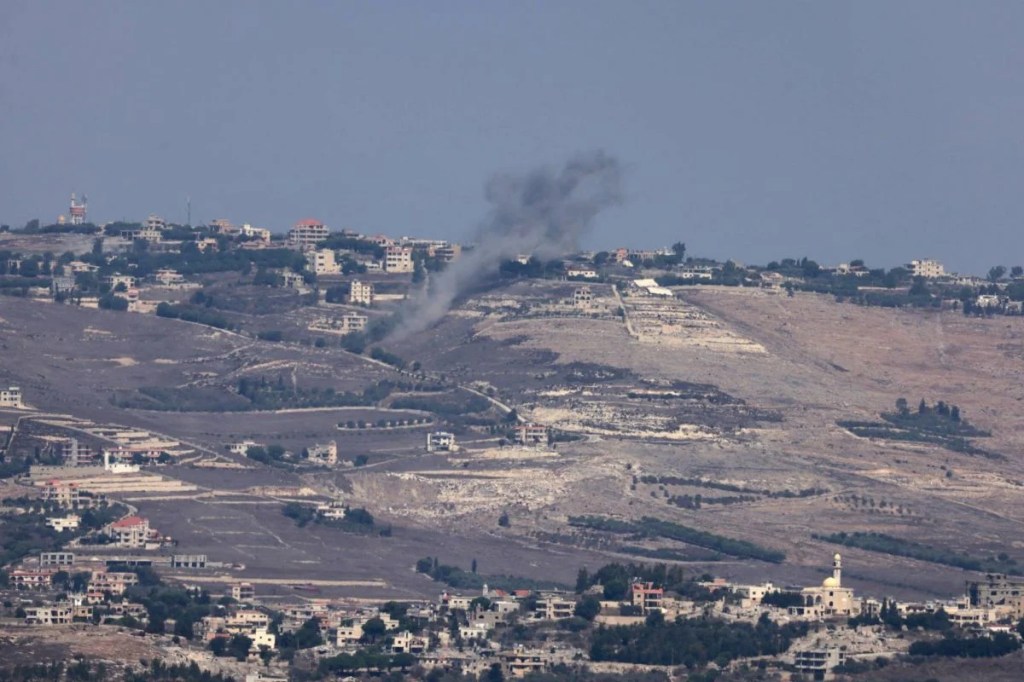
The Zionist colony has established a new military outpost in Jal al-Deir, a 3,000-square-meter area in Maroun al-Ras (Bint Jbeil District)—an area it previously occupied before South Lebanon’s liberation in 2000. The site lies between the town’s forest and the nearby villages of Malikiyah and Aitaroun, overlooking Maroun Plain—one of the town’s most fertile agricultural areas—preventing farmers from reaching their land, according to Mayor Adnan Alawieh. Its strategic location provides “Israel” with surveillance over key valleys, such as Saluqi and Hujayr Valleys, as well as roads leading to Beaufort Castle in the Nabatieh region.
Maroun al-Ras, the second-highest hill in Amel Mountain after Rayhan Hill, one of the seven occupied villages. Historically, the town was closely linked to Palestinian villages in the occupied Galilee, Ras al-Ahmar and Salha, through family ties and trade. “Maroun al-Ras was the gateway for the people of Galilee when they headed to the Thursday market in Bint Jbeil,” says retired teacher Hussein Alawieh. Before Zionist militias seized the region, many town residents worked in Haifa, Acre, and Safed. Despite the British-imposed border separating the seven villages from Lebanon, locals continued accessing their lands, holding ownership documents and obtaining British licenses to cultivate them. However, in the early 1960s, Israeli forces began seizing these lands, eventually annexing part of Maroun al-Ras’ territory to the northern section of the Avivim settlement.
The 1978 Israeli invasion forced most of the town’s residents to flee, with only a few staying after a fierce battle between the Lebanese National Movement and Israeli occupation forces. After the 2000 liberation, the displaced population returned, and the number of homes grew from 60 to around 600.
During the last Israeli war on Lebanon, Maroun al-Ras lost 55 residents. Apart from three buildings on its outskirts near Bint Jbeil, the town was entirely destroyed—its homes, three mosques, three husseiniyas, two public schools, the municipal building, two cultural centers, and a public park established by the Iranian Committee for the Reconstruction of Lebanon on 50,000 square meters were reduced to rubble. “Israel” also bulldozed roads and property boundaries, making it difficult to distinguish private and public lands. According to the mayor, thousands of ancient olive and oak trees were uprooted and stolen, and the destruction is so extensive that specialized engineering teams are needed to restore the town’s land and infrastructure.
 Nascent Yemen
Leave a comment