HRW calls for stronger international law on incendiary weapons.
Lebanon’s Ministry of Public Health said that, as of May 28, exposure to white phosphorus had injured at least 173 people since October.
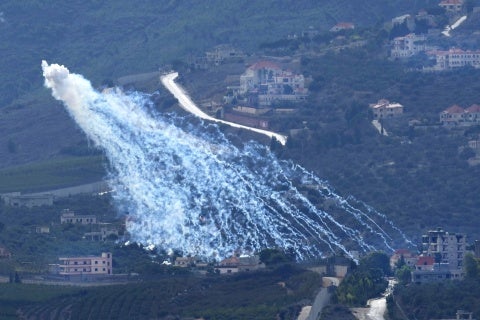
Israel’s widespread use of white phosphorus in south Lebanon is putting civilians at grave risk and contributing to civilian displacement, Human Rights Watch interviewed eight south Lebanon residents and verified and geolocated 47 photos and videos from south Lebanon posted on social media or shared directly with researchers indicating the use of white phosphorus munitions. In five municipalities, photos and videos show airburst munitions containing white phosphorus landing on top of residential buildings in the southern Lebanese border villages of Kafr Kila, Mays al-Jabal, Boustane, Markaba, and Aita al-Chaab.Israel’s widespread use of white phosphorus in south Lebanon highlights the need for stronger international law on incendiary weapons, Human Rights Watch said. Protocol III of the Convention on Conventional Weapons is the only legally binding instrument dedicated specifically to incendiary weapons. Lebanon is party to Protocol III, while Israel is not.
White phosphorus that contacts people can burn down to the bone. Fragments of white phosphorus can exacerbate wounds even after treatment and can enter the bloodstream and cause multiple organ failures. Already dressed wounds can reignite when dressings are removed and the wounds are reexposed to oxygen. Even relatively minor burns are often fatal. For survivors, extensive scarring tightens muscle tissue and creates physical disabilities. The trauma of the attack, the painful treatment that follows, and appearance-changing scars lead to psychological harm and social exclusion.
White phosphorus ignites when exposed to atmospheric oxygen and continues to burn until it is deprived of oxygen or is exhausted. Its chemical reaction can create intense heat (about 815°C/1,500°F), light, and smoke.
 Nascent Yemen
Leave a comment