The Saudi Arabia-led coalition declared the entire cities of Saada and Marran to be military targets. Without regard for civilian lives, the ensueing intense and indiscriminate bombing campaign lasted for several months.
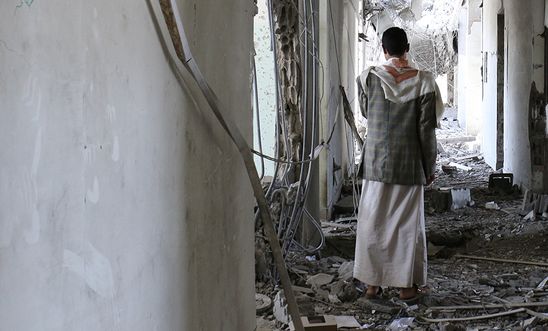
In the wake of the bombing frenzy, the Saudi Arabia-led coalition attacked residential houses, countless markets, food/wheat storages, schools, petrol stations, mosques, wells, and many other civilian infrastructure.
Human Rights Watch identified from a time series of satellite imagery 210 distinct impact locations in built-up areas of the city consistent with aerial bombardment as of May 19, 2015. The satellite imagery shows that these attacks damaged or destroyed hundreds of buildings.Impact craters and damage to buildings at some sites indicate that coalition forces on several occasions used aerial bombs of at least 1,000 pounds in attacks on the city. At a government building in Saada City, Human Rights Watch photographed the remnants of an MK-83 air-dropped 1,000-pound bomb made in the US.
The city of Sa’da has suffered more destruction from coalition airstrikes than any other city in the country.
Amnesty International researchers also found remnants of two types of cluster bombs, BLU-97 sub-munitions and their carrier (CBU-97) and the more sophisticated CBU-105 Sensor Fuzed Weapon. Cluster bombs, which are banned under international law, scatter scores of bomblets over a wide area. Many of the bomblets fail to explode upon impact, posing an ongoing deadly threat to anyone who comes into contact with them.
“Even though the city is noticeably emptier,
many people were not aware of the order of evacuation – it hasn’t been heard by the entire population. There is no electricity, no working telephones and yesterday there was a huge storm … we fear that everyone wasn’t aware of the ultimatum.
“The bombing has been quite intense, more than twenty bombs have hit different buildings in the city, which has already suffered a huge level of destruction in recent weeks. There have been reports of 140 bombs being dropped on the city in a single day.
“Even before the most recent conflict broke out in March 2015, Saada’s inhabitants were among the most vulnerable in the country. The governorate was already the scene of intense fighting during a succession of wars between the Houthis and the then-President Ali Abdallah Saleh’s armed forces between 2004 and 2010. President Saleh was assassinated in December 2017. Before 2015, extremely high levels of malnutrition and stunting had already been observed among children under the age of five in Saada governorate.”
Saada’s political, economical and developmental state must be seen within the context of a lasting central governmental neglect in conjuction with constant military attacks.
Lacking investments and subsidiaries from the Central government, Saada was not able to recover or make any developmental improvement.
This stagnation goes back to the aftermaths of the 1962 Revolution and overlaps with the six Saada wars fought between 2004-2011, with the involvement of multiple foreign powers.
 Nascent Yemen
Leave a comment