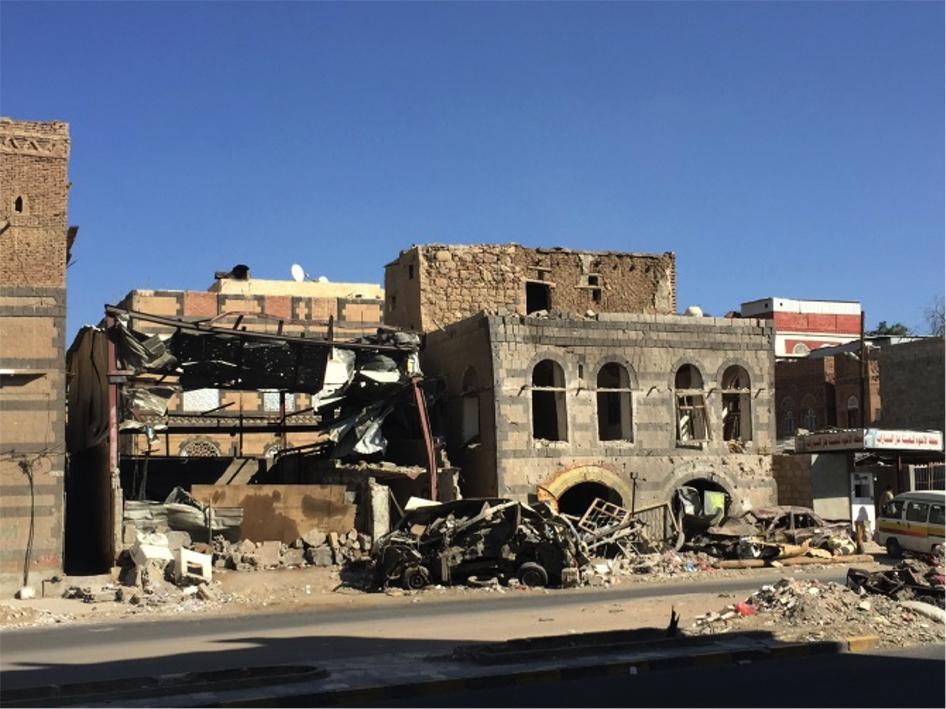
Marib Street, Sanaa//
Five civilians, including a woman and a child, were killed, and another eight were seriously wounded.
On September 18 2015, at about 10:30 p.m., coalition aircraft struck a brick house next to an unused iron lathe workshop. The airstrike damaged the house and destroyed the workshop, an aluminum-sheet roof over a metal frame. Earlier that evening, heavy strikes began on the Interior Ministry compound, a kilometer away. Ibrahim Ateeq al-Jihm and his brother Fayez left their house and, from a street corner in their neighborhood, watched as another strike hit a market, Souq Bathar, at a roundabout about a kilometer away.
Al-Jihm told Human Rights Watch:
[M]y brother shouted, “Let’s go home now! It’s not safe to stay here.” As we were walking home, I suddenly found myself flying in the air and then thrown to the ground. I was covered with stones and dust. There was smoke everywhere and I was covered in blood. I was having difficulty breathing as if someone was squeezing my chest tightly. I finally stood up and looked around me, trying to find my brother – he was lying next to me.
His brother was not hurt, but al-Jihm saw three other people lying on the ground nearby, covered in rubble. One, Walid Fadel Muhammad Thabet, was not moving. The other two – one of whom works in the iron workshop and the other at an aluminum workshop – were moaning and convulsing. The two brothers ran home to check on their family and found the cousin of one of the renters in the building badly wounded. They took him to the hospital.
Three witnesses said that this was the first airstrike in the area. Six days later, on September 24, coalition aircraft began bombing the Military Police headquarters, 350 meters from where the first strike hit. Within four days the coalition had carried out at least two dozen strikes on the headquarters.
 Nascent Yemen
Leave a comment