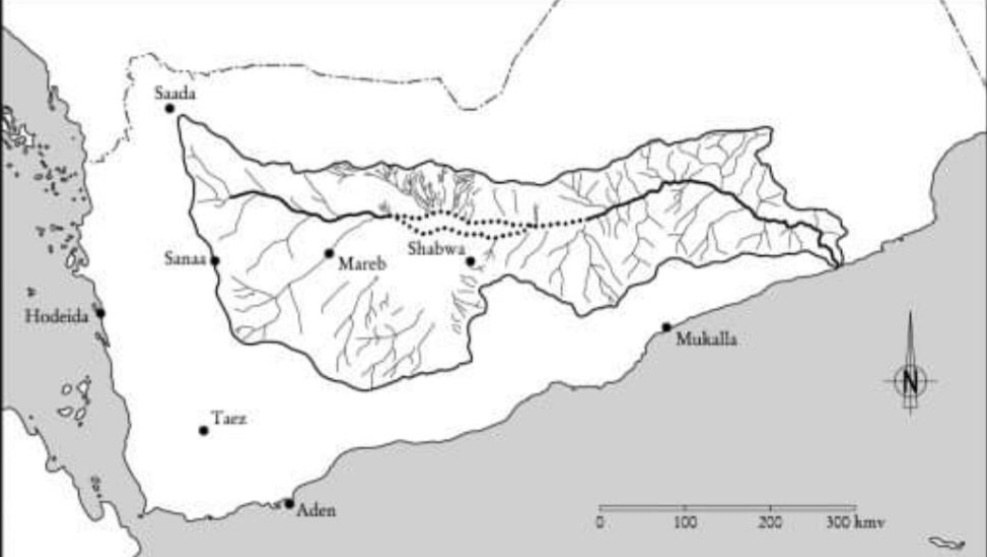
Water scarcity is a predicament widely shared among the Arab countries in the Middle East. With many Monarchies and few republics, several counties in the Middle East have no rivers gushing through their territory, except for Lebanon. Lacking deserts Lebanon benefits from its geologically ideal ‘goldilocks zone‘ position, giving rise to countless rivers, lakes, and waterfalls, making life abound. However, this post is not about the beguiling beauty of Lebanon. Rather, my intention is to spread the word about a river, which was once crossing through Yemen. Emerging from high up the mountains of Saada, with its countless deltas and tributaries, the River Al-Kharid was flowing east wards through Marib, Shabwah eventually connecting to and building a large estuary at the Arabian Sea between Hadramout and al Mahra. However, this fairytale-like sounding annectode of a lifeline concludes with the sober reality that the river dried out centuries ago due to a combination of prolonged periods of droughts and seasonal scarce rainfalls.
On the other hand, scientists emphasise the return of the River Al-Kharid, which was once flowing through Yemen like a vein of fertility. Hypothetically scientists and geologicst claim that after more than 300 years of scarce rainy saisons and drought, torrential downpours, flash rains combined with floods could favour the replenishment and re-emergence of the now petrified river, which is buried under sand and dunes. The felicitious return of the third largest river after the Nile and Euphrates raises hopes in Yemen, where more than 17 million people lack access to clean water. Most certainly, this is great news considering that Yemen, alike its adjacent neighbours Oman and Saudi Arabia, is lacking life-bearing rivers flowing through. Many so sceptics might now downgrade the findings to a mere theory, dismissing the whole thought process by venqueshing it at the onset. However, with the words of a scientists who’s work I have been following for years,
“in science, a theory is much more than just a speculation about how things are … it is an extensively documented set of principles— For a theory to be considered scientific, it must be testable and make verifiable predictions.”
Jerry Coyne, Professor in Biology
The scientific theory, which is built on aerial images, renders the itinerary of the once rushing river now petrified. Do the ongoing torrential rainy seasons support or disprove this scientific theory? You might now think that there is much room for discussion and speculation.
 Nascent Yemen
Leave a comment